
Intrinsic Value: Why the Inputs Matter More Than the Formula
October 2, 2026
Warren Buffett defines intrinsic value as “the discounted value of the cash that can be taken out of a business during its remaining life” in Berkshire Hathaway’s 1994 chairman’s letter. It’s an estimate, and two investors looking at the same facts “will almost inevitably come up with at least slightly different intrinsic value figures,” as Berkshire’s Owner’s Manual puts it.
So the estimate is only as good as the earnings and cash flow figure it starts from, and most of the argument about a stock’s value is an argument about that figure rather than about the formula. The market price already holds an estimate of its own, and you can read that one before building yours.
Key points
- Buffett calls intrinsic value an estimate, and in 1964 Berkshire’s $19.46 book value overstated it.
- A DCF is only as good as its starting earnings figure, which most tools take as reported.
- Roku’s as-reported ROA was negative 3% against a Uniform operating return of almost 20%.
- Solve for the Uniform ROA today’s price implies, such as Lululemon’s expected drop to 9% by 2031.
- When a client brings a fair value from a screen, ask what figure it started from.
What Is Intrinsic Value?
The Owner’s Manual calls intrinsic value “an estimate rather than a precise figure,” one that “must be changed if interest rates move or forecasts of future cash flows are revised.” In the 1994 letter, Buffett adds that “despite its fuzziness,” intrinsic value “is all-important and is the only logical way to evaluate the relative attractiveness of investments and businesses.”
Intrinsic value isn’t book value. In 1964, Berkshire’s per-share book value was $19.46, and Buffett wrote that the figure “considerably overstated the stock’s intrinsic value” because the company’s resources were tied up in a sub-profitable textile business. The Owner’s Manual adds that “the disparity can go in either direction.”
For an option contract, “intrinsic value” means the amount the contract is in the money. Those are the same words for a different thing.
Where Does an Intrinsic Value Estimate Come From?
The standard method is a discounted cash flow. You forecast the cash the business will produce, discount each year back to today, and add a value for everything after the forecast. The formula is the same on every page, and the forecast is a stack of judgments, so the answer moves with the inputs.

Altimetry wrote in June 2021 that most investors use a DCF that “makes assumptions about the future and produces the ‘intrinsic value’ of the stock,” and that “models with garbage-in assumptions only come out as garbage” (Altimetry, June 25, 2021).
The biggest input is the earnings and cash flow figure at the top of the sheet, and most tools pull it straight from the reported statements. If that starting figure doesn’t describe the business, no discount rate or forecast will rescue the estimate. The cash flow statement shows the cash the estimate is built from, so start there before debating the model.
Why Does the Starting Earnings Figure Move Intrinsic Value?
An estimate often goes wrong before anyone makes a forecasting choice, because the reported figure it starts from follows accounting rules that have nothing to do with how the business is doing. U.S. GAAP requires research and development costs to be expensed as incurred (PwC Viewpoint 8.3), so a company that spends heavily on its future reports lower earnings for doing so.
Uniform Accounting applies over 130 adjustments to the reported statements so earnings and cash flows are on one comparable basis (uafrs.org). Uniform return on assets (ROA) is Uniform earnings divided by Uniform net assets (Valens, “How to Calculate Uniform ROA”).
The difference can be large enough to dominate an intrinsic value estimate. On October 28, 2019, Valens wrote that “for the average company, as-reported ROA understates profitability by almost 90%.” In the same piece, Roku’s as-reported ROA was negative 3% against a Uniform operating return of almost 20%. RingCentral’s was negative 1% against 17% (Valens, October 28, 2019). On October 22, 2020, Valens showed Microchip Technology at a 2% as-reported ROA against a 35% Uniform ROA (Valens, October 22, 2020). On November 5, 2025, it showed TechnipFMC at a 6% GAAP ROA for 2024 against a Uniform ROA of 16% (Valens, November 5, 2025).
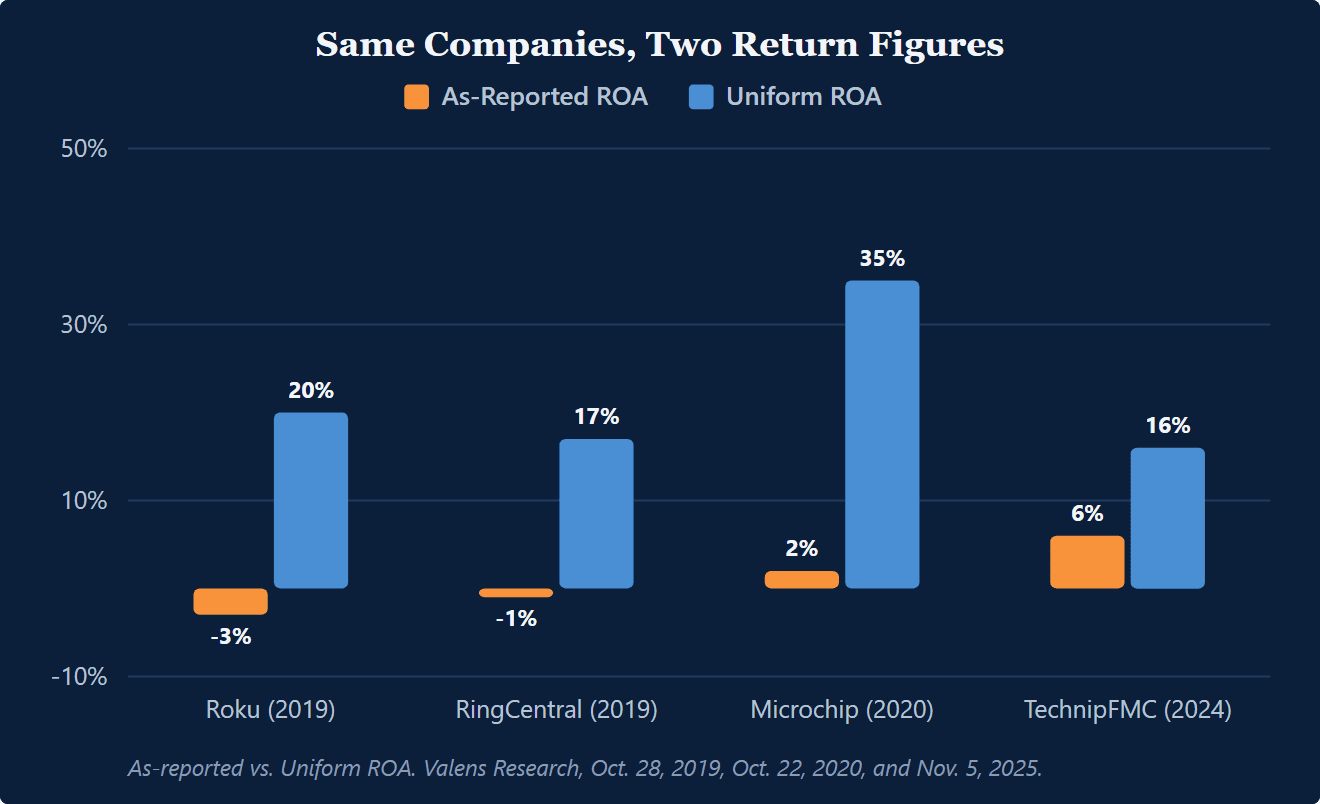
An estimate that starts from the first number in each pair values the accounting. One that starts from the second values the business. The choice between reported earnings and earnings put on one comparable basis can decide the whole output. That is what earnings quality checks. Putting every company on one basis is the work of forensic accounting.
What Is the Market Already Pricing In?
If intrinsic value is an estimate, the market price isn’t waiting for yours. As Valens puts it in its chart guide, “Embedded in every company’s stock price is the market’s forecast for the future performance of the firm” (Valens, “How to Read the Performance & Valuation Prime Chart”). So the first move is to read that forecast. Hold today’s price fixed and solve for the return on assets the company would have to earn to justify it.
Altimetry wrote in June 2020 that most investors “never solve for the current market price to understand the company’s embedded expectations” (Altimetry, June 29, 2020). A P/E multiple, including the Shiller P/E, is a shortcut for the same calculation.
Three dated cases show what the solve returns. On October 27, 2022, Valens wrote that Intel’s Uniform ROA fell from 14% in 2018 to 9% in 2021. At around $26, the same piece said, “the market expects the company to have a huge hit and its Uniform ROA to fall even further to 5%” (Valens, October 27, 2022). On September 8, 2026, Valens wrote that Lululemon’s Uniform ROA averaged 33% a year from 2022 to 2025 and fell to 24% last year. “At current valuations,” Valens added, “investors expect the company’s Uniform ROA to deteriorate to 9% by 2031” (Valens, September 8, 2026). On July 28, 2026, Valens wrote that SPS Commerce’s Uniform ROA “since 2022 has trended above 30%” and reached 39% last year. The market, it said, expects that Uniform ROA “to decline to 18% by 2030” (Valens, July 28, 2026).
Each readout turns “what is this stock worth” into “will this company’s returns fall to that level by that year.” That is a question about the business, and one an advisor can reason through with a client. The price already holds a forecast, so a stock isn’t undervalued because an estimate comes out above it.
How Do You Put Price Against Value for a Client?
Before you take a “fair value” from a screen to your firm’s investment committee, three questions settle what that number is worth:
What Did It Start From?
“Before we use this fair value, let’s find the earnings or cash flow figure at the top of the sheet and check if it’s as-reported or on one comparable basis. A tool that won’t say is hiding the decision that moves the whole estimate.”
What Does Today’s Price Already Assume, and by When?
“Let’s solve for the returns today’s price requires, and the year it requires them by.”
What Would Have to Be True for the Estimate to Be Right?
“For that estimate to hold, the company’s returns, reinvestment, and competition all have to play out a certain way. I’ll write each one down as a claim we can check against the company.”
An advisor who can answer those three explains value rather than quoting it. Doing that across every holding in a book of clients is a data job, and the research platforms page compares the tools that do it.
Key takeaways
- Intrinsic value is an estimate, and most of the argument over a stock’s value is about the earnings figure the estimate starts from rather than the formula.
- Most tools take that starting figure straight from the reported statements, where rules like expensing R&D as incurred make it describe the accounting rather than the business.
- The market price already holds a forecast, so solve for the return on assets today’s price requires, and by when, before building your own estimate.
- When a client brings a fair value from a screen, ask what it started from, what the price assumes, and what has to be true for it to hold.
Frequently Asked Questions
What Is Intrinsic Value?
Intrinsic value is the discounted value of the cash that can be taken out of a business during its remaining life, as Warren Buffett defines it in Berkshire Hathaway’s 1994 chairman’s letter and Owner’s Manual. It is an estimate, and two investors with the same facts will get different figures.
How Do You Calculate Intrinsic Value?
The standard method forecasts the cash the business will produce, discounts each year back to today, and adds a value for everything after the forecast. The result moves most with the earnings and cash flow figure you start from, and far less with the formula.
What Is the Difference Between Intrinsic Value and Market Value?
Intrinsic value is an estimate of what the business will deliver in cash over its remaining life, discounted back to today. Market value is the stock price, and that price already holds the market’s own forecast of the company’s future performance.
Is Intrinsic Value the Same as Book Value?
No. Berkshire’s per-share book value was $19.46 in 1964, and Buffett wrote that the figure “considerably overstated the stock’s intrinsic value.” Berkshire’s Owner’s Manual adds that the disparity between book value and intrinsic value can go in either direction.
One company on the numbers, every morning
FA Alpha Daily applies this to one company, metric, or market signal every morning, free for financial advisors.