
How to Read a Cash Flow Statement Like a Forensic Analyst
August 31, 2026
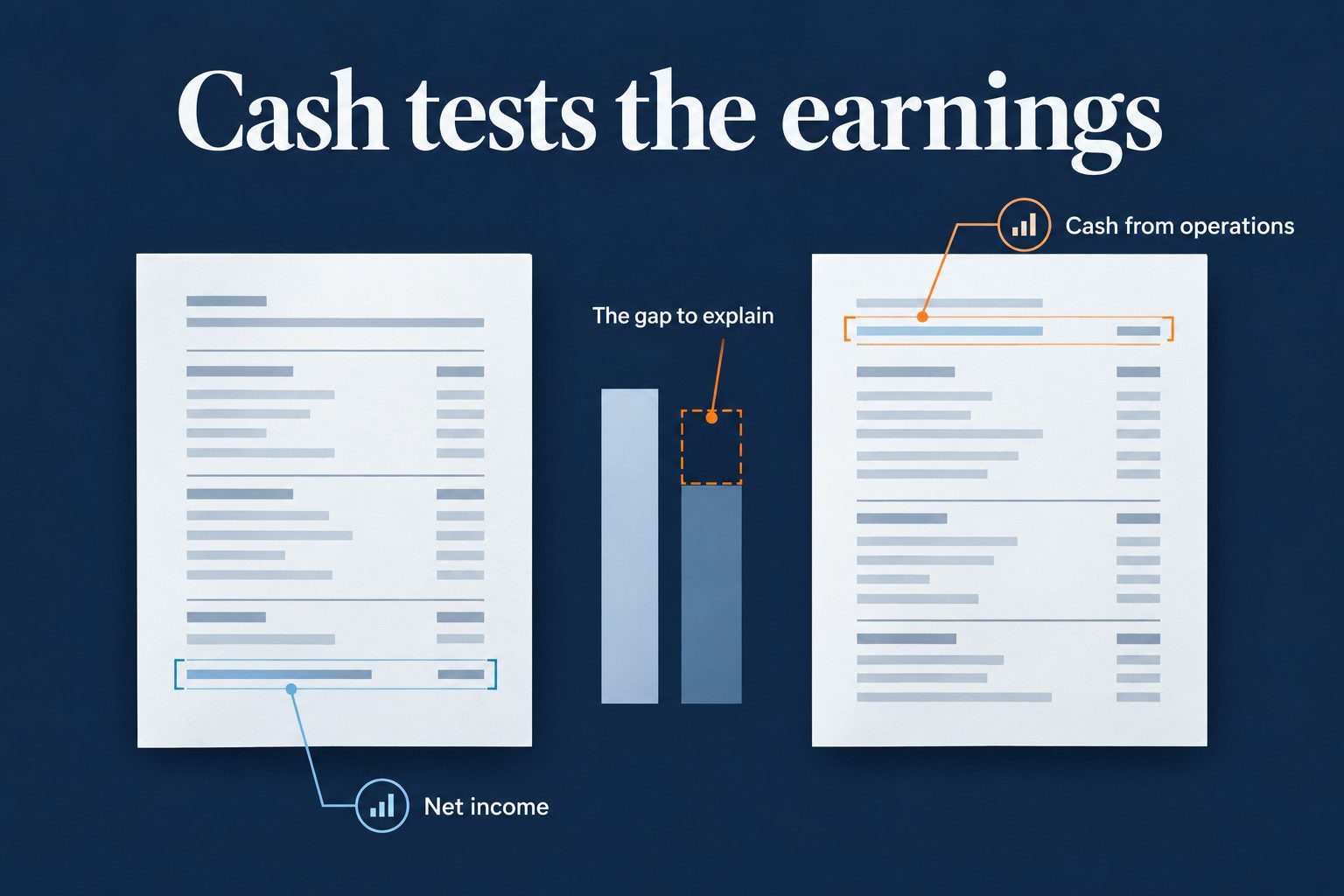
The cash flow statement is the hardest financial statement for management to shape. Read it first, because it tests earnings.
The statement reconciles as-reported net income to cash from operations. Once you have that, you can trace the cash through investing and financing to see how management used it, or how it covered the shortfall when operations didn’t produce enough.
Key points
- Check cash from operations against reported net income before you look at EPS.
- When net income rises and CFO lags for several periods, read the reconciling lines.
- Compare dividends plus buybacks to free cash flow, then look for new debt covering the gap.
- Six checks catch most problems, from working capital to capex versus depreciation.
- More than 130 Uniform adjustments make earnings and cash flow tell the same story.
Read the Cash Flow Statement First
Start with cash, not the income statement. You’re trying to answer one question fast: did the business generate cash from operations that matches its reported net income, and if not, why?
Most investors start with EPS and treat cash flow as a footnote. That habit lets weak earnings quality hide in plain sight until a payout or buyback starts to depend on financing instead of operations.
Operating, Investing, Financing: What to Look For
The operating section isn’t automatically safe. One misclassified cash line can change your whole read.
The statement is a map of where cash came from and where it went. You don’t need to memorize every line, just what each section should show. Operating cash flow should track the earnings engine, investing should show reinvestment choices, and financing should show if payouts fit inside what the business generated.
| Section | What it contains | Healthy sign | Warning sign |
|---|---|---|---|
| Operating | Starts with net income, then backs out non-cash items and working-capital swings | Cash from operations tracks net income over time, with explainable working-capital moves | Net income rises while operating cash stalls, or big “other” reconciling items do the heavy lifting |
| Investing | Capital expenditures, acquisitions, asset sales, investment purchases | A steady reinvestment cadence that doesn’t depend on asset sales | “Cash generation” comes from selling assets, or acquisitions substitute for organic growth |
| Financing | Debt issued or repaid, shares issued or bought back, dividends paid | Payouts and buybacks fit inside free cash flow without routine new borrowing | Dividends and buybacks require new debt or equity, even when earnings look fine |
“Operating” doesn’t automatically mean “high quality.” Classification is the one place the statement can be managed, so read the buckets like an analyst rather than a label printer.
Start With CFO Versus Net Income
Line up cash from operations and net income. You’re testing if reported earnings turn into cash year after year, because that’s where earnings-quality problems appear first.
Example Co. is an illustrative company, and the numbers are made up. Index its net income at 100, 112, 125, 138, 150 over five years, while cash from operations runs 100, 104, 98, 101, 95.
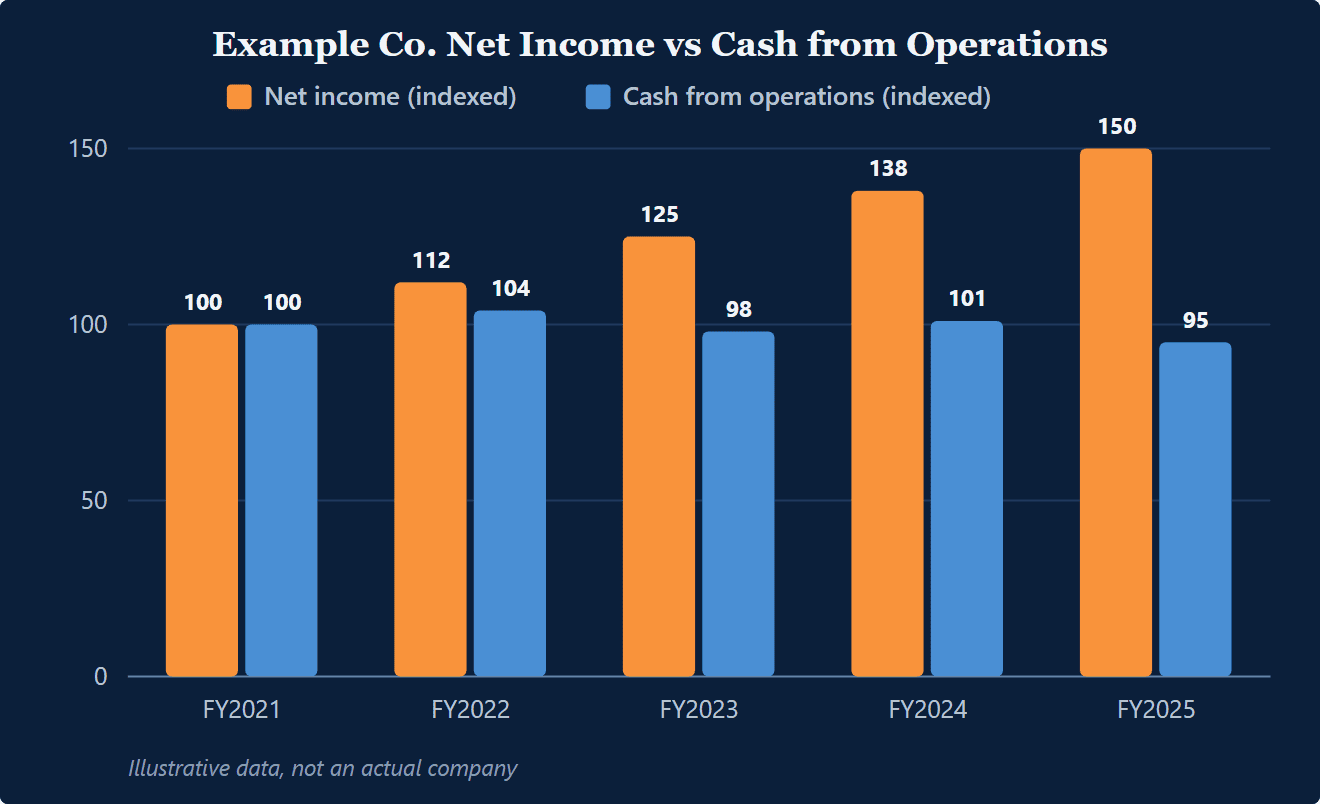
One bad year isn’t the problem. The problem is four years of reported growth that brought no added operating cash. Keep a two-line trend for net income and CFO in your notes for each core holding. When net income rises and CFO lags for several periods, don’t rationalize it as timing. Treat it as the trigger to read the reconciling lines next.
Free Cash Flow and Payout Coverage
Free cash flow is what funds every dividend and buyback promise. Define it once and use it every time.
Free cash flow = Cash from operations − Capital expenditures
Now connect Example Co.’s cash to its capital returns. Dividends plus buybacks run $80M, $100M, $120M, $135M, $150M against free cash flow of $120M, $118M, $105M, $96M, $88M.
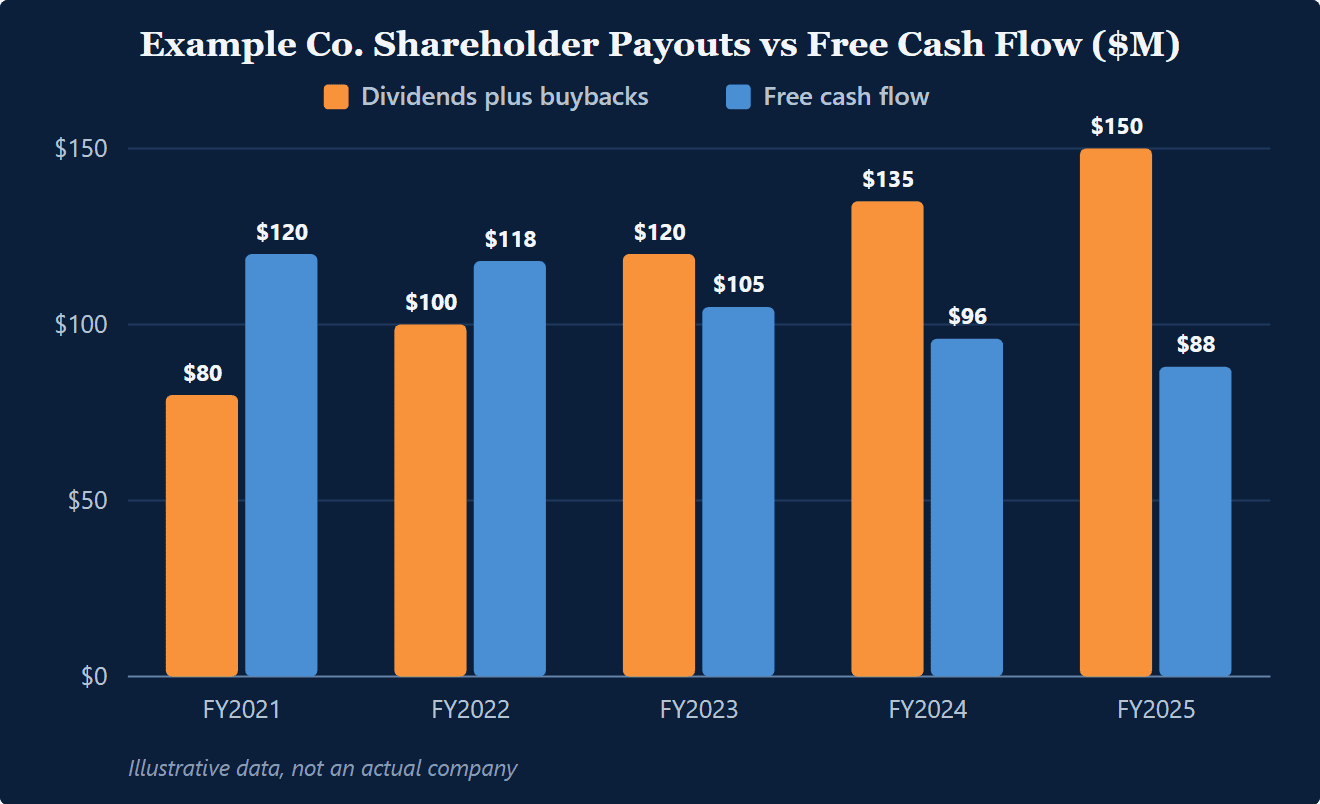
From year three, payouts exceed free cash flow. The financing section shows the difference came from new debt. The dividend looked covered against earnings. Against free cash flow it wasn’t covered at all. Write down the first year payouts exceed free cash flow, then pull the financing section to confirm the funding source. Explain the gap in one sentence before you move on.
The Six Forensic Checks That Don’t Fit in a Ratio
Cash can look fine to a screen right before a credit downgrade. The problem usually hides in working capital and the reconciling lines.
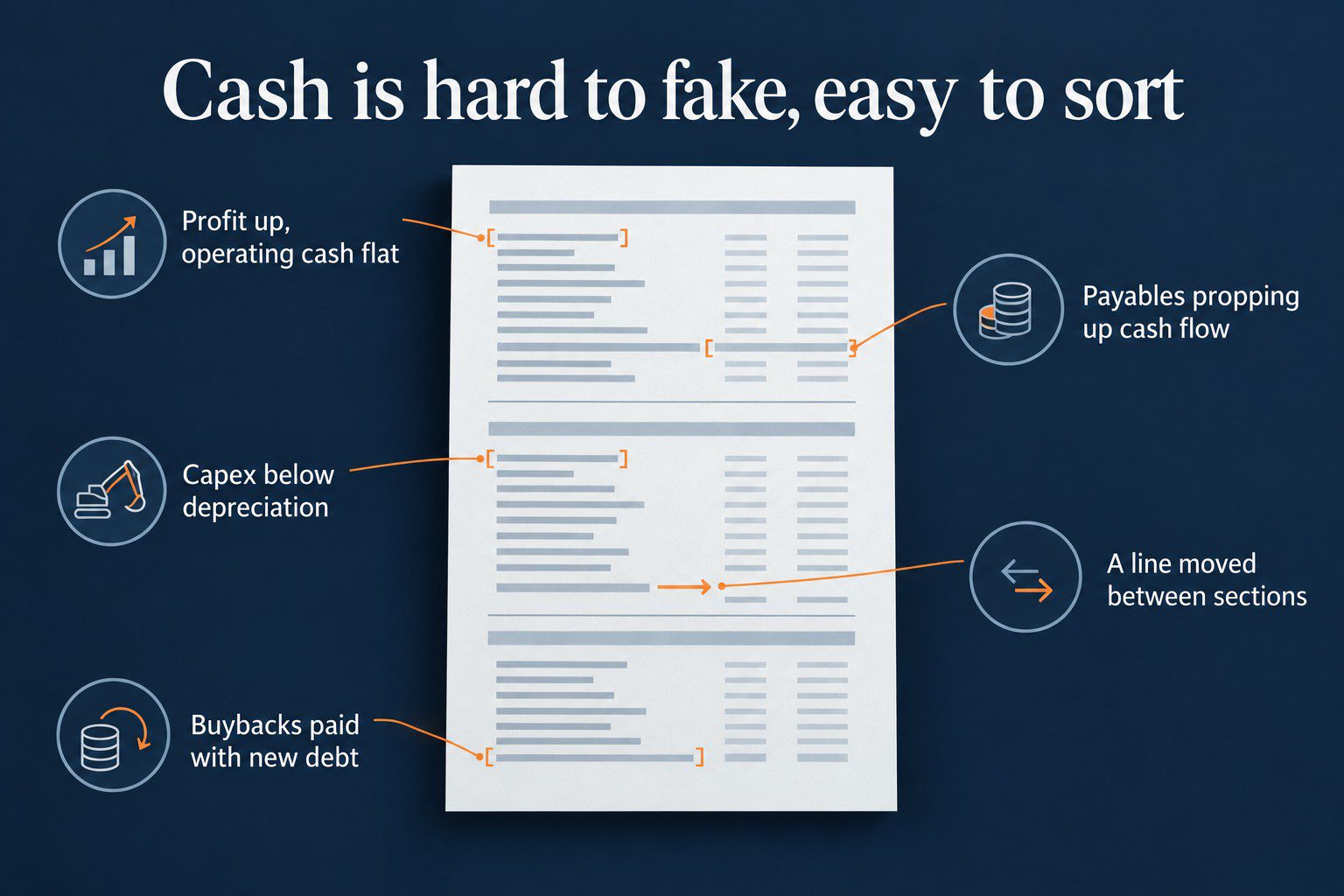
CFO below earnings is a big red flag. SEC staff have warned that cash flow statement errors and misclassifications matter because investors rely on the operating, investing, and financing split to interpret cash generation. Rather than litigating every line, find the one or two drivers you can write down.
1. Cash From Operations Against Net Income
Track the gap over several periods instead of one quarter. A persistent shortfall says the income statement is pulling profit forward before the cash arrives. That changes how you frame the holding in a client review about “growth.”
2. The Working-Capital Lines
Read receivables, inventory, and payables as sources and uses of cash. CFO that improves mainly because payables spiked can reverse fast, so note if the company’s cash story depends on suppliers funding operations. Receivables growing faster than sales means the company is booking revenue ahead of collection.
3. Capex Against Depreciation
Compare capital expenditures to depreciation and amortization to see if the business is consuming assets faster than it reinvests. Capex consistently below depreciation can mean an earnings profile that holds up on paper while the reinvestment burden gets deferred. Capex far above it may be growth, or operating costs capitalized to keep them off the income statement.
4. Acquisitions Doing the Growing
Scan investing cash flow for acquisitions that repeatedly offset weak organic cash conversion. When roll-ups drive the narrative, separate “reported growth” from “cash earned on the installed base,” and keep that distinction explicit in your notes.
5. Payouts Funded by Borrowing
Tie financing outflows for dividends and buybacks back to free cash flow. Borrowing to buy back stock raises earnings per share and leverage at the same time, and only one of those makes the headlines.
6. Items Moved Between Sections
Watch for cash flows that could plausibly belong in more than one bucket. Three common ones are customer financing shifted into investing, capitalized software counted as investment, and securitized receivables that turn a collection problem into a “sale.” Under IFRS, interest and dividends can be classified differently than under U.S. GAAP, so cross-border comparisons need care. A change in classification from one year to the next is worth a footnote read.
The Five-Minute Version for a Client Holding
The short version ties earnings, cash, and funding together in five steps.
- Put cash from operations beside net income over several periods.
- Read the reconciling lines and working-capital moves that explain any gap.
- Compute free cash flow (CFO minus capex) and compare it to dividends plus buybacks.
- Confirm the funding source in the financing section when payouts exceed free cash flow.
- Scan for classification choices that flatter operating cash, then write your conclusion in one sentence.
Any holding that fails two of the five deserves the full treatment in our guide to forensic accounting. Any holding that passes all five is, at minimum, reported straight.
What You’ll Say to Clients
Clients don’t need the statement. They need your translation.
- “Profit is an opinion, cash is a fact. So we check if cash from operations keeps pace with net income over time.”
- “A dividend can look covered by earnings while free cash flow says otherwise. When payouts exceed free cash flow, the gap usually comes from new borrowing, and dividends funded by debt have a way of getting cut.”
- “We own some boring businesses on purpose. They turn earnings into cash consistently, so distributions and reinvestment don’t depend on financing staying easy.”
Why Uniform Accounting Starts Here
The cash flow statement is useful because it ignores timing, and that’s also why it isn’t enough. A great company in a heavy investment year and a failing company selling assets can show identical cash flow. Uniform Accounting brings the income statement toward cash reality instead of abandoning it. More than 130 adjustments expense what was improperly capitalized, capitalize the investment that was improperly expensed, and put leases back where they belong. The result is Uniform earnings and cash flow that tell the same story. That reconciled view underpins the FA Alpha 50. For the other two statements, see income statement vs balance sheet.
Key takeaways
- The cash flow statement starts from net income and undoes everything that wasn’t cash. Read it first.
- Free cash flow, cash from operations minus capex, isn’t printed on the statement and funds everything else.
- Six checks catch most problems: cash versus profit, working capital, capex versus depreciation, acquisition-driven growth, payouts versus free cash flow, and items moved between sections.
- A dividend covered by earnings but not by free cash flow is paid with borrowed money.
Frequently Asked Questions
What Is a Cash Flow Statement Used For in Equity Analysis?
You use it to test if reported earnings turn into cash and to see what management did with that cash. Put cash from operations next to net income, then use the investing and financing sections to separate reinvestment and acquisitions from payouts and their funding sources.
Why Can Net Income Rise While Cash From Operations Falls?
The drivers are in the reconciliation. Working-capital builds, non-cash gains, and “other” reconciling items can support as-reported earnings while cash collection lags. When the pattern persists, stop calling it timing. Call it a business or accounting signal and find the explanation.
How Do You Calculate Free Cash Flow From the Cash Flow Statement?
Free cash flow is cash from operations minus capital expenditures, using the cash paid for property, plant, and equipment in the investing section. If management highlights its own “free cash flow” in presentations, reconcile that version back to the statement so you know what was added back.
How Can the Cash Flow Statement Be Managed If Cash Is Hard to Fake?
Management can’t invent cash at the bottom, but it can influence where cash lands through classification choices and how it frames reconciling items. Cross-border comparisons add another trap. Under IFRS, interest and dividends can be classified differently than under U.S. GAAP, so reported CFO can look stronger or weaker with no change in economics.
When Is Cash Flow Statement Analysis Less Reliable?
One heavy-investment year can make a great company look “cash poor,” while a deteriorating business can look “cash rich” by selling assets or shrinking working capital. The statement ignores accrual matching, which is why it’s a clean check on cash reality and why you can’t read it as the whole scorecard.
The cash flow read on real companies, every morning
FA Alpha Daily applies this to one company, metric, or market signal every morning, free for financial advisors.
Get FA Alpha Daily