Forensic Accounting: What It Reveals That GAAP Hides
August 28, 2026
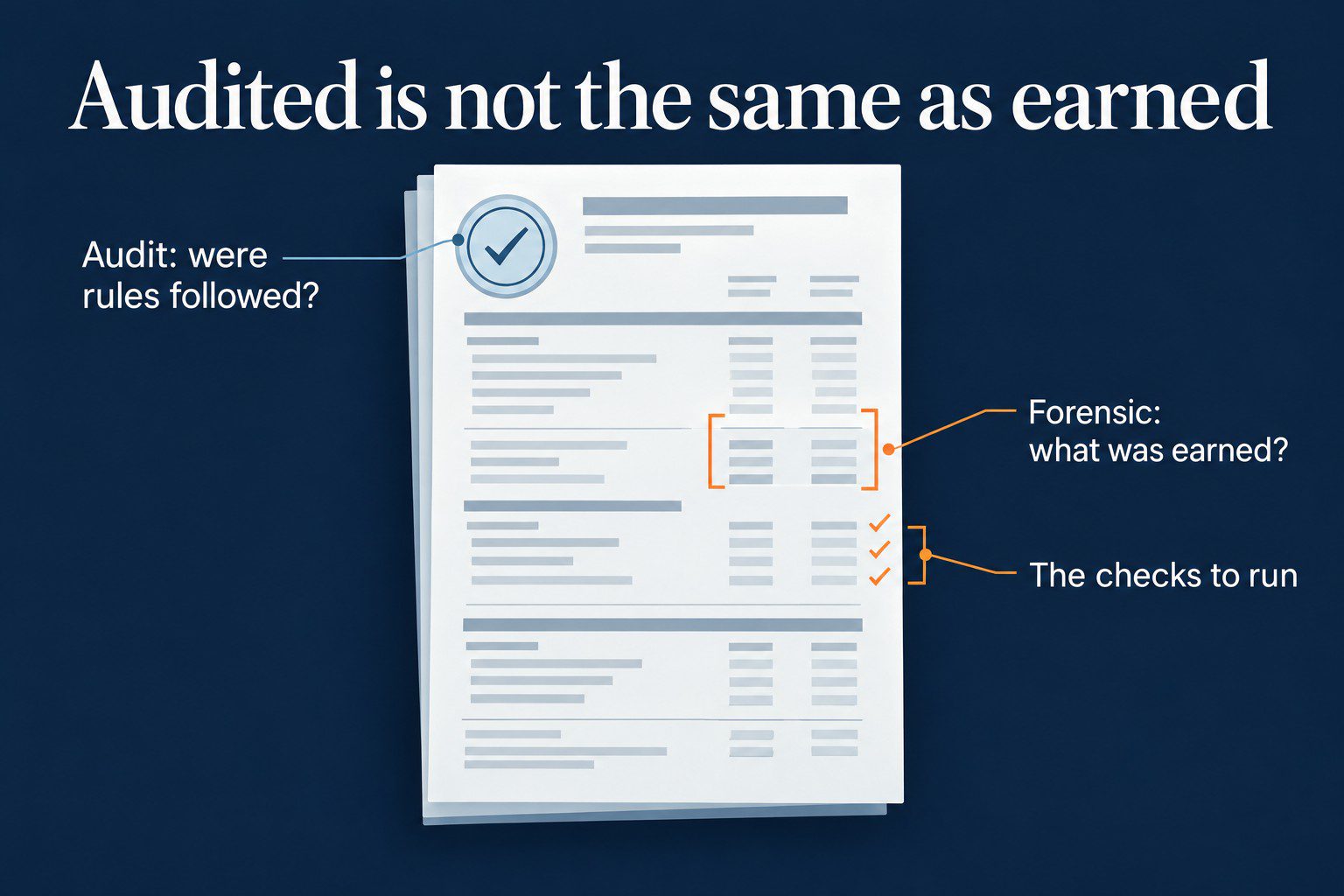
Forensic accounting tests what a business earned, owned, and owed, using evidence that holds up under scrutiny. In plain terms, it tests reported results against reality.
For an advisor, the question is whether the reported numbers hold up once you probe them, even when every accounting rule was followed. Fraud happens, but legal distortion is routine. A clean audit opinion only says the rules were followed. Five fast checks separate as-reported optics from underlying performance. The sections below show where audits stop and how to run them.
Key points
- An audit asks whether statements follow GAAP, while forensic accounting asks what the business earned.
- Test whether margins and Uniform ROA hold up after unwinding routine reporting choices.
- Put net income beside cash from operations for eight or more quarters.
- Treat a Beneish M-Score or Altman Z-Score as triage, since both use as-reported inputs.
Audit vs. Forensic Accounting
An audit answers whether management followed GAAP. Forensic accounting asks what the business earned.
| Dimension | Audit | Forensic accounting |
|---|---|---|
| Asks | Did management follow GAAP? | What did the business earn, own, and owe? |
| Standard | GAAP and auditing standards | Evidence that holds up under scrutiny |
| Scope | Financial statements as presented | Numbers plus the choices, timing, and classification behind them |
| Output | Audit opinion | A Uniform view and a plain explanation |
| Who pays | The company being audited | Whoever needs the truth (investor, advisor, counsel) |
A clean audit opinion can coexist with earnings built on choices that shift costs into assets or postpone obligations. If you treat audited as the finish line, you’ll miss the bigger risk. Permitted distortions still move valuation, Uniform return on assets (“ROA”), and the story you tell clients.
The professional field has its own credentials, the Certified Fraud Examiner and the AICPA’s Certified in Financial Forensics among them. Howard Schilit’s Financial Shenanigans is the standard reference for the patterns. None of that is required to borrow the method.
What an Advisor Is Testing For
You aren’t hunting fraud. You’re deciding if a company’s reported results line up with what the business likely earned, owned, and owed.
In practice, you’re underwriting earnings quality. Do margins and Uniform ROA hold up after you unwind the routine reporting choices that move profit across periods? A stock can look cheaper on a reported P/E because expenses became assets, or because recurring charges got labeled “one-time.” Then you’re telling clients a story the cash flows never supported.
You’re doing triage here, and nobody is on trial. You need a short answer a client and a compliance officer can test. What changed under the Uniform view, and what would have to be true for the as-reported story to stand?
The Five Distortions to Check First
A CFO can play by the rules and still give you a misleading growth story. The five below most often turn an easy pitch into a hard client call later.

1. Profit Outrunning Cash
Companies can book revenue before they have the cash on hand, and they can defer expenses. Both are legal, and both let reported profit pull away from the business. Put net income beside cash from operations for eight or more quarters. When profit climbs and cash doesn’t follow, estimates and timing are carrying the growth, not paying customers. This is the highest-yield check in the toolkit.
2. Receivables and Inventory Growing Faster Than Sales
If revenue grows 5% while receivables grow 25%, the company may be booking sales customers haven’t committed to. Or it may be extending credit to make a quarter look right. When inventory builds faster than sales, that tells a similar story about demand. Compare the growth rates every quarter.
3. Expenses That Became Assets
Capitalized costs move off the income statement and onto the balance sheet, where they depreciate slowly instead of hitting profit at once. Software development, customer acquisition, and interest during construction all have conservative treatments and aggressive ones. A capitalization rate that drifts up while the business doesn’t change is worth understanding before you trust the margin.
4. “One-Time” Charges That Recur
Investors learn to look past restructuring charges, and companies know it. A company reporting restructuring five years running is pushing ordinary operating costs through a line the market discounts. Count the years. Two in a row is a pattern. Five is a policy.
5. Obligations Kept Off the Balance Sheet
Leases, joint ventures, and purchase commitments can move real obligations somewhere less visible. The economics don’t change. The reported leverage does. Read the commitments footnote and add what you find back to debt. This is the distortion most likely to matter when a business hits a rough patch.
Example: When 45% Growth Becomes 2%
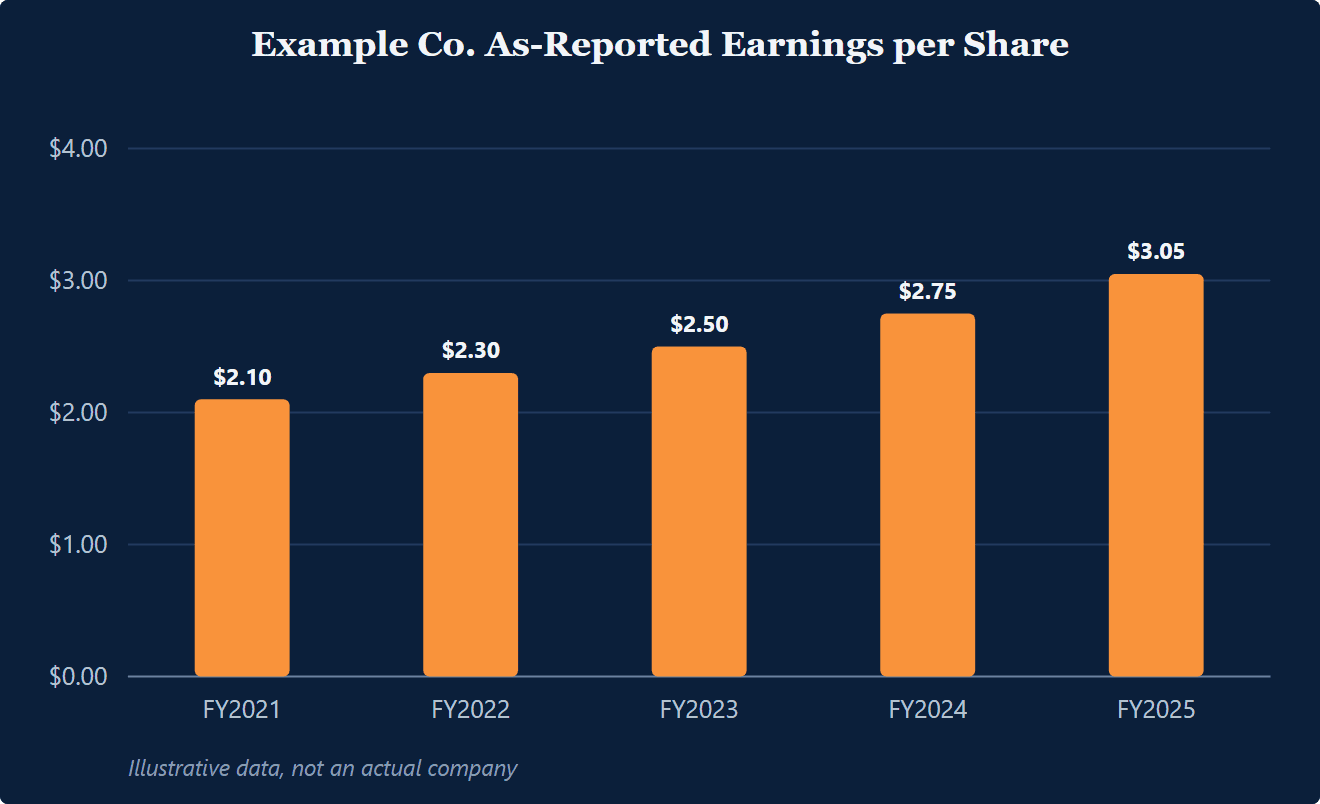
Here’s how the as-reported and Uniform views can diverge. Example Co. is an illustrative company, not a real one. Its as-reported EPS rises $2.10, $2.30, $2.50, $2.75, $3.05 from fiscal 2021 to 2025. Nothing about that series invites a second look.
Now adjust the same statements under Uniform Accounting, a standardized set of more than 130 adjustments that puts every company on the same basis, and index earnings to 100. As-reported earnings reach 145 by 2025. Uniform earnings run 100, 103, 101, 104, 102.
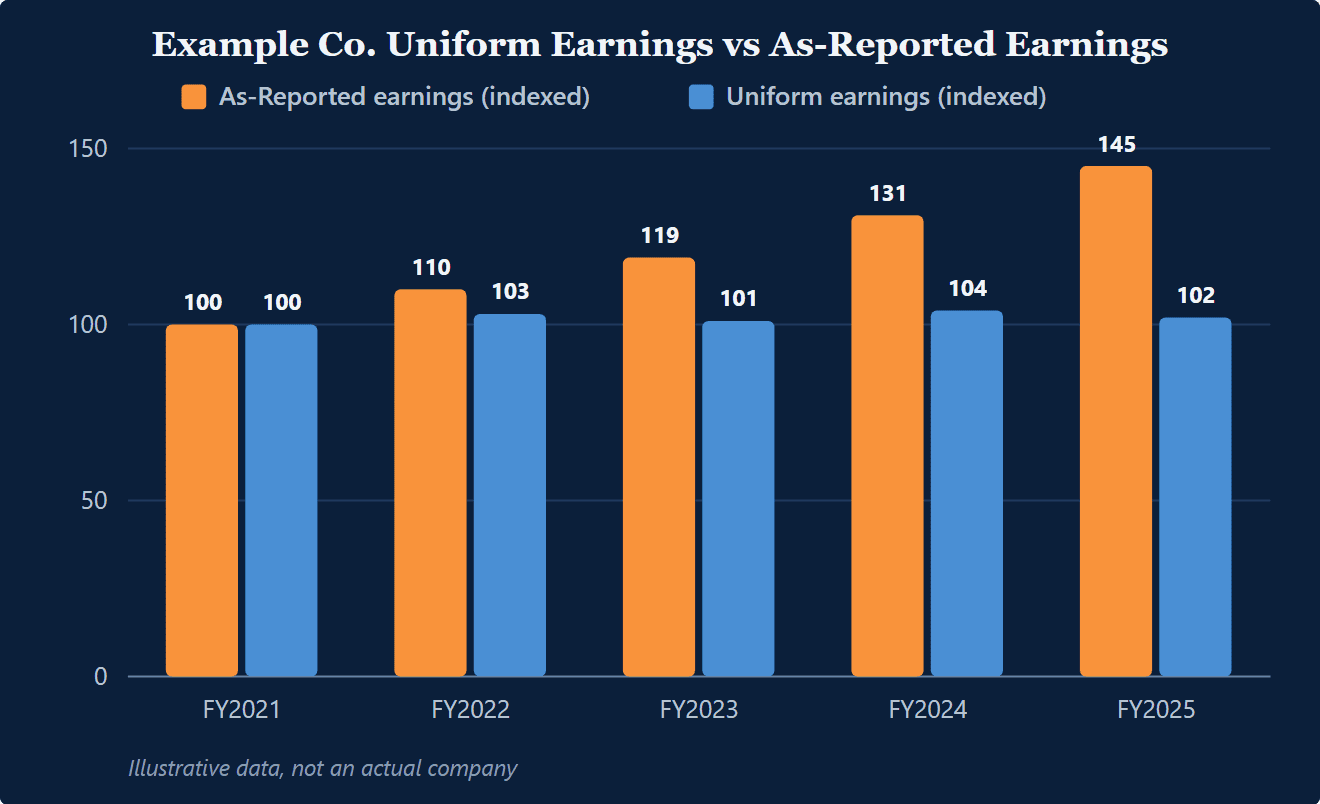
The same five years go from 45% reported growth to 2% underlying growth. The business didn’t grow. The accounting did. Every choice behind it was legal and disclosed. That’s why the forensic layer exists. The distortions are visible to anyone who looks, and almost nobody looks.
Screeners Are Triage
Screeners help you decide where to spend your 10-K reading time. They don’t tell you what the business earned, because they inherit every distortion in their as-reported inputs. A company that capitalized costs aggressively can pass a screen cleanly.
For a fast pattern check across earnings and working capital, start with the Beneish M-Score, an eight-ratio screen for statement patterns associated with manipulation. A score above roughly minus 1.78 is the conventional caution flag. It isn’t a fraud call. The screen can’t separate aggressive but permitted accounting from a durable improvement, because its inputs already embed the capitalization and timing decisions.
Use the Sloan accrual ratio when profit seems to outrun cash, and the Altman Z-Score when you’re checking solvency risk, with a score below roughly 1.8 as the conventional distress flag. Both can fire on fast growers, acquisitive roll-ups, and lease-heavy businesses. Treat a flag as a prompt to re-run the five checks, never as permission to stop thinking.
Spot checks work on one company. They don’t scale to a book of forty positions, and they don’t make companies comparable, because each company’s distortions are different. That’s the problem Uniform Accounting was built to solve, and it’s the basis for the FA Alpha 50, a monthly list of 50 high-quality, undervalued stocks screened on the Uniform numbers. The stock analysis page walks through the method.
How to Say It to Clients
Say it plainly. You want language that survives a client meeting and a compliance review without drifting into a fraud claim.
When You Pass on a Popular Stock
Anchor on the mismatch you can document. “As-reported earnings show about 45% growth over five years. On the Uniform view, the same period shows about 2%. That gap comes from timing and classification choices, so we’re not paying for growth that may not repeat.”
When You Keep a Holding That Looks Expensive
“On as-reported earnings it trades at 28 times. On Uniform earnings it’s closer to 17, because we adjust for capitalized costs and recurring ‘one-time’ charges. We track both, but we value the business on the Uniform view.”
When a Client Asks Whether a Company Is Another Enron
The answer is usually no. The useful answer is that the five checks are built to catch legal distortion, which is the far more common risk.
Where Forensic Methods Are Less Reliable
The signals get noisy when the business model creates noise on its own: fast growers, acquisitive companies, firms with big mix shifts. Adjustments that reclassify expenses into assets force judgment calls about useful lives, and those calls can move the answer. And nothing replaces reading the filings, because the footnotes explain the obligations and timing items you’re trying to normalize. For the broader subject, see how to find undervalued stocks without falling for value traps.
Key takeaways
- An audit asks whether the statements follow GAAP. Forensic accounting asks what the business earned, and a clean audit doesn’t answer that.
- Five distortions catch most problems: profit outrunning cash, receivables growing faster than sales, capitalized costs, recurring “one-time” charges, and off-balance-sheet obligations.
- Screening models like the Beneish M-Score are triage tools that inherit the distortions in their inputs.
- Uniform Accounting is the forensic method applied systematically, so companies become comparable on one basis.
Frequently Asked Questions
What Is Forensic Accounting?
Forensic accounting is the practice of testing what a business earned, owned, and owed, using evidence that holds up under scrutiny. In public-company work, it separates routine, legal reporting distortions from underlying performance. Fraud happens, but most of what moves a client narrative comes from permitted choices and timing.
How Is Forensic Accounting Different From an Audit?
An audit asks whether the statements follow GAAP and are free of material misstatement. Forensic work asks whether the reported numbers match the economics well enough to rely on them for valuation. When “audited” becomes your shortcut for earnings quality, within-the-rules distortions slide by.
What Are Common Red Flags That Don’t Require Fraud?
The common ones are profit outrunning cash, working capital building faster than sales, expenses getting capitalized, “one-time” charges that keep returning, and obligations living in the notes. Those patterns can inflate growth, margins, and coverage without any fabricated revenue.
Is the Beneish M-Score Proof of Manipulation?
No. It’s a statistical screen that inherits every distortion in the as-reported inputs. Treat a high score as a prompt to slow down and re-check the drivers, especially working capital and capitalization.
Where Is Forensic Accounting Less Reliable?
Wherever the business model creates noise on its own: fast growers, acquisitive companies, and firms with big mix shifts. Adjustments that reclassify expenses into assets also require judgment about useful lives. And the method never replaces reading the filings.
See the forensic read on a company every morning
FA Alpha Daily applies this to one company, metric, or market signal every morning, free for financial advisors.