Why do GAAP earnings sometimes give a distorted picture of a company’s real profitability?
Quick answer
GAAP earnings distort underlying profitability because the rules are ranges, not formulas. Management chooses when to recognize revenue, which costs to capitalize, what to label “one-time,” and how to book acquisitions and leases. Every choice is legal and moves reported profit or the asset base.
Five patterns do most of the damage. They are profit booked before cash arrives, investment expensed as if it had no future, recurring costs labeled one-time, goodwill inflating the asset base, and obligations kept off the balance sheet. Correcting them means adjusting every company’s statements to one consistent basis, which is what Uniform Accounting does.
A company can follow every accounting rule and report GAAP net income that doesn’t match its cash. Timing and capitalization choices move as-reported profitability up or down, even when operations barely change.
The question isn’t whether GAAP is “wrong.” It’s whether the as-reported numerator and denominator reflect what the business earns year after year, and whether they compare cleanly across companies. Below are five patterns that skew as-reported return on assets, then an example pair where the same 8% GAAP ROA hides a 6% and a 17% Uniform result.
The Five Patterns That Distort GAAP Earnings
GAAP earnings that look precise can misstate underlying profitability. The cause usually isn’t an error. Permitted choices move the earnings numerator or the asset base, and reported ROA moves with them.
| Pattern | Where it hits ROA | Typical bias | Fast check |
|---|---|---|---|
| Profit recognized before cash | Numerator (earnings) | Overstates near-term profitability | EPS up while operating cash flow lags |
| Investment expensed as if it had no future | Numerator (earnings) | Understates profitability during a build phase | Large multi-year spending runs through current expenses |
| Recurring costs labeled one-time | Numerator (earnings) | Overstates profitability | The same “non-recurring” add-backs appear year after year |
| Goodwill inflates the asset base | Denominator (assets) | Depresses as-reported ROA | ROA falls after an acquisition even when operations don’t |
| Obligations kept off the balance sheet | Denominator (assets) | Inflates as-reported ROA | Leases and commitments missing from operating assets |
1. Profit recognized before cash
GAAP is accrual accounting. Revenue is recorded when earned, not when collected, so a company can book a multi-year contract up front or loosen customer credit terms to hit a quarter’s number. Reported profit rises while cash doesn’t. The gap between net income and cash from operations is the first thing to check. Our guide to reading a cash flow statement shows how.
2. Investment expensed as if it had no future
GAAP requires most research and development to be expensed immediately, even though the point of the spending is future profit. A company investing heavily looks less profitable than one that has stopped investing. This distortion runs the other way from the first one: it makes good businesses look worse than they are.
3. Recurring costs labeled one-time
Restructuring charges and impairments are supposed to be unusual, so companies exclude them from non-GAAP earnings and investors often follow. Once the add-backs appear quarter after quarter, they stop being one-time, and those non-GAAP earnings overstate what the business earns. Count the years.
4. Goodwill inflates the asset base
When a company buys another for more than book value, the premium goes on the balance sheet as goodwill. It represents no operating capacity, yet it inflates total assets and depresses every return ratio, even without an impairment. A serial acquirer can look asset-heavy and low-return when the operating business is anything but.
5. Obligations kept off the balance sheet
Leases, joint ventures, and purchase commitments can stay outside reported debt and operating assets. The company owes the money either way, but its capital base looks smaller than it is, so returns on that capital look higher. The economics don’t change. The reported picture does.
An 8% ROA Can Mean 6% or 17%
Is an 8% ROA a business outcome, or a mix of numerator pull-forward and denominator noise? Take two companies, an energy producer and a warehouse retailer, that both reported an 8% as-reported ROA for the prior fiscal year. Their Uniform ROA was 6% and 17%. These are example figures, not data for any company.
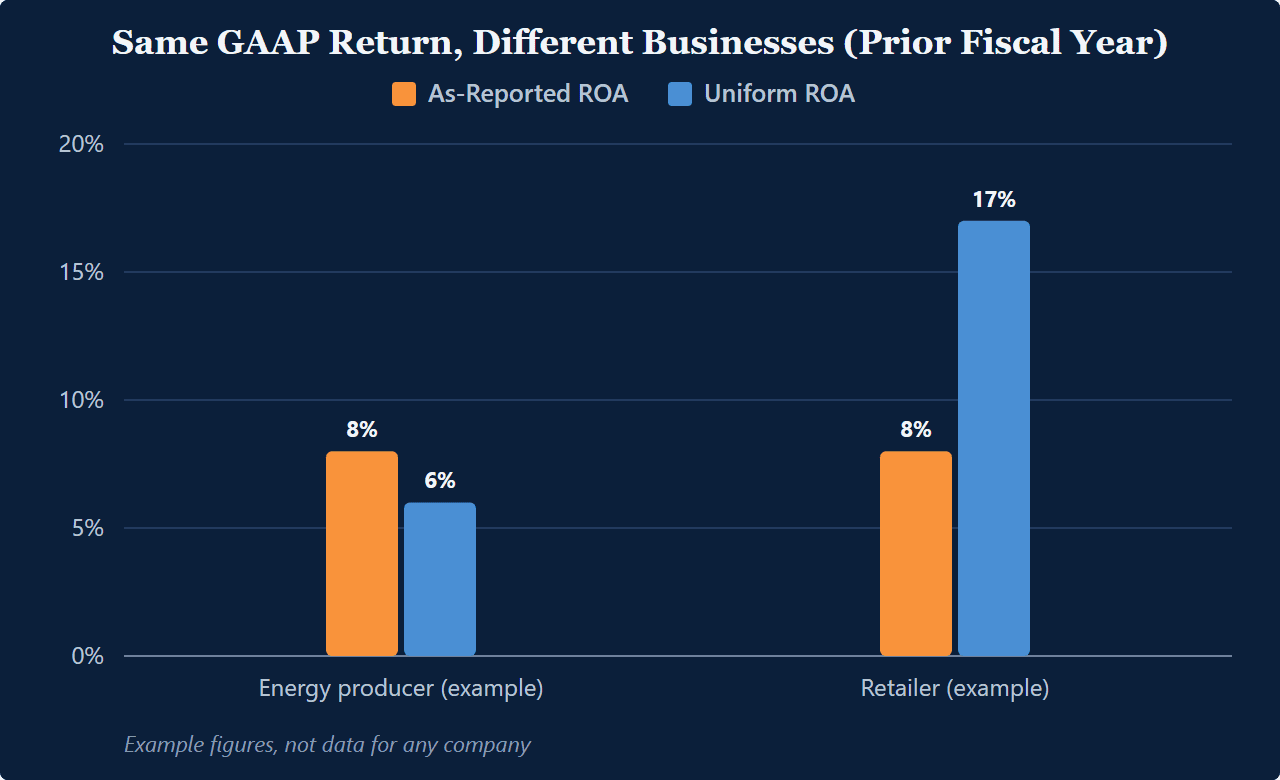
Under Uniform Accounting, the energy producer earned 6% that year, below an illustrative 8% cost of capital. The retailer earned 17%, more than double the same hurdle. The most recent fiscal year shows the same split, with the energy producer at 6.5% as-reported and 5% Uniform, and the retailer at 9% as-reported and 16% Uniform. The as-reported figure doesn’t say which of the five patterns moved each company’s number. Finding that out means applying every adjustment to both companies the same way. A screen sorting on GAAP return on assets ranks them as equals. They aren’t.
How to Sanity-Check GAAP Fast
Most large companies now report some form of non-GAAP earnings alongside GAAP. If you’re relying on as-reported numbers, you need a quick way to spot when the reconciliation tells you more than the headline number does.
Start with the reconciliation. SEC rules require companies that present non-GAAP measures to reconcile them to the most comparable GAAP figure. A large or widening gap should trigger the checks above. Start with timing versus cash, then investment versus period cost. A quarter with strong EPS but weak operating cash flow usually signals pull-forward rather than a suddenly better business.
Two or more flags should disqualify a GAAP-only ROA screen. Document it plainly. GAAP is the starting point, and you’re checking comparability and persistence. You aren’t claiming GAAP is wrong. Spot checks work on one company. Comparability across a book needs every company adjusted the same way, and Uniform Accounting does that with more than 130 adjustments across 25,000+ companies. It’s a normalization method with judgment of its own: capitalization schedules and useful lives are conventions. The article on earnings quality covers where they matter.
Key points
- Five permitted accounting choices distort GAAP profit, starting with profit booked before cash arrives.
- Goodwill inflates assets and depresses as-reported ROA, while off-balance-sheet leases push it up.
- On example figures, two companies both report an 8% ROA, yet their Uniform ROA is 6% and 17%.
- Treat strong EPS with weak operating cash flow as a pull-forward signal.
See the corrected numbers every morning
FA Alpha Daily applies this to one company, metric, or market signal every morning, free for financial advisors.