
Required Minimum Distribution
September 28, 2026
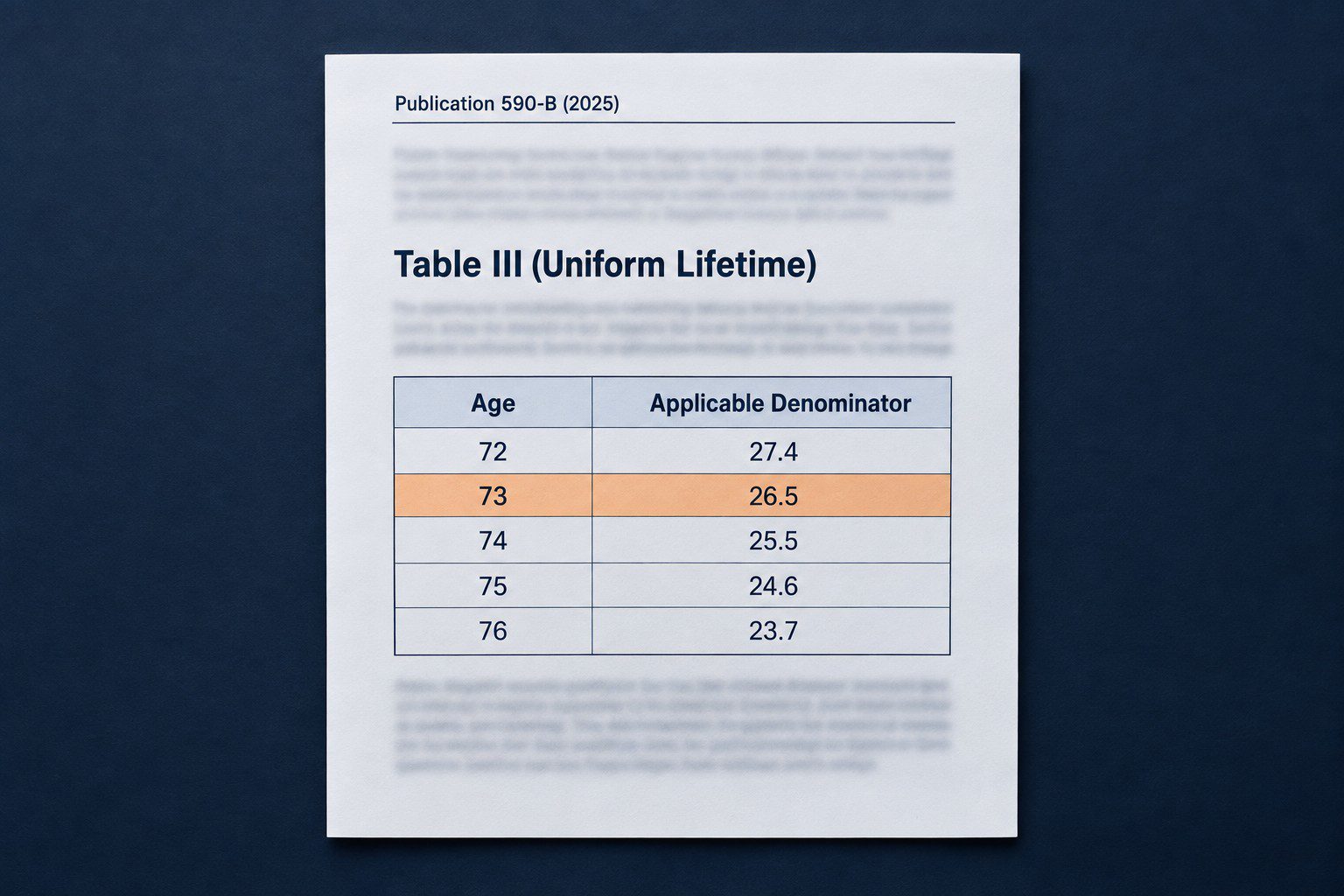
A required minimum distribution (RMD) is the minimum the tax code makes an owner withdraw each year from tax-deferred retirement accounts, starting at age 73. The amount is the prior year-end balance divided by an IRS life-expectancy factor. The rule fixes the date and the amount. It says nothing about which holding leaves the account, or whether it leaves as cash or as shares.
That second part is the decision the RMD guides skip, and it’s the one that matters for the portfolio. The holding you move out is the holding that stops compounding under tax deferral.
Key points
- RMDs begin at 73 for IRAs and workplace plans and move to 75 for clients born in 1960 or later.
- The divisor shrinks every year, so the RMD climbs from 3.8% of the balance at 73 to 8.2% at 90.
- You can satisfy an RMD with shares in kind, taxed at fair market value on the distribution date.
- In an example, a 6% as-reported ROA is 72% Uniform, so the weak-looking holding may be strongest.
- A 2026 withdrawal sets the 2028 Medicare Part B premium, which steps up above $109,000 of income.
What Are the RMD Rules for 2026?
RMDs begin at 73 for IRAs and workplace plans, per the IRS Retirement Topics page. The final RMD regulations move that to 75 for anyone who reaches 74 after December 31, 2032, in practice clients born in 1960 or later. The first question every year is which clients turn 73.
The first RMD can wait until April 1 of the following year. Every later one is due by December 31. Waiting puts two in one tax year. The IRS RMD FAQ example is an owner who reaches 73 in 2024, with the first RMD due by April 1, 2025, and the second by December 31, 2025. So the question is which clients should take the first one in the year they turn 73 instead.
A client who is still working can delay RMDs from the current employer’s plan until April 1 after the year they retire. That delay doesn’t apply to a 5% owner, per the IRS comparison chart, and IRAs get no still-working delay at all.
Traditional, SEP, and SIMPLE IRAs are covered, and so are 401(k), 403(b), 457(b), and profit-sharing plans. Roth IRAs and designated Roth accounts in a 401(k) or 403(b) require nothing while the owner is alive. A missed RMD carries a 25% excise tax on the amount not withdrawn, 10% if it’s corrected within two years. The RMD is taxed at the owner’s income tax rate, and it can’t be rolled over.
Which Accounts Can Be Pooled?
IRAs are calculated one by one, but the total can come out of any one of them, and the same goes for 403(b)s. A 401(k) or 457(b) RMD has to come out of that plan. So the question is which accounts can be pooled and which must each show their own withdrawal by year-end.
How Is an RMD Calculated, and Why Does It Grow?
The RMD for any year is the account balance on December 31 of the prior year divided by the distribution period from the IRS Uniform Lifetime Table. For a 2026 RMD, Publication 590-B says to use the owner’s age on their 2026 birthday and the balance at the close of business on December 31, 2025. Table III is the default. The Joint and Last Survivor Table applies only when the sole beneficiary is a spouse more than ten years younger.
The divisor shrinks every year, so the RMD rises as a share of the account even when the balance doesn’t change. Table III lists 26.5 at 73, 24.6 at 75, 20.2 at 80, 12.2 at 90, and 6.4 at 100.
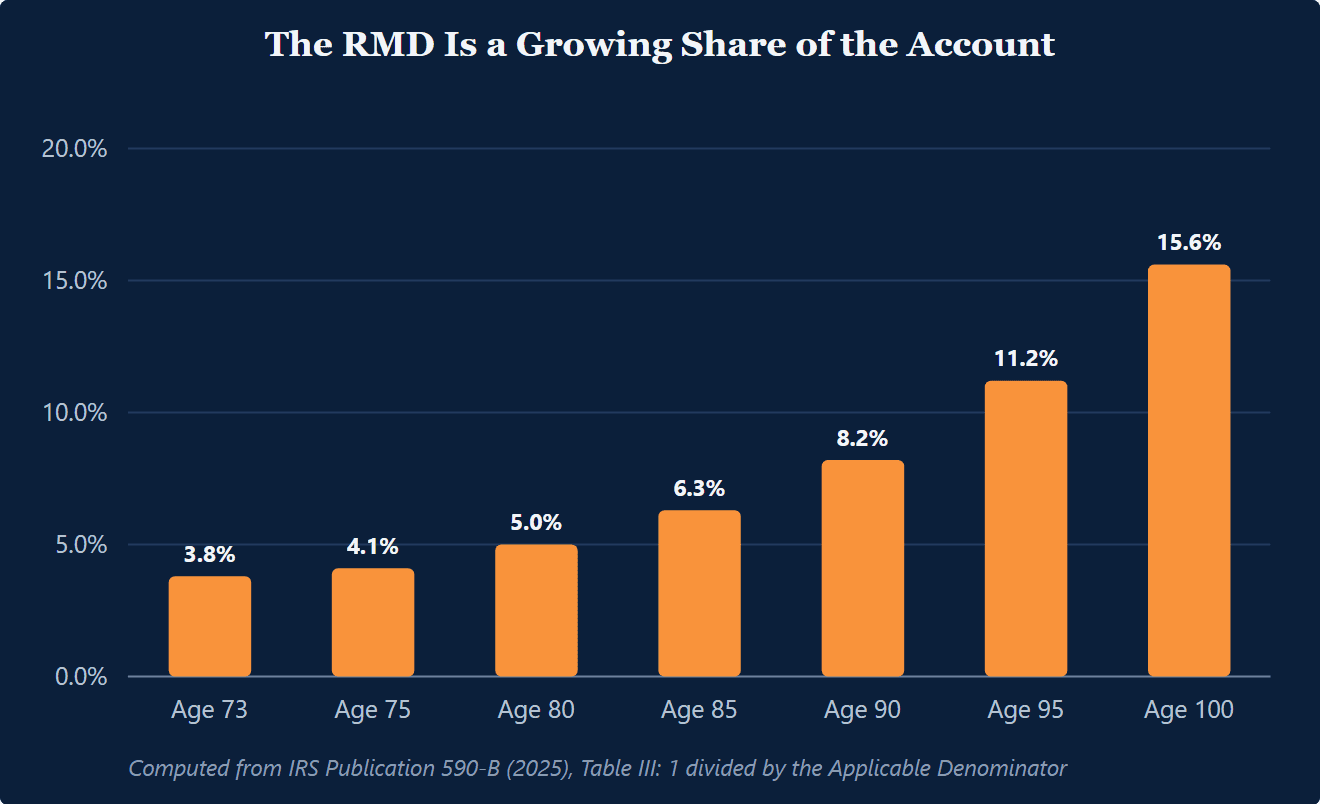
Computed from the table (1 divided by the denominator, rounded to one decimal), the RMD is 3.8% of the prior year-end balance at 73, 5.0% at 80, 8.2% at 90, and 15.6% at 100. At 73 it looks like a small sweep. By 90 it’s a twelfth of the account, so the question of which holding leaves gets bigger every year instead of going away.
Does an RMD Have to Be Taken in Cash?
No. Publication 590-B describes an IRA distribution as “money or other property,” so shares can satisfy the requirement. The tax is the same either way. The Form 1099-R instructions tell the custodian to report the fair market value of the securities on the date of distribution in box 1, and that’s the amount taxed.
So an in-kind distribution moves a position to a taxable account without selling it, and the income tax gets paid from somewhere else. Whichever mechanics the custodian offers, sell and send cash or move shares intact, you’re choosing what leaves the account. The rule doesn’t make that choice for you.
Which Holding Should Leave the Account?
In most books the choice comes from convenience, not judgment. Sell pro rata across the account. Sweep whatever the cash sleeve holds. Send out the highest yielder because it’s income, or the position that looks weakest on reported earnings. None of those is a judgment about a business. The only question that matters is which business you want compounding under tax deferral for another year, and which one you’re willing to move out.
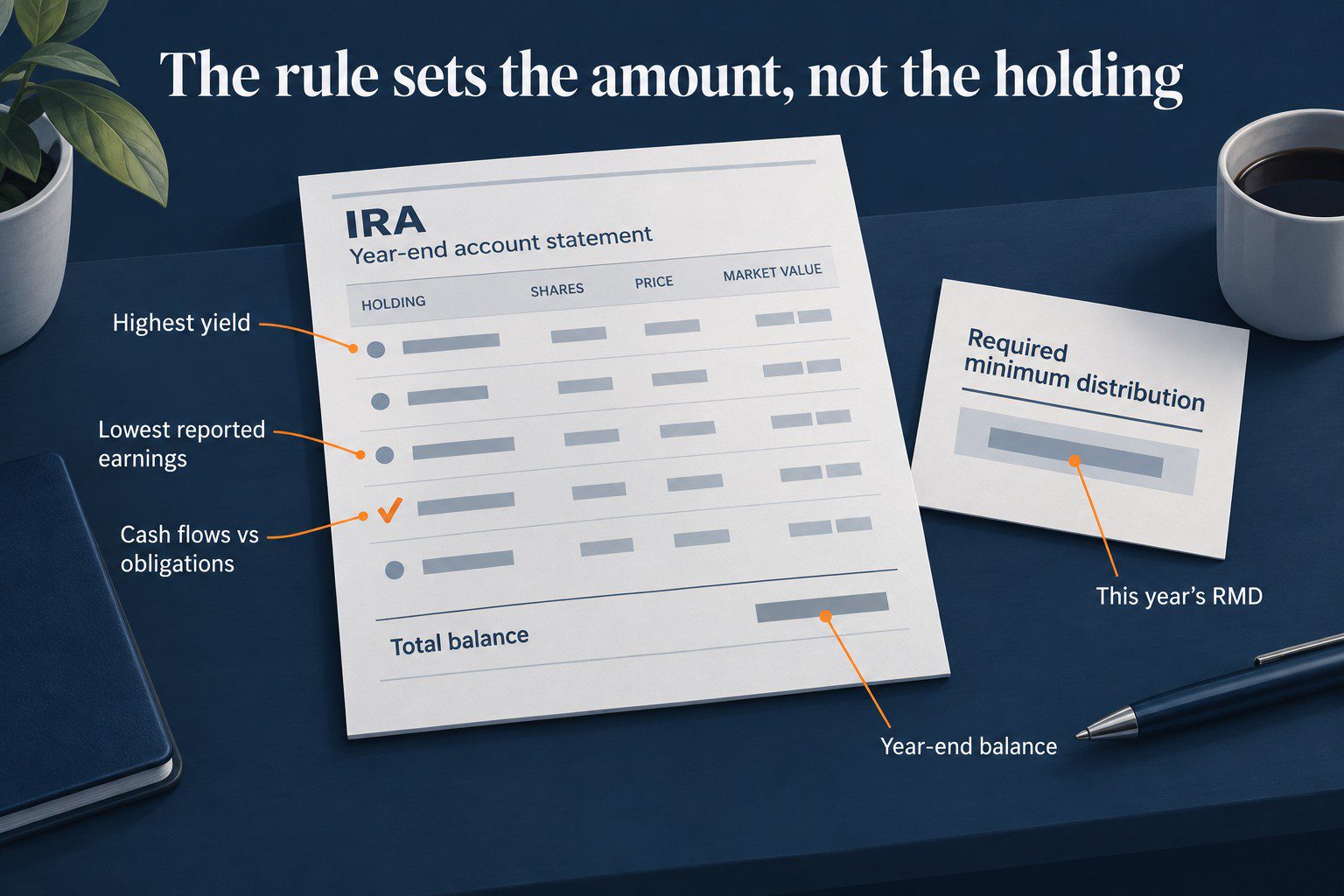
Yield is a price signal as much as an income signal. Sorting by yield to decide what stays selects for the companies the market has already marked down, the same way sorting by P/E selects for value traps.
What Do the Reported Numbers Miss?
As-reported statements don’t compare cleanly across holdings, and that’s a fact about the accounting standards rather than about any management team. Uniform Accounting adjusts the reported statements with over 130 adjustments so companies can be compared on one basis. Uniform return on assets (ROA) is the return computed from those adjusted statements, and it can differ widely from the as-reported figure. Reading a company’s statements the way a forensic accountant does starts there.
Take an example. These are example figures, not data for any company. A holding shows a modest 6% as-reported return on assets, or ROA. Under Uniform Accounting, the same business earns a 72% ROA. Fund an RMD by selling what looks weak on the income statement, and you can distribute the strongest business in the account.
Can the Business Keep Paying?
Comparable performance answers half the question. The other half is the business’s ability to keep paying what it has promised. The method in Litman and Spivey’s The MISinterpretation of Financial Statements (2019) sets Uniform cash flows against hard obligations, in order: debt maturities, interest, and maintenance capital spending. A dividend is paid out of cash, which is why the cash flow statement gets read before the income statement.
Thomson Reuters shows what that catches. On May 1, 2024, Altimetry Daily Authority wrote that the company “should have about $1 billion in spending money this year,” “has about $1 billion in debt coming due next year,” and “pays nearly $1 billion in annual dividends.” It concluded, “Starting in 2025, it’s going to need to save all its cash just to pay its existing bills.” A payout ratio won’t show a maturity wall. The obligations schedule does.
What Else Does an RMD Change on the Tax Return?
The RMD is ordinary income, so it adds to everything else on the return. Four rules push back, and each one carries a question.
For 2026 the standard deduction is $16,100 single and $32,200 joint, and the 37% top rate starts above $640,600 for a single filer, per the IRS inflation adjustments. Taxpayers 65 or older get an additional $6,000 deduction that phases out above modified AGI of $75,000, or $150,000 joint. The question is which households the RMD pushes across that phase-out.
Medicare looks back two years. CMS lists the 2026 Part B premium at $202.90 a month, stepping to $284.10 above $109,000 for an individual or $218,000 on a joint return, on income from two years earlier. The question is which 2026 withdrawal sets the 2028 premium.
A qualified charitable distribution (QCD) goes straight from the IRA trustee to an eligible charity, requires the owner to be at least 70½ on the day of the distribution, and counts toward the RMD. For 2026, Notice 2025-67 sets the amount excluded from income at $111,000. The question is which clients already give.
Inherited accounts run on a different clock. For owners who died in 2020 or later, a beneficiary who isn’t a spouse, a minor child, disabled, chronically ill, or within ten years of the owner’s age must empty the account by the end of the tenth year. When the owner died on or after the required beginning date, the final regulations, which apply from 2025, require annual distributions inside those ten years as well. The question is which inherited accounts are on the calendar under the right rule.
What Goes on the Calendar, and What Needs Judgment?
The rule layer goes on the calendar once a year with this year’s numbers. Who turns 73, which accounts are covered, which can be pooled, the December 31 deadline, and the 25% excise tax if it’s missed. That part is knowable, and getting it right is worth the hour.
The withdrawal gets chosen holding by holding, obligations first, as-reported earnings last. Doing that across every RMD client every fall is a data job, and it’s the reason the research platform matters as much as the divisor.
Key takeaways
- The rules fix the date and the amount, using age 73 (75 for clients born in 1960 or later), the prior year-end balance, and the IRS divisor.
- The divisor shrinks every year, so the share of the account that has to come out rises from 3.8% at 73 to 8.2% at 90.
- The rules don’t choose the holding. Shares can leave in kind, so choose what leaves by judging the business rather than by convenience or reported earnings.
- Every RMD is ordinary income, so check the senior deduction phaseout, the Medicare premium two years out, and a QCD before the money moves.
Frequently Asked Questions
What Happens if a Client Misses an RMD?
The amount not withdrawn may be subject to an excise tax of 25%, or 10% if the RMD is corrected within two years, per the IRS RMD FAQ. The RMD still has to be taken.
Can an RMD Be Rolled Over?
No. The IRS RMD FAQ says RMD amounts can’t be rolled over into another tax-deferred account. The withdrawal is taxed at the owner’s income tax rate in the year it comes out.
Do Roth Accounts Have RMDs?
Not while the owner is alive. The IRS states there are no RMD requirements for Roth IRAs or for designated Roth accounts in a 401(k) or 403(b) plan during the owner’s lifetime.
Can RMDs From Several Accounts Be Combined?
For IRAs, yes. Calculate each one, then take the total from any one or more of them, and the same applies to 403(b)s. A 401(k) or 457(b) RMD must be taken from that plan.
One company on the numbers, every morning
FA Alpha Daily applies this to one company, metric, or market signal every morning, free for financial advisors.