The Great Wealth Transfer: Keeping the Next Generation
September 1, 2026

The great wealth transfer is the largest asset movement in history. Cerulli projects $124 trillion changing hands through 2048, and most advisory practices will lose their share of it by default. Heirs rarely keep an advisor they’ve never met.
The money usually goes to the surviving spouse first and to the kids second. Both decisions get made fast, by family members who may know you only as a name on a statement.
The way to keep them is evidence, a research process any generation can understand and repeat. You can start building it this year.
Key points
- Cerulli projects $124 trillion will transfer through 2048, about $54 trillion to spouses first.
- Most heirs leave because they already have an advisor or feel no tie to their parent’s.
- Write a one-page case for each core holding on Uniform earnings and what the price assumes.
- Meet the heirs this year and turn one annual review into a family review.
- On a $200 million book, every 10 points of heir retention is worth $6.7 million.
The Great Wealth Transfer, in Numbers
The numbers are too large to ignore. Cerulli projects $124 trillion will transfer through 2048, with about $105 trillion going to heirs and $18 trillion to charity. About 81% of it comes from baby boomers and older generations, so the wave runs straight through the average advisory book.
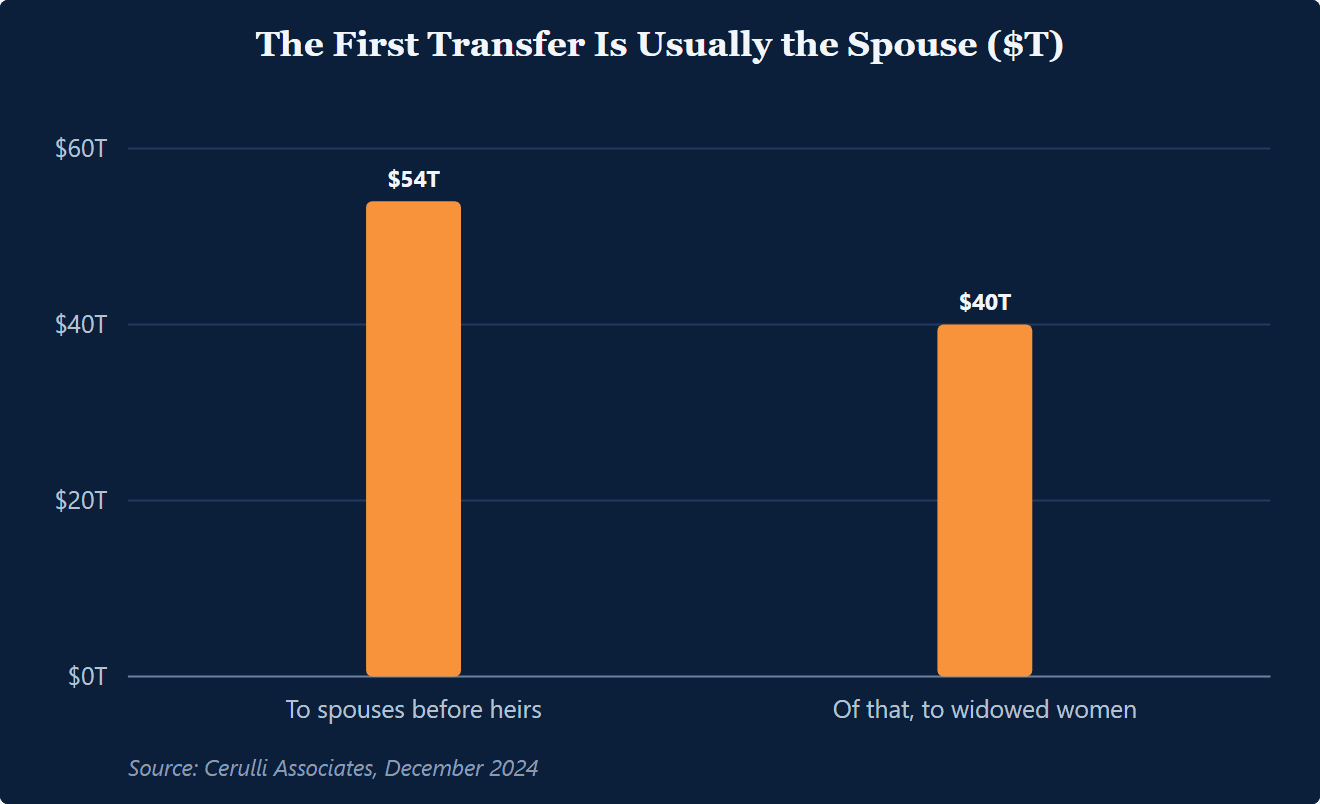
The sequence matters as much as the total. Cerulli expects roughly $54 trillion to pass to spouses first, with nearly $40 trillion of that going to widowed women. The surviving spouse is usually the first test, and she decides within months if you’re still her advisor.
Heirs say so themselves. In an April 2026 Natixis Investment Managers survey, 47% of U.S. investors expecting an inheritance said they plan to switch away from their benefactor’s advisor. In the same survey, 41% of U.S. advisors called the transition an existential threat to their practice.
Why Heirs Leave After a Death
Heirs leave because the relationship belonged to their parent, and performance rarely has anything to do with it. When the transfer happens, the heir sees a stranger attached to an account balance.
In the same Natixis survey, the top reasons for switching were already having an advisor of their own and feeling no personal connection to their parent’s. You can’t fix either one at the funeral.
The portfolio has the same problem. If all the heir has ever heard is “we’re diversified” or “we’ve owned it a long time,” they have no answer when a friend says, “Just move it to my guy.”
The first real test usually comes earlier, and many practices treat it as paperwork. When every review has been a conversation with the husband, the widow learns she was never the client. She’ll choose the advisor who gives her clear next steps she can act on.
Evidence the Heir Can Inherit
Relationships don’t transfer, but a research process can. Your client’s adult child can inherit a portfolio. They can’t inherit your history, your rapport, or the years you spent keeping clients invested through volatility. When your best argument is “your parents trusted me,” you’re asking grief and inertia to do the work.
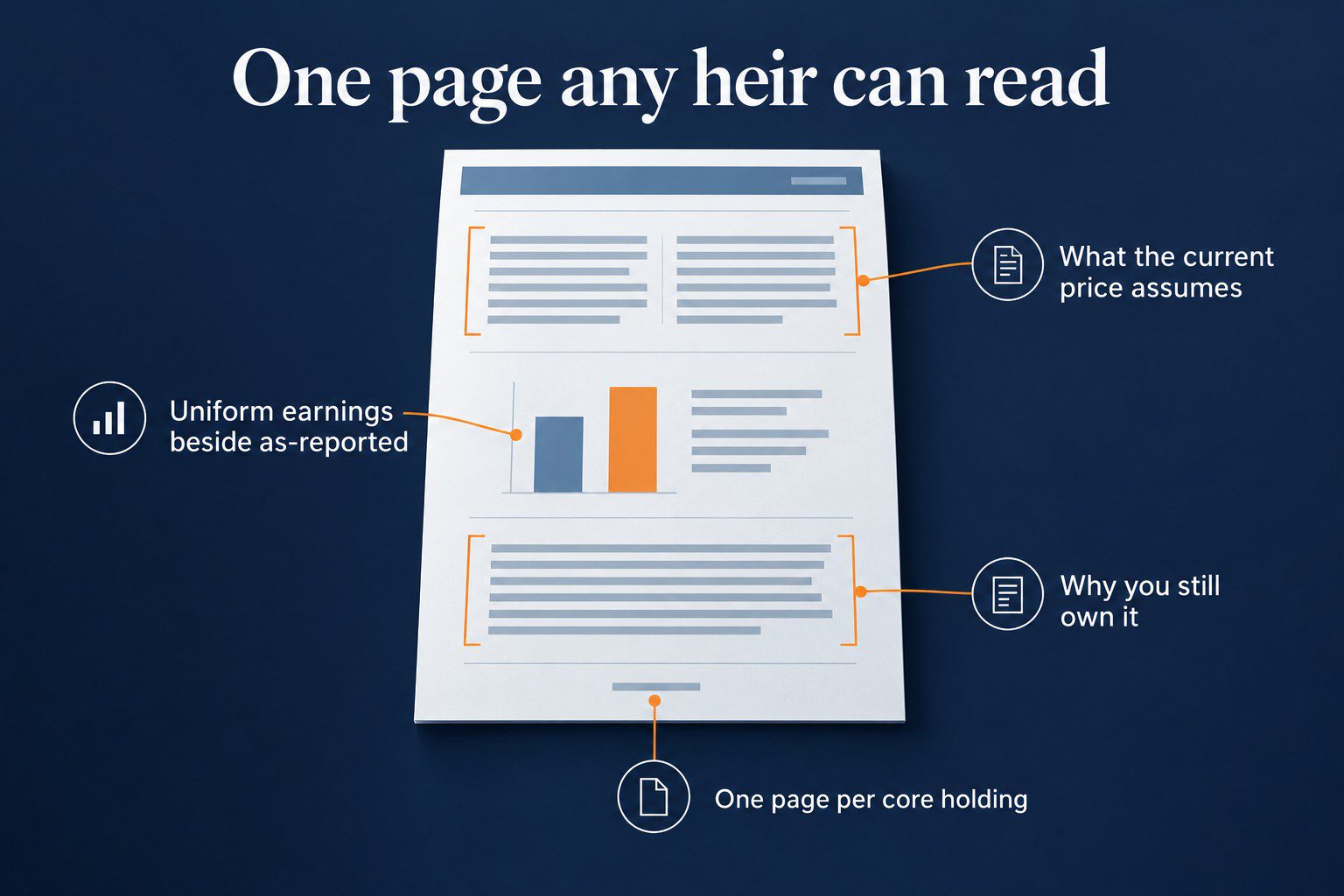
Evidence does carry over, once the heir has watched it work. Uniform Accounting makes more than 130 adjustments per company to the reported statements and sets the Uniform result beside the as-reported numbers. That lets you explain what a business earns and what the current price assumes. When an heir asks why a holding belongs in the portfolio, you can answer in three sentences:
- What the business earns on a Uniform basis
- What would have to be true for the current price to make sense
- Why you still own it
One page per core holding covers it. The same discipline applies to earnings quality. Know what the businesses earn before anyone asks.
A Next-Generation Program to Start Now
Build the cadence in calm years. If you wait for a death to bring the kids in, the first real conversation happens when everyone is grieving, distracted, and busy. That meeting becomes your first impression.
The program is four actions, none of them complicated. Put the heirs’ names and emails in the household record, and meet them once this year, even for 20 minutes. Convert one annual review into a family review. Send both generations the same one-page evidence for a holding, so the heir learns how you think and can follow along.
Give the heir’s starter account the same research treatment as the parent’s portfolio. A $30,000 teaching account run with full documentation teaches the family more about your process than any brochure.
A monthly note helps here, too. The same macro insight you bring to client meetings gives the next generation a voice they come to recognize. FA Alpha Academy trains exactly these client and family conversations.
The Economics of Heir Retention
The trillions make headlines, but the decision is about your own book. A small change in retention rate separates a haircut from a permanent reset.
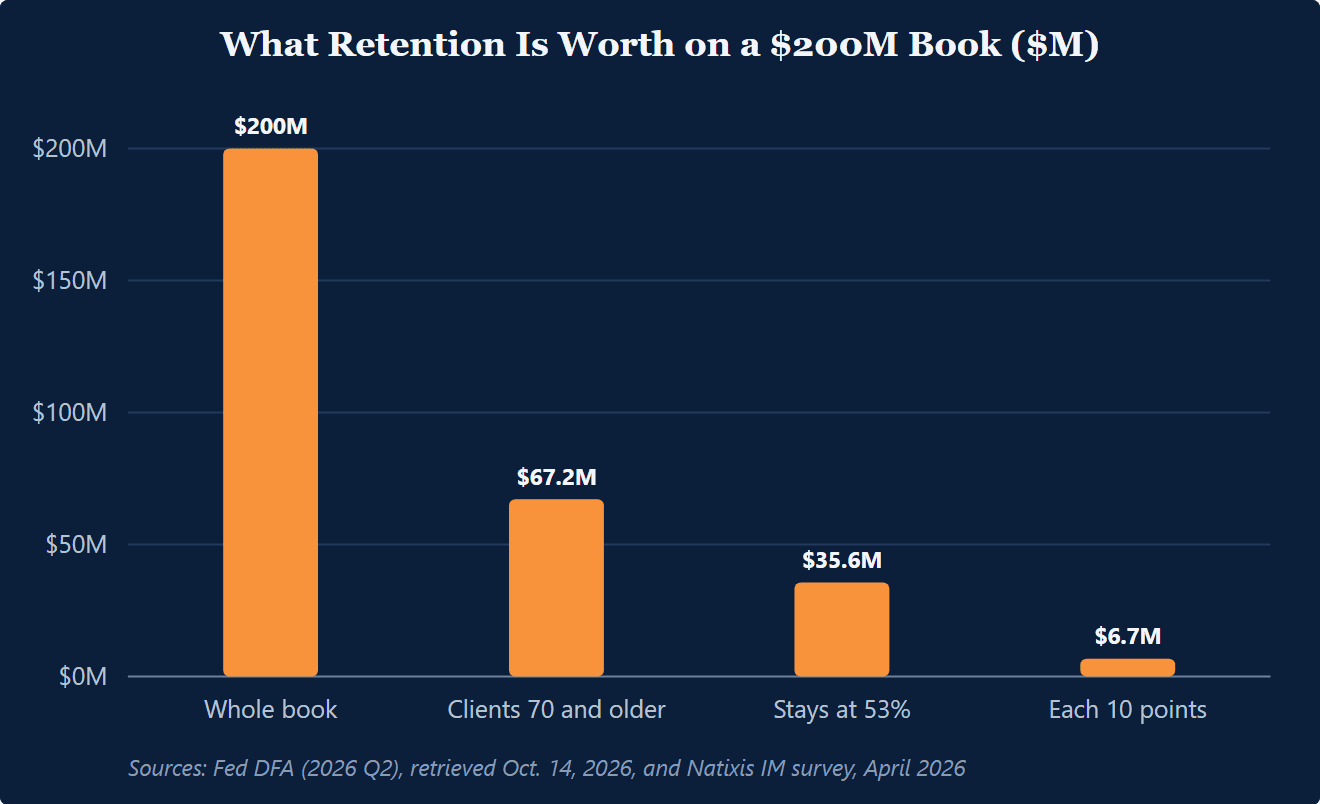
Run it on a $200 million book. Households headed by someone 70 or older held 33.6% of U.S. household net worth in the second quarter of 2026, per the Federal Reserve Board’s Distributional Financial Accounts, net worth share by age group, retrieved Oct. 14, 2026. At that national share, $67.2 million of the book sits with clients 70 and older. In the same April 2026 Natixis survey, 53% of heirs plan to keep their benefactor’s advisor. At that stay rate, $35.6 million stays and $31.6 million walks.
Every 10 points of retention you add on top is $6.7 million, and that is the value of work done before the transfer. None of it requires new clients, new markets, or a single cold call.
The Three Conversations, Word for Word
An heir doesn’t need reassurance. They need a clean next step, in words they can repeat to siblings and attorneys. These lines avoid two traps. One is talking like you own the relationship. The other is talking like the portfolio is only a number.
A Client Who’s Never Introduced Their Kids
“Let’s make one review this year a family review. We won’t go deep on the money. I want your kids to know who I am, what I do, and how to reach me when you can’t be the interpreter. They’ll hear how we decide what to own and what would make us change our mind.”
An Heir Who Asks Why They Should Stay
“You don’t have to stay because your parents did. Stay if the process makes sense to you. I can show you, one page per holding, what each core holding earns on a Uniform basis and what the current price assumes. If you want a second opinion, I’ll help you compare processes instead of promises.”
A Widow in the First Review After the Funeral
“Today isn’t a portfolio meeting. Today is a plan for the next 30 days. We’ll settle what gets retitled, which bills keep getting paid, and what can wait. When you’re ready, we’ll walk through the investments as businesses, one page each, so you’re never signing off on something you can’t explain.”
The Four Actions and What They Build
You can’t delegate relationship history. You can delegate a cadence, document it, and track if it happened. When the program lives as four named actions, it survives staff turnover and compliance review.
| Program move | When it happens | What it builds |
|---|---|---|
| Family meeting | In calm years, scheduled like an annual review | Familiarity and permission, so you aren’t a stranger at the worst moment |
| Heir-included review | Once a year for transfer-exposed households | Shared language for decisions, so the heir can follow how you think |
| Teaching account | As soon as an adult child has investable assets, even small | A low-stakes place to demonstrate your research process, with real documentation |
| Shared research one-pager | After each major rebalance or core holding change | Transferable evidence, so any family member can explain what you own and why |
The same one-pager does double duty when a client asks about undervalued stocks they read about, because the family has already seen what evidence looks like.
Key takeaways
- Cerulli projects $124 trillion transferring through 2048, with $105 trillion going to heirs and most of it passing through spouses first.
- Nearly half of U.S. inheritors plan to switch advisors, mostly because the relationship never included them.
- Relationships don’t transfer, but evidence does. A one-page Uniform earnings memo per holding gives any generation a reason to stay.
- Start the program in calm years, with a family meeting, an heir-included review, a teaching account, and a shared research one-pager.
Frequently Asked Questions
What Is the Great Wealth Transfer?
It’s the multi-decade shift of assets from older generations to spouses, heirs, and charity, now projected at $124 trillion through 2048. For an advisory practice, it’s a relationship-transfer problem as much as a portfolio problem.
How Much Money Will Change Hands?
Cerulli projects $124 trillion through 2048, with about $105 trillion going to heirs and $18 trillion to charity. Roughly $54 trillion passes to spouses first, which is why the surviving spouse is usually the first test.
Why Do Heirs Leave Their Parents’ Financial Advisor?
In Natixis’s 2026 survey, the top reasons were already having an advisor of their own and feeling no personal connection to their parent’s. An heir who only ever saw the portfolio as an account balance has no answer when someone says to move it.
How Do Advisors Keep the Next Generation as Clients?
Meet the heirs before the transfer, and give both generations the same evidence. Show what each core holding earns on a Uniform basis, what the price assumes, and why you own it. When the heir’s starter account gets the same documented process as the parent’s portfolio, the family learns to recognize your work.
Evidence every generation can read
FA Alpha Daily applies this to one company, metric, or market signal every morning, free for financial advisors.