
Behavioral Finance for Advisors: Keeping Clients Invested
August 31, 2026
Markets don’t break plans. Stories do.
Behavioral finance is your toolkit for keeping evidence in the room when a scary headline arrives. Clients abandon an allocation when the headline beats the evidence, and a repeatable conversation is what keeps the evidence in front of them.
This article translates behavioral finance into a repeatable conversation you can document. You’ll see the three biases that most often trigger selling and the behavior gap as a measurable drag.
Key points
- Handle a drawdown as a behavior problem, and you can run a repeatable, documented conversation.
- Loss aversion, recency bias, and herding write most of the stories that push clients to sell.
- Barber and Odean found the most active households earned 11.4% a year while the market made 17.9%.
- Write a three-line script in calm markets that puts Uniform business evidence beside the price move.
Your Biggest Impact on Returns Is Behavioral
Headlines and quarter-to-quarter pricing are beyond your control. What you can control is whether a client turns volatility into permanent loss by selling and parking in cash.
Behavioral finance keeps evidence on the table when the push alerts say recession. Let’s say you argue a drawdown as a performance problem. While that may seem okay on the face of it, it might lead you to improvise reassurance that compliance will hear as an implied promise. Handle it as a behavior problem and you can run a repeatable conversation that pairs the client’s story with business evidence.
But there’s a relatively simple fix for this. Stop seeing your value to clients as selecting the right holdings. Your bigger return impact is preventing the wrong decision on the worst day, and you can document that.
Three Biases That Trigger Selling
Stocks just fell hard, and your portfolios are under their equity targets. Getting back to target means buying more of what fell, right when clients want to sell. In that moment, you’re usually fighting a pattern more than you’re fighting the market.
You’ll hear the same fear manifested in different ways. In a drawdown, clients will most often contact you preloaded with a narrative. There are three biases that are most often at the bottom of it.
| Bias | What the client says | What you do |
|---|---|---|
| Loss aversion | “I don’t care about the plan, I just need this to stop.” | Name the pattern, slow the decision, and put price action beside Uniform business performance before changing anything. |
| Recency bias | “It’s been down for months, so it’ll keep going.” | Restate what you heard, then shift from near-term guessing to expectations in the price and the underlying earnings trend. |
| Herding | “Everyone I know is getting out.” | Separate the crowd’s story from your evidence: the allocation’s role, Uniform earnings today, and the risk of timing re-entry. |
You can’t talk a client out of these with more market trivia. What works is a script you committed to in calm markets, backed by evidence, and a check on whether investor sentiment is too bullish when herding is the story.
The Behavior Gap You Can Prove
When the screen is flashing red, trading can feel like control. In the data, it’s often a repeatable way investors tax their own returns.
The behavior gap is the return lost to poor entry and exit timing.
You see it when clients sell after losses, then re-enter after the recovery is already in the price. The plan can be fine and the client still converts volatility into a permanent haircut. You can’t treat that as a soft, unmeasurable problem, because it’s often the biggest driver of what clients experience.
The cleanest way to anchor this is to point to behavior in the real world, not a personality quiz. In Trading Is Hazardous to Your Wealth, Barber and Odean tracked 66,465 brokerage households. The ones that traded most earned 11.4% a year while the market returned 17.9%. That’s the point you need in the room. Activity, on its own, can dominate outcomes.
In a client review, keep the numbers simple and sourced. The S&P 500 returned 13.0% a year with dividends reinvested from September 2021 to September 2026, per Robert J. Shiller’s U.S. stock market data (ie_data.xls, shillerdata.com, S&P 500 total return index, retrieved Oct. 13, 2026). Morningstar’s Mind the Gap 2026 study, published Aug. 6, 2026, found that the average dollar in U.S. mutual funds and ETFs earned 8.7% a year over the 10 years ended Dec. 31, 2025, while the funds themselves returned 9.9%. That 1.2-point gap comes from the timing and size of investors’ purchases and sales. Apply Morningstar’s gap to the index return on $500,000. Five years at 13.0% compounds to about $922,000. Five years at 11.8% compounds to about $874,000, roughly $48,000 left on the table. That figure isn’t a market prediction. It’s the cost of turning feel-better trades into policy.
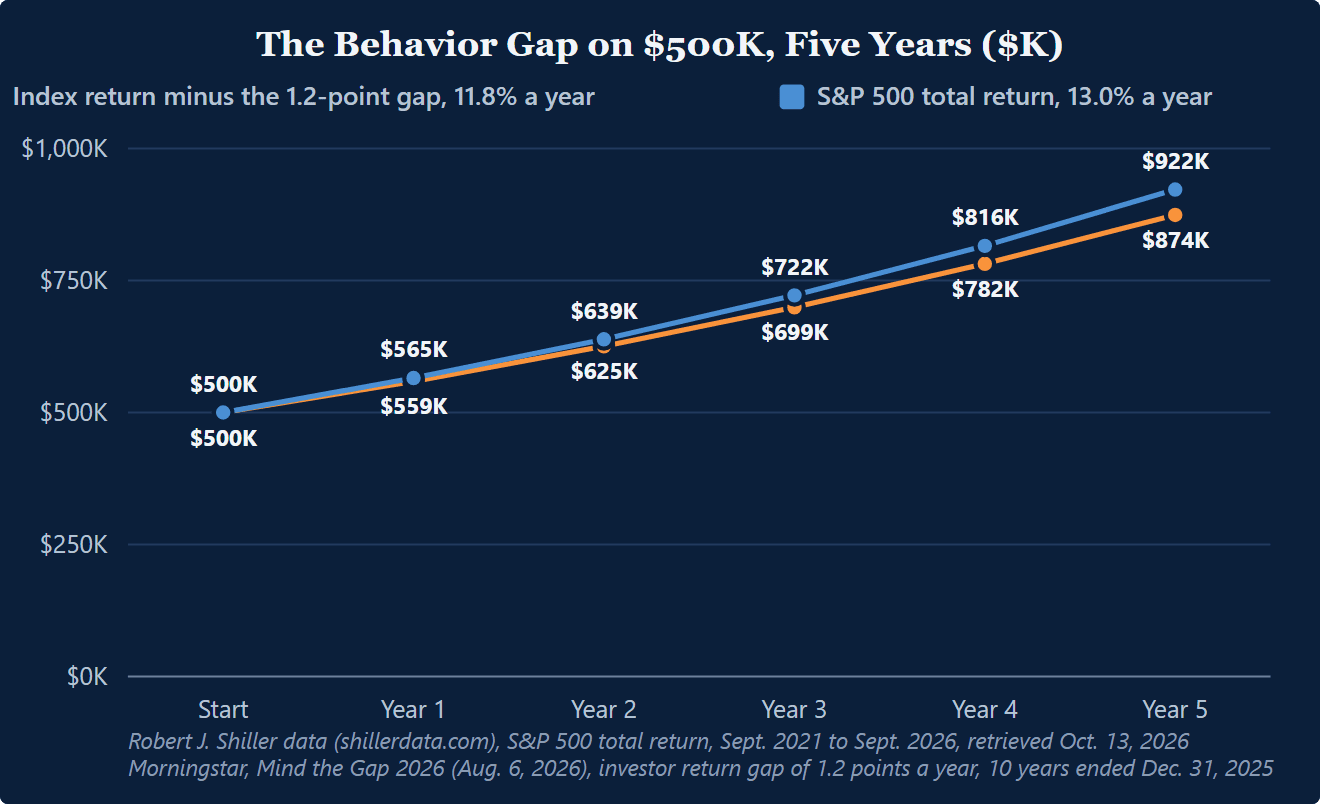
What you can do differently is track this as a planning metric. When a client asks for a wholesale exit, you’re not debating whether the next month is green. You’re documenting a decision that historically creates a measurable drag, then shifting the conversation back to what evidence would have to change for selling to be the disciplined move. The same evidence discipline runs through earnings quality. Know what the businesses earn before the phone rings.
Your Pre-Committed Behavioral Finance Script
If you wing this conversation, you’ll slide into prediction in the one moment you can’t afford to. A written default keeps you factual, consistent, and supervisable when emotions spike.
A better pep talk won’t get you through a drawdown. You need a written default. When you wait until the phone rings to “find the right words,” you’ll slip into narrative combat and accidental prediction, and you’ll lose both the client and the paper trail.
Draft three lines and rehearse them until they’re automatic. Each line does one job. Validate the emotion, then put business evidence next to the price move.
When The Client Wants Out After A 20% Drop
“I hear you. Down 20% feels like the plan is breaking. Before we change anything, let’s put two facts side by side, what the price did and what the businesses earned on a Uniform basis. Then we’ll decide what would have to be true for selling to be the disciplined move.”
When The Client Says, “It’ll Keep Falling”
“Let me repeat what I’m hearing. Recent declines feel like the next chapter. Instead of guessing the next month, let’s look at the expectations already in the price and the latest underlying earnings trend.”
When The Client Says, “Everyone Else Is Moving To Cash”
“It makes sense you’d want safety if your peers are exiting. Let’s separate the crowd’s story from our evidence, the role this allocation plays in your plan and what these businesses are earning today on a Uniform basis.”
The evidence has to be ready before the call. Keep a one-page exhibit per core holding or sleeve with the Uniform earnings trend and what the current price implies. Ask the same two questions every time. “What did you read or hear that scared you?” “What would you need to see to feel okay holding for 12 months?” Document the answers and the evidence you reviewed, and volatility stops being a debate you have to win.
A bounce after a steep drop deserves the same discipline. Our page on a dead cat bounce covers that conversation.
Bake The Script Into Your Process
Keep it boring in calm markets. If you only “do behavioral finance” when a client panics, you’ll default to reassurance, and you’ll make implied promises you can’t supervise.
Start by writing the three lines into your review agenda and your CRM templates so behavioral coaching is part of normal planning hygiene. Have juniors role-play the client side for five minutes at weekly huddles. Save the best paraphrases as approved language for the whole team. FA Alpha Academy trains exactly this kind of client conversation.
Then tie every core holding or sleeve to one sentence you could give a client. It covers what the business earns on a Uniform basis and what the price already seems to assume. The goal isn’t predicting a rebound. It’s a business-understanding anchor you can document, the same one that separates undervalued stocks from value traps.
Key takeaways
- Clients abandon plans when a story beats the math. Behavioral finance keeps the math in the room.
- The behavior gap is measurable: Barber and Odean’s most active households earned 11.4% a year against a 17.9% market.
- Write the volatility script in calm markets and pair every line with Uniform business evidence.
Frequently Asked Questions
What Is Behavioral Finance?
Behavioral finance is the study of how real people make financial decisions under uncertainty, especially when fear, stories, and social pressure override the plan. For you, it’s a practical toolkit for keeping evidence in the conversation when markets get loud.
What Is The Behavior Gap?
The behavior gap is the return lost to poor entry and exit timing. It’s the cost of selling after declines and buying back after recoveries, even when the underlying plan didn’t change.
How Do Advisors Keep Clients Invested During Volatility?
You keep clients invested by running a repeatable, documented conversation. Ask what they heard, paraphrase it back, then put price action beside underlying business evidence like Uniform earnings and what the price already implies. That approach keeps you out of accidental prediction, which matters under communication rules like FINRA Rule 2210.
What Should You Say To A Client Who Wants To Sell Everything?
Start with acknowledgment and a speed bump. “I hear why this feels urgent. Before we act, let’s put the drawdown next to what the businesses earned and what the price already assumes, then write down what evidence would justify a full exit.” You’re not arguing the next month, you’re insisting on a decision standard.
When Do Behavioral Techniques Not Apply?
They don’t apply when the plan is wrong for the client’s real horizon or liquidity needs. If the drawdown reveals a risk mismatch, your job is to re-underwrite the plan, not coach them into tolerating something they can’t stick with.
The evidence for the worst day, every morning
FA Alpha Daily applies this to one company, metric, or market signal every morning, free for financial advisors.