
What Is a Dead Cat Bounce, and What Does It Mean?
August 29, 2026
Quick answer
A dead cat bounce is a sharp rally inside a broader decline that later fails and makes new lows. Positioning like short covering and dip buying usually drives it, rather than any change in fundamentals. Price alone can’t confirm it in real time, so treat it as a bounce until the evidence changes.
Instead of predicting it, check whether the conditions that end bear markets are present. Credit spreads narrow, market breadth improves, and earnings estimates stabilize. If none of those has changed, treat the rally as a bounce and don’t chase it.
You don’t need to name the move with certainty to stay disciplined. Use “bounce” as a working hypothesis, and write down the conditions that would have to change before you treat the move as more than a bear-market rally. Look for confirmation away from the index itself, especially breadth and credit spreads. Credit leads. Major bear markets have come with corporate credit stress first, so spreads get the most weight.
What a Dead Cat Bounce Signals
Merriam-Webster defines it as a brief and insignificant recovery after a steep decline. The phrase comes from an old trading-floor joke that even a dead cat will bounce if it falls from high enough. The market version is a rally, often 5% to 15% and sometimes more, that appears partway through a bear market and then rolls over. Every major decline has had several, and most looked like the bottom at the time.
The bounce gives you information. It forces a tighter question. Are breadth and spreads confirming a turn, or is this a relief move? Market breadth is how widely gains are shared across stocks, often tracked with the advance-decline line. Credit spreads are the extra yield investors demand over Treasuries to own corporate bonds, often watched through high-yield spreads.
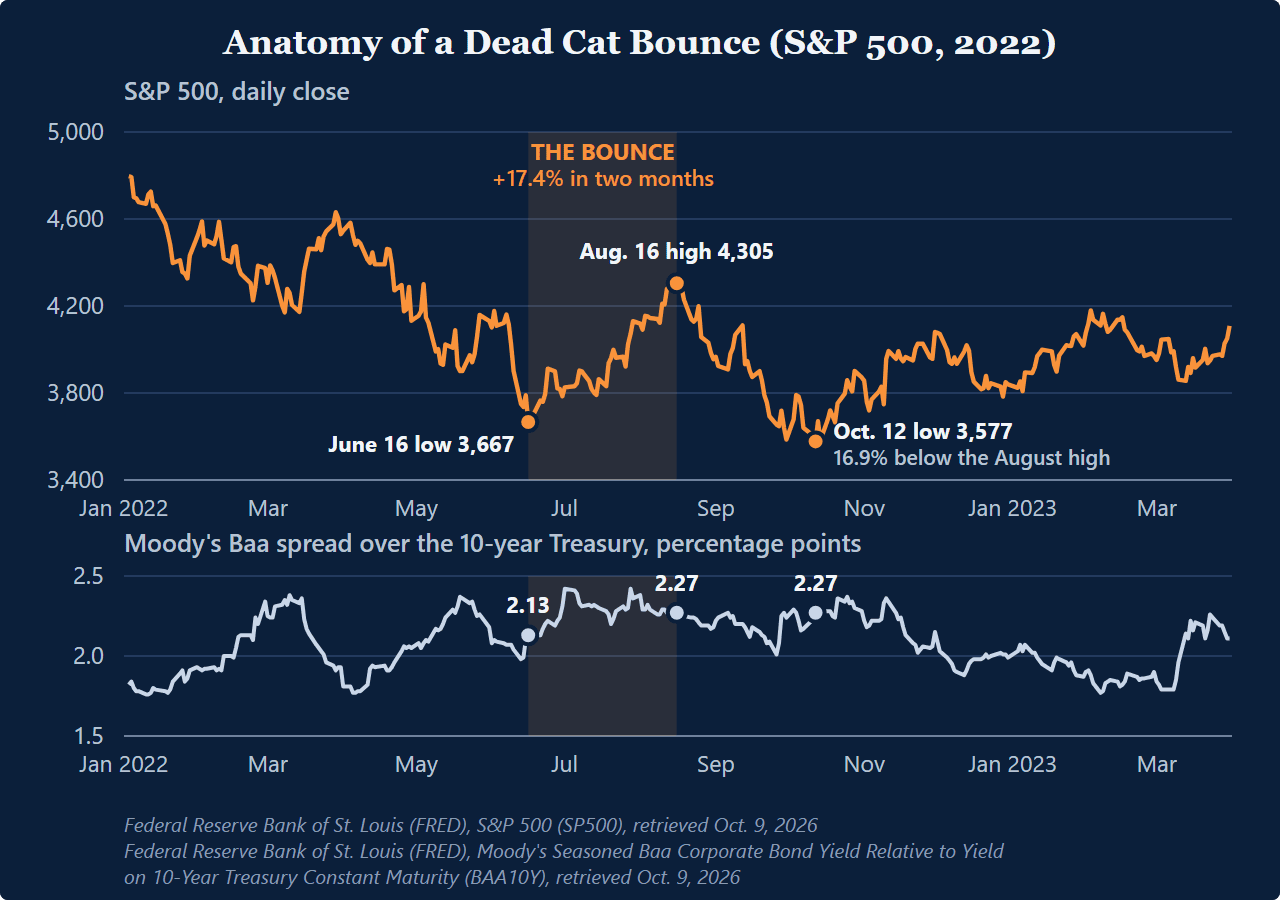
The S&P 500 did this in 2022. It closed at 3,666.77 on June 16, 2022, then rallied 17.4% to 4,305.20 on Aug. 16, and every headline said the worst was over. By Oct. 12 it had fallen 16.9% from that high to 3,577.03, 2.4% below the June low. Credit never confirmed the rally. The Moody’s Baa spread over the 10-year Treasury was 2.13 percentage points on June 16, 2.27 on Aug. 16, and still 2.27 on Oct. 12. The only thing that distinguished August from a real recovery was what happened afterward, which was no use to anyone deciding in August. Figures from the Federal Reserve Bank of St. Louis (FRED), series SP500 and BAA10Y, retrieved Oct. 9, 2026.
| Signal | Dead cat bounce | Durable bottom |
|---|---|---|
| What causes the move | Positioning and flows: short covering, dip buying, oversold rebound | Fundamental repair and risk appetite returning |
| Market breadth | Narrow participation. A few large names carry the index | Broadening participation. New lows dry up |
| Credit spreads | Don’t tighten much, or re-widen | Tighten and stay tighter |
| Earnings estimates | Still falling or unstable | Stabilizing or improving |
Why Dead Cat Bounces Happen
You can get a clean, convincing rally while the reasons for the drawdown are still there. Most of the time the rally starts with positioning and flows rather than a change in underlying earning power.
1. Short covering
When positioning gets crowded, an inflation print or a Fed press conference can force shorts to buy shares to close. That buying lifts the index quickly even when breadth stays narrow and credit spreads don’t confirm.
2. Dip buying on price alone
Rules-based flows and investors anchored to last month’s price step in because the stock looks cheap against that level. Uniform fundamentals haven’t improved. You’ll hear “it’s down 20%, it has to bounce,” even while earnings estimates keep sliding.
3. Oversold rebounds
After heavy selling, trend signals and volatility-control strategies add exposure back, and prices snap back from oversold levels. The rebound looks convincing on a chart, but it fades if the funding stress and widening spreads that caused the selloff are still present.
How Advisors Should Interpret and Monitor One
Bear markets throw off several rallies before the bottom. The practical edge isn’t calling the last low. It’s insisting on confirmation beyond the headline index.
- Don’t call it. “This is just a bounce” and “this is the bottom” both put your credibility on a guess. Say what the signals say instead.
- Don’t chase it. A sharp rally after a decline is the highest-risk moment to add exposure, because the positioning that caused it reverses just as fast. If the plan calls for rebalancing, rebalance on schedule.
- Use it for what it’s good for. A bounce is a chance to exit positions you wanted out of anyway at better prices. It’s also the moment clients most need a calm, evidence-based read.
- Watch the company, not the tape. For individual holdings, the question during any rally is whether underlying earnings and Uniform return on assets (“ROA”) held up. Companies whose Uniform returns stayed intact through the decline tend to recover. Companies whose reported earnings were flattering to begin with usually make the next low.
In a client note, keep it plain. “We’re not treating price alone as a cycle signal.” Then list what you are tracking, such as participation, high-yield spreads, and whether underlying returns held. A green week can feel like resolution, but it often just resets positioning.
How FA Alpha Tracks the Phase
FA Alpha Pulse monitors the credit, profit, and sentiment signals of the Market Phase Cycle each month. Advisors know which phase the market is in and what usually follows, without trying to time the turn. The bear-market rally is a named phase in that framework. Credit easing, corporate profit stabilizing, and sentiment shifting mark the way out of it, not a good week in the index.
No signal set times the turn. The signals reduce false positives. They don’t eliminate them. Our page on whether investor sentiment is too bullish covers the other end of the cycle.
Key points
- A dead cat bounce is a 5% to 15% rally inside a bear market that fails and makes new lows.
- Short covering, dip buying, and oversold rebounds usually cause it, with no change in fundamentals.
- Before calling a bottom, check credit spreads, market breadth, and earnings estimates.
- Check whether each holding’s Uniform ROA held up through the decline, since price alone isn’t a signal.
The macro read, without the noise
FA Alpha Daily applies this to one company, metric, or market signal every morning, free for financial advisors.