
How can a financial advisor add unique macro insights to client conversations each month?
Quick answer
Advisors add fresh macro insight by running a fixed monthly framework instead of reacting to headlines. Read a few weighted signals in the same order every month, credit first, then earnings growth, then momentum and sentiment, then valuation. Turn each reading into one sentence a client can repeat.
Earnings growth gets read on Uniform numbers, and valuation serves as context, never as a timing tool. Clients remember a framework they hear applied the same way, month after month.
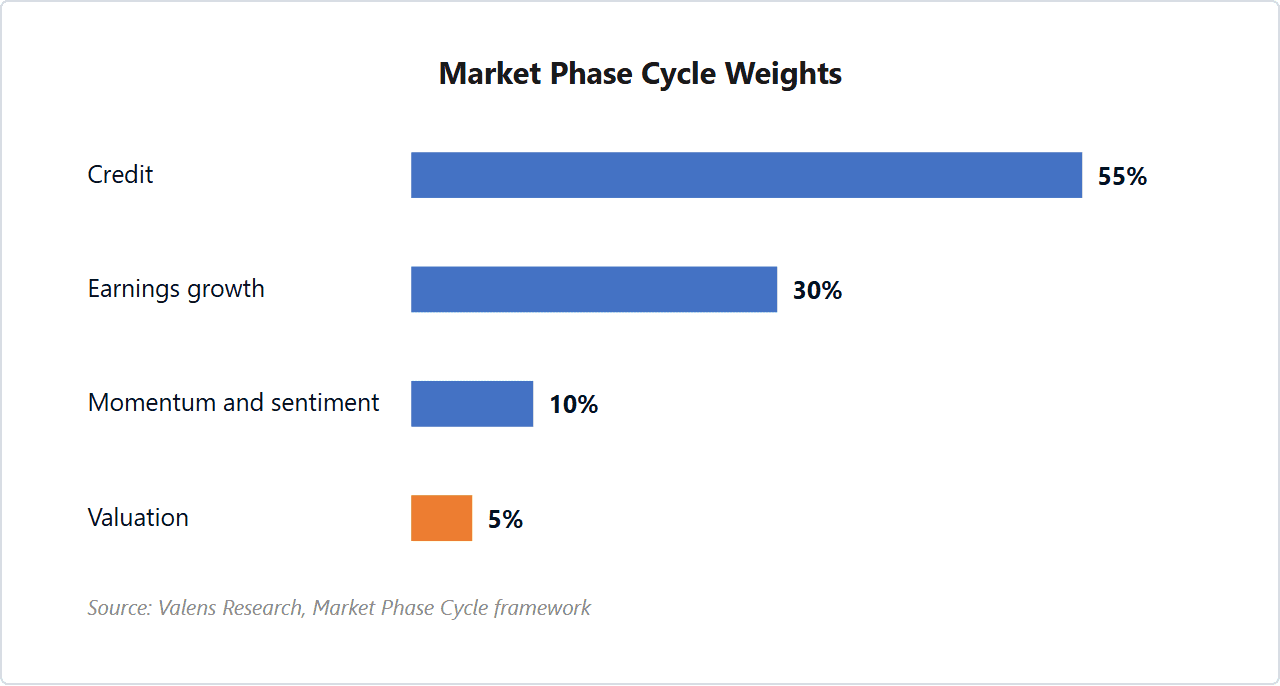
Valens Research’s Market Phase Cycle framework is the model. It weights credit at 55%, earnings growth at 30%, momentum and sentiment at 10%, and valuation at 5%. In its August 2026 monitor, the framework called the market a GARP market, with a market Uniform P/E of 20.4x against forecast earnings growth in the mid-twenties. It read rising Treasury yields as borrower demand for credit rather than inflation fear. Uniform Accounting adjusts as-reported financials to remove common distortions, so you can compare profitability and growth more consistently.
Adopt a Monthly Signal Spine
When stocks rise and bonds fall in the same month, the usual narratives reverse. A fixed signal order keeps your message steady.
Clients don’t need another market recap. They need to hear the same decision structure every month, so your commentary sounds like a process. Build a fixed signal spine you can run in 15 minutes, in the framework’s order.
The weights are a constraint. When a CPI print grabs your attention, file it under credit or earnings growth, and give it only the airtime its weight allows. If credit stays calm, your client message stays measured.
Run the Four-Signal Monthly Check
The table lists the macro indicators to watch monthly. Run the same checks every month, in the same order.
| Signal family | Weight | What to check monthly | Trap to avoid |
|---|---|---|---|
| Credit | 55% | Investment-grade spreads, refinancing conditions, and if a Treasury yield move means a higher cost of money from borrower demand or an inflation story | Overreacting to headlines when credit stays calm |
| Earnings growth | 30% | Direction and breadth of aggregate earnings revisions, sanity-checked with Uniform numbers (Uniform Accounting) | Reading as-reported aggregates as clean signals |
| Momentum and sentiment | 10% | Price trend confirming the fundamental read, sentiment at an extreme, and participation breadth | Adding new indicators each month, or reading sentiment as a constant signal |
| Valuation | 5% | One explainable yardstick (for example, the Shiller PE) paired with the earnings-growth read | Using valuation as a timing tool, or talking multiples in a vacuum |
Consistency matters more than being early or loud. Clients learn the framework and stop reading headlines as instructions.
Credit
Check first if financing conditions are still smooth. Look at investment-grade spreads and refinancing conditions, and ask if a Treasury yield move means a higher cost of money or fear. Log one line in your CRM each month, noting spreads tighter or wider and any clear stress points.
Client line. “Credit still looks orderly, so the market’s risk backdrop hasn’t meaningfully deteriorated.”
Earnings Growth
Two advisors reading the same earnings season can tell opposite stories. The difference is usually who reads through the accounting noise and who lets it steer the headline.
Check the direction and breadth of aggregate earnings revisions, then cross-check the story with Uniform numbers. For a single anchor, tie your read to earnings quality and to how much of the revision comes from one narrow corner of the market.
Client line. “Earnings expectations are still doing most of the work, so we’re watching revisions more than narratives.”
Momentum and Sentiment
Use price as a cross-check, then scan sentiment only for extremes. One repeatable check on whether investor sentiment is too bullish is enough, plus a note on participation, like how many areas of the market are advancing.
Client line. “Positioning and price action look supportive, but we only treat sentiment as a risk flag at extremes.”
Valuation
Choose one yardstick you can explain, like the Shiller PE, and pair it with your earnings-growth read. Valuation earns its 5% weight as context, never as a timing tool.
Client line. “Valuation gives us context, but we won’t treat it as a short-term signal.”
Translate the Signals Into Client Language
Clients want to know what to do with this month’s news. You earn credibility when your first answer is a condition you’re watching, not a forecast.
Build the update on weighted conditions rather than point forecasts. Keep two lines fixed. One states the weighted read. The other names the next CPI print or Fed meeting.
When credit and earnings revisions disagree, say so and move on. A line that works is “The signals are mixed this month. Credit stays orderly, and earnings expectations still matter most.” Avoid predictions, performance claims, and anything that sounds like timing. Log the exact two or three lines in your CRM so the story stays consistent across clients and compliance review. FA Alpha Pulse publishes the monthly Market Phase Cycle reading, the Chart of the Month, and the Investor’s Timetable.
Key points
- Unique macro insight comes from a fixed monthly framework. Read the same few signals in the same order every month.
- Weight the signals: credit leads at 55%, earnings growth 30%, momentum and sentiment 10%, valuation 5%.
- Translate each reading into one client-ready sentence, and say “mixed” when the signals disagree.
The monthly review, one signal at a time
FA Alpha Daily applies this to one company, metric, or market signal every morning, free for financial advisors.