What Is Uniform Accounting and How Does It Improve Analysis?
October 22, 2026
Quick answer
Uniform Accounting, also called UAFRS, is a published set of standards that adjusts a company’s reported financials from the outside so you can read every company on one basis. It improves equity analysis because comparisons then hold across companies and across years, so a screen ranks businesses.
It has nothing to do with the governmental uniform system of accounts that transit agencies and municipalities file under. This is a framework for reading corporate filings, and what it changes is bigger than a more precise number. Two return series for the same company, one as reported and one Uniform, can move in opposite directions over the same two years. That changes what you tell a client about a trend.
What Uniform Accounting Adjusts, and Why
Uniform Accounting puts every company’s as-reported financials, meaning GAAP and IFRS as filed, onto one consistent basis. Management changes nothing. You adjust the reported statements from the outside, working from the same filings everyone else has.
The scale of the problem is the part that surprises advisors. Research shows more than 130 adjustments are necessary to create uniformity in financial reporting standards. Every one of those is a choice the rules permit, and two companies doing nothing wrong can choose differently. The problem is comparability, not conduct.
Three of the adjustments do most of the work in equity analysis. Companies expense research and development in the year they spend it, so a business investing hard in its own future reports lower earnings and a smaller asset base than the investment warrants. Goodwill from an old acquisition stays in the asset base, weighing on every return measured against it. And purchase accounting after a deal leaves the balance sheet and the income statement telling slightly different stories about the same transaction. Capitalizing a cost, meaning recording it as an asset and recognizing it across the years it benefits, is the move behind the research adjustment and a number of others on the list.
Not all of it runs on a rule. Standardizing inventory so you can compare LIFO and FIFO filers is a formula, and it applies to thousands of companies at once. Merger and acquisition accounting is not. The published standard says several adjustments are manual and need an analyst to settle the right figure, which is worth knowing if the whole thing sounds like a black box. Forensic accounting is the same instinct applied one company at a time.
The output most advisors meet first is Uniform return on assets (“ROA”), which is Uniform earnings divided by Uniform net assets. One return metric, calculated the same way for every company on the screen.
Why a Rising Reported Return Can Mean Nothing
A return measured against net assets has a denominator that shrinks on its own, and nobody has to bend a rule for it to happen. Accumulated depreciation builds year after year, so net assets fall and the ratio drifts upward even when profits, margins and asset turns never move. That’s a balance sheet effect arriving in a number everyone reads as performance.
Valens works it through with a deliberately unchanged business. Its return climbs from 5.3 percent in year one to 9.1 percent in year five while, in their words, “the economic performance of the company did not really change. Profits neither increased; nor did the margins and turns.” That business is a teaching example rather than a company, built to hold everything else still.
So an advisor can walk into a client review with three years of improving returns and a story ready, and the improvement is the asset base getting older.
Deere, with Real Numbers
Deere is the published case, with real numbers rather than an illustration. Altimetry reported as-reported ROA of 4 percent in 2020 and 6 percent in 2021, against Uniform returns of 21 percent and 15 percent over the same two years. The reported series rises. The Uniform series falls.
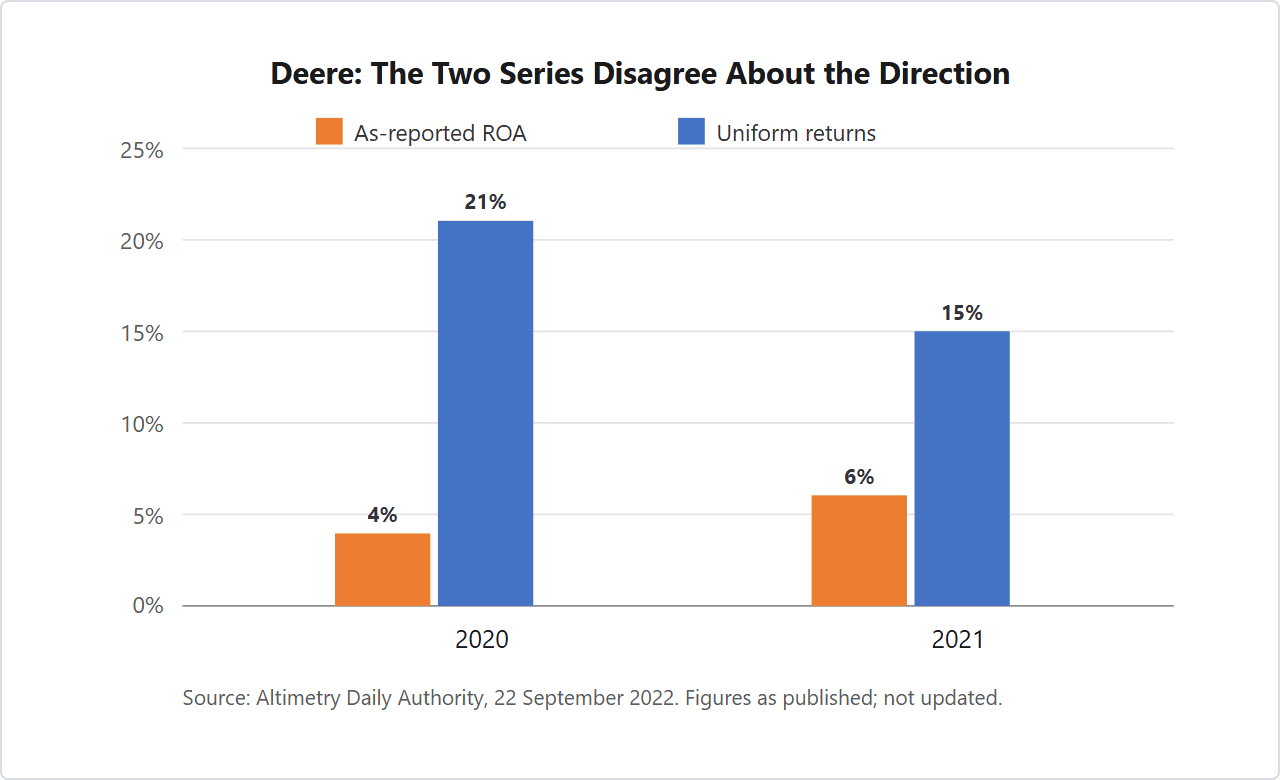
Both can’t be the story. One reads as a weak business improving off a low base, the other as a strong business compressing off a high one, and an advisor working from the reported line alone would have had the direction backwards. “Returns are improving” stops being a finding and turns into a question.
In practice that is a small change of habit with a large effect. When an asset-heavy company posts improving reported returns, check if operations improved or the assets aged. When a screen calls a company mediocre, ask if you’re ranking businesses or accounting policies, and if a Uniform peer set would reorder the list. It’s the same discipline that separates a cheap stock from a value trap, and it depends on having corrected data to hand, which is what a research platform is for.
Key points
- Uniform Accounting adjusts reported financials so companies compare on one basis across years.
- Expensed research, old goodwill, and purchase accounting do most of the work among 130-plus adjustments.
- Net assets shrink as depreciation builds, so a reported return can climb while the business stands still.
- Deere’s as-reported ROA rose from 4% to 6% while its Uniform ROA fell from 21% to 15%.
Uniform Accounting on one company, every morning
FA Alpha Daily applies this to one company, metric, or market signal every morning, free for financial advisors.