
The Trump administration has championed deregulation as a means to promote American companies.
And while this policy stance has proven beneficial to industries such as energy, the same can’t be said for other sectors.
Take the electric vehicle (“EV”) industry for example. In 2022, the Inflation Reduction Act (“IRA”) offered a massive tailwind to the sector, providing incentives for electric vehicle production and adoption.
However, fast forward to 2025, the incentives that propped up the sector and accelerated investments in it have been clawed back, leading to investor skepticism in the market.
While this regulatory shift has put the industry’s near-term future in doubt, some companies have been able to buck the trend, sustaining impressive profitability.
Bus maker Blue Bird Corporation (BLBD) is an example.
The company is one of the major school bus makers that collectively control roughly 95% of the market, alongside Thomas Built and IC Bus, companies owned by Mercedes and Volkswagen, respectively.
What makes Blue Bird unique among the three is that it’s the only pure-play option for investors. Moreover, it’s also the leading manufacturer of buses that run on alternative sources such as propane, gasoline, and electric.
In 2014, only 17% of Blue Bird’s buses were non-diesel, but over the past decade demand for more environmentally-friendly buses has grown. Between 2020 and 2025 alone, the number of EV buses on the roads have grown from 415 buses to more than 5,100 today.
In total, over 60% of the Blue Bird’s sales come from non-diesel powered buses, while that figure stands between 10% and 20% for its competitors.
According to recent estimates, the average school bus age is 11 years, with half the current fleet being 10 years older today. With aging bus fleets set to be replaced with new ones over the coming years, Blue Bird is well-positioned to capitalize on this replacement cycle. And it already has.
During the third quarter of 2025, the company generated revenues of $398 million, up 19% year over year. The improvement in revenue was partly due to higher bus unit bookings, product mix changes, as well as small boost to parts sales.
Furthermore, the company expects its North American deliveries to rise by about 6% annually from 2024 to 2029, with bus sales for 2025 and 2026 expected to grow by 13% and 10%, respectively.
Yet despite these results and the company’s market positioning, investors have yet to realize just how profitable this business is. Uniform Accounting reveals why.
According to as-reported metrics (represented in orange bars), Blue Bird generated only 19% return on assets (“ROA”) last year, slightly above the 12% corporate average and a modest improvement over the 8% ROA it generated in 2023.
However, Uniform Accounting shows the company is far more profitable than as-reported financials suggest. After generating a Uniform ROA of 20% in 2023, Blue Bird vastly improved its returns to 45% last year.
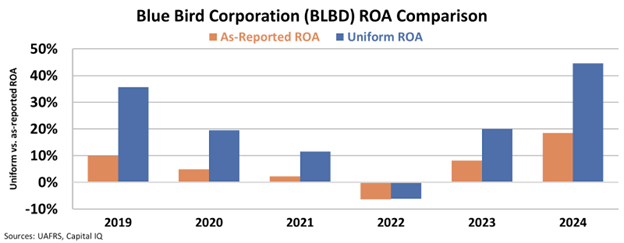
As Uniform accounting has shown, Blue Bird is far more profitable than as-reported financials seem to indicate. And even though it is facing regulatory shifts, these haven’t stopped the company from generating revenues and capitalizing on the bus replacement cycle.
If the company can continue to deliver and maintain its upwards trajectory, then it could warrant upside from investors who catch on to its hidden potential.
Best regards,
Joel Litman & Rob Spivey
Chief Investment Officer &
Director of Research
at Valens Research
Today’s analysis highlights the same insights we share with our FA Alpha Members. If you want to an get in-depth analysis of market trends and uncover undervalued stocks, become an FA Alpha Member today.