Is There a Framework That Corrects Distortions in Filings?
October 22, 2026
Quick answer
Yes. You can put every company on one basis with Uniform Accounting, also called UAFRS, a published framework that adjusts reported statements from the outside. It corrects permitted treatments that differ between filers, among them leases, research spending and depreciation, so comparisons hold.
The common distortions in standard financial statements are not errors. GAAP and IFRS permit a range of choices, and two companies running the same business can make different ones and both be right. That’s what breaks a comparison. It’s also why the fix has to be a framework applied to every company rather than a judgment call about one of them.
Most advisors arrive at this question the same way. You pull return on assets for two companies in the same industry, the figures come back a long way apart, and you can’t tell whether one business is weaker or is reporting on a different basis. The screen has an opinion. You don’t have an answer you’d say out loud to a client.
Why the Fix Has to Be a Framework
The usual advice is to handle it case by case. Read the footnotes, work out your own add-backs, normalize the statements in front of you. Most of what’s written about correcting financial statements teaches some version of that, and on a comparison question it can’t work, because an add-back you build for one company is an opinion about that company. Line two of them up and you’re comparing two opinions.
A framework does the opposite. It applies the same corrections to every company, including the ones you wouldn’t have flagged, and that’s what makes the output comparable. Analysts tend to resist it, since judgment on a single name is the part of the job they’re proudest of. On a cross-company question, uniform beats bespoke.
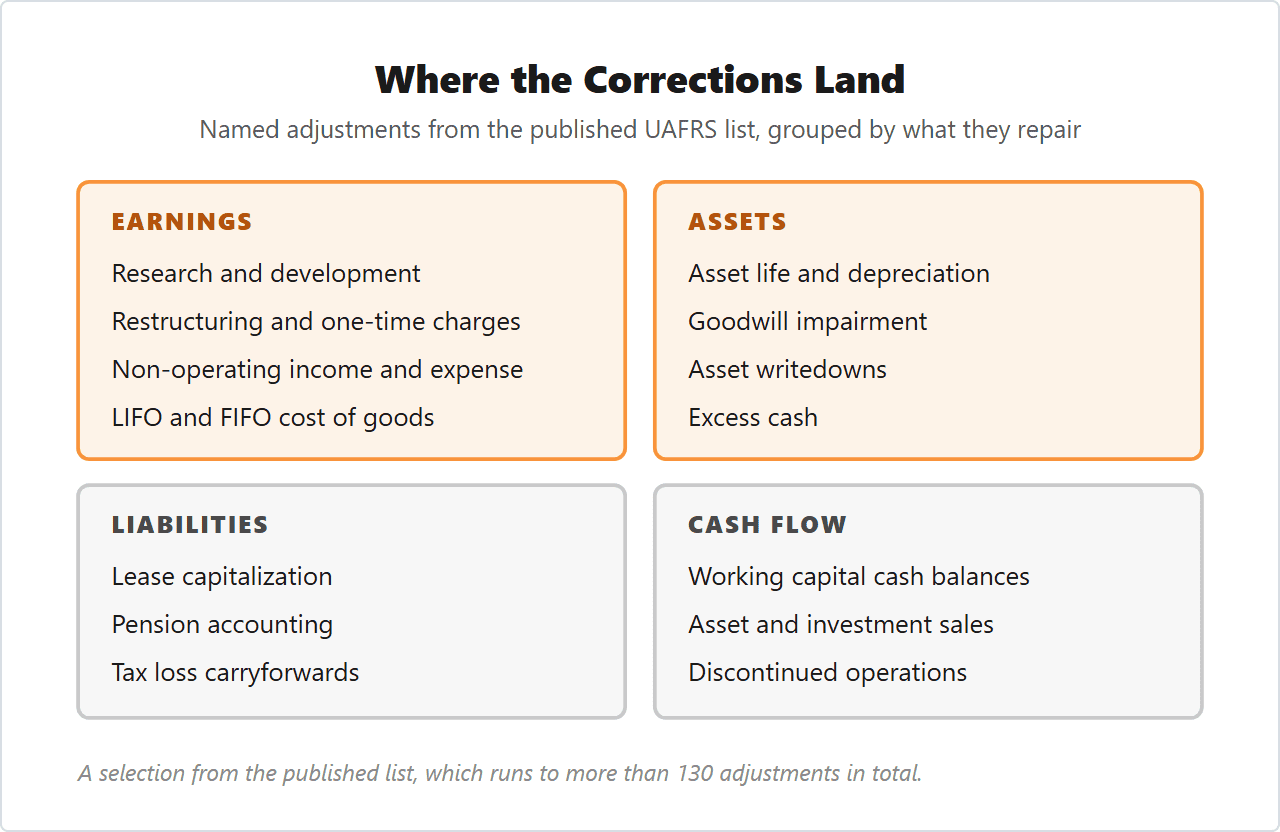
Uniform Adjusted Financial Reporting Standards, or UAFRS, is that framework, and its adjustment list is public. Research shows more than 130 adjustments are necessary to create uniformity in financial reporting standards, according to the published UAFRS methodology. Some of them run mechanically. Standardizing LIFO and FIFO cost of goods is automatic once you know the policy. Others, merger and acquisition accounting above all, still need an analyst reading the filing.
One thing it doesn’t do is ask management for anything. Uniform Accounting adjusts the reported statements from the outside, working from what the company has already filed. Nobody restates a thing. That’s the difference between it and the forensic accounting work that digs into one company’s reporting, which is a different question asked one company at a time.
What Gets Corrected, and What Changes
Three adjustments account for most of what an advisor notices in a screen.
| Distortion | As reported | On a Uniform basis |
|---|---|---|
| Operating leases | Lease cost runs through operating expense | Lease economics treated as an operating asset with a financing cost |
| Research and development | Expensed in full the year it happens | Capitalized, with the cost recognized over its useful life |
| Depreciation | Method and asset life vary by filer | An asset life based charge, adjusted for inflation and asset age |
Leases are the one people get half right. Operating leases have been on the balance sheet since ASC 842, for fiscal years beginning after 15 December 2018, so anyone still calling them off balance sheet is describing 2018. The distortion that survived is on the income statement, where lease cost still runs through operating expense, and in any comparison that crosses 2019 and mixes the old presentation with the new. Our page on what the income statement and the balance sheet each tell you covers why changing one and not the other leaves a gap.
Research spending is a different shape of problem. Expensing it the year it happens treats a long-lived investment as this year’s cost, which pushes down the asset base and earnings together, and it hits hardest at the companies investing most in their own future. Capitalizing it puts the spend where it belongs and recognizes the cost over the years it pays for.
As reported, depreciation is a weak stand-in for what a company spends to keep its assets working, because the method varies between filers and the age of the asset base is ignored. The Uniform treatment calculates an asset life based charge instead, adjusted for inflation and for how new the assets are, so the figure approximates the maintenance spending the business needs.
The rest of the list reaches the parts of a filing that decide a ratio without announcing it, among them goodwill impairment, restructuring and other one-time charges, pension accounting, tax loss carryforwards, and cash held well beyond what the operating business uses. Several change the cash statement, which is usually where an advisor notices first that two peers aren’t describing the same thing. Our page on reading a cash flow statement closely walks through the tells.
Correcting a distortion doesn’t mean flattering the company, and that’s the part that surprises people. Take an illustrative case, not a real one: a decades-old business reports a return on assets near 6 percent, low enough to screen as a company earning less than it costs to fund, and shows a Uniform return on assets (“ROA”) nearer 16 percent once its leases and research spending are capitalized. At the same time, its reported price-to-earnings multiple of about 20 times becomes closer to 28 times. The business looks a great deal better and the stock looks more expensive, both at once.
The screen that flagged a good business as a mediocre one can be run again on one basis, and the ranking either survives that or it doesn’t. You can tell a client why two competitors looked so far apart, in a sentence, without rebuilding either filing yourself. And when a name looks cheap on reported figures, a consistent earnings definition tends to settle whether it belongs on the list of undervalued companies or only screened that way. The UAFRS database is where the adjusted figures live if you’d rather not assemble them by hand.
Key points
- Uniform Accounting, or UAFRS, adjusts reported statements from the outside and publishes what it adjusts.
- Reported statements fail on comparability rather than honesty, so one correction for every company wins.
- Leases, research spending, and depreciation move a screen the most.
- The same adjustment can show a much better business and a more expensive stock.
- Early-stage, discovery-driven, and non-corporate issuers lack the reporting history it needs.
One company, one metric, every morning
FA Alpha Daily applies this to one company, metric, or market signal every morning, free for financial advisors.