
How Can I See a Company’s Return on Capital More Clearly?
October 22, 2026
Quick answer
Check two things before you trust a reported return on capital. Ask how old the asset base is, and whether the company’s research spending is growing or flat. Both move the reported number without the underlying business changing at all, and each pushes in a direction you can work out in advance.
Neither problem is exotic. Depreciation shrinks the book value of equipment a company already owns, so an older plant reports a higher return than an identical new one. Most research spending never reaches the balance sheet, because GAAP requires expensing it as it happens. Uniform Accounting rebuilds both halves of the ratio so the earnings figure and the capital figure describe the same business.
A stock screen ranks accounting before it ranks businesses. Say you sold a holding and you’re screening for a replacement. An old factory ranks above a company that just built a new plant. Two mechanical accounting effects are usually behind that gap. Once you can name them, you can tell which comparisons in the results hold up.
Asset Age Matters More Than Performance Does
Start with depreciation. It reduces the book value of an asset every year while that asset keeps producing at the same rate. Earnings hold roughly steady, the capital base underneath them shrinks, and the ratio climbs on its own. Aswath Damodaran makes the same point in his Return Measures paper, writing that depreciation makes older firms appear more profitable.
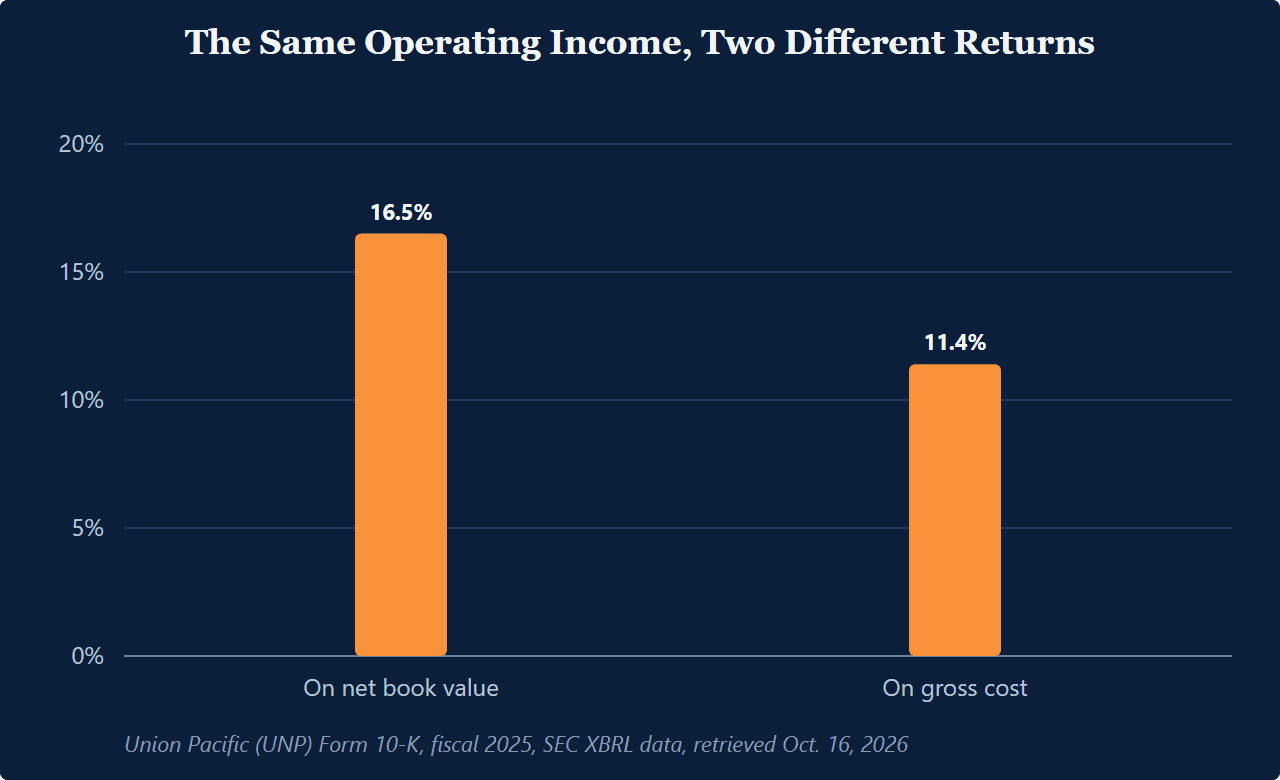
Union Pacific’s fiscal 2025 figures make it obvious. The railroad reported operating income of $9.846 billion. Its property and finance-lease assets cost $86.404 billion, and after accumulated depreciation they carry at $59.645 billion, so $26.759 billion, or 31 percent of cost, has already been written down. Set operating income against the net book value and the ratio is 16.5 percent. Set the same operating income against what the assets cost and it’s 11.4 percent. Nothing about the railroad changed between those two numbers. The depreciated base added five points. Both ratios are pre-tax operating income over property, so neither one is a return on assets, but the gap between them is the gap depreciation builds into any reported return. The figures are from Union Pacific Corp.’s (UNP) annual report on Form 10-K for fiscal 2025, SEC XBRL data, retrieved Oct. 16, 2026.
Valens Research also computes a Uniform ROA for Union Pacific, which rebuilds both halves of the ratio. That figure isn’t shown here.
So check the age of the asset base on your first pass. Compare accumulated depreciation against gross property, plant and equipment. A company late in its depreciation cycle will look more profitable than one that just finished building, and neither number tells you which is the better business. Our page on why GAAP earnings distort profitability works through the same mismatch from the earnings side.
Uniform Accounting is our name for rebuilding a company’s reported statements onto a consistent basis before any ratio is calculated. It handles asset age by normalizing the asset base, instead of accepting whatever point of the depreciation cycle a company happens to occupy. It also replaces book depreciation with economic depreciation, which reflects the maintenance spending a business needs to keep its assets working.
Expensed Research Never Enters the Capital Base
GAAP won’t let a company capitalize research. ASC 730 requires that research and development costs be expensed as incurred. The reasoning is that the future benefit of an R and D dollar is too uncertain to record as an asset. Narrow exceptions exist, for equipment with another use and for software costs after technological feasibility. The general rule holds.
One consequence is permanent. Money spent on research never enters the capital base you’re dividing by, so the reported return comes out higher than the economics support. That’s true whether research spending is growing, flat or shrinking.
The earnings side is the part that varies. While research spending is growing, this year’s charge is bigger than the amortization a capitalized approach would have booked. That pushes the reported return back down. So a company investing heavily can post a return that looks poor, while a company whose research budget has flattened posts one that looks strong. Same rule, opposite appearances.
Check what each company spends on research and which way that spend is moving, before you set two returns side by side. If the two companies differ much on that, the returns aren’t measuring the same thing. Our guide to the income statement and the balance sheet covers how the two line up.
What Uniform ROA Checks
A Uniform Accounting rebuild produces Uniform return on assets (“ROA”). It’s the one return measure we use throughout our forensic accounting work, and it’s built from two categories of adjustment.
On the earnings side, the numerator moves toward the cash the operations generate. Uniform Accounting puts research spending and lease costs back on a consistent footing, and takes out non-operating items such as equity investment income. On the asset side, the denominator is rebuilt to the operating capital the business has deployed. Research and lease assets get capitalized, property is adjusted for inflation, and excess cash comes out.
One shortcut to skip. Cash flow from operations looks like a clean numerator and isn’t one, because it nets working capital changes. A company building inventory shows that build as an operating outflow rather than as the investment it is. So a growing business can look cash-poor for a purely mechanical reason. Our walkthrough on how to read a cash flow statement traces where those swings come from.
Key points
- Depreciation lifts reported return on capital as assets age, so an old plant beats an identical new one.
- Compare accumulated depreciation with gross property, plant, and equipment to gauge asset age.
- ASC 730 expenses research, so a company growing R&D posts a weaker return than a flat spender.
- Uniform ROA capitalizes research and leases, adjusts property for inflation, and removes excess cash.
One company, one number, every morning
FA Alpha Daily applies this to one company, metric, or market signal every morning, free for financial advisors.