
Reading Filings and Earnings Calls
October 23, 2026
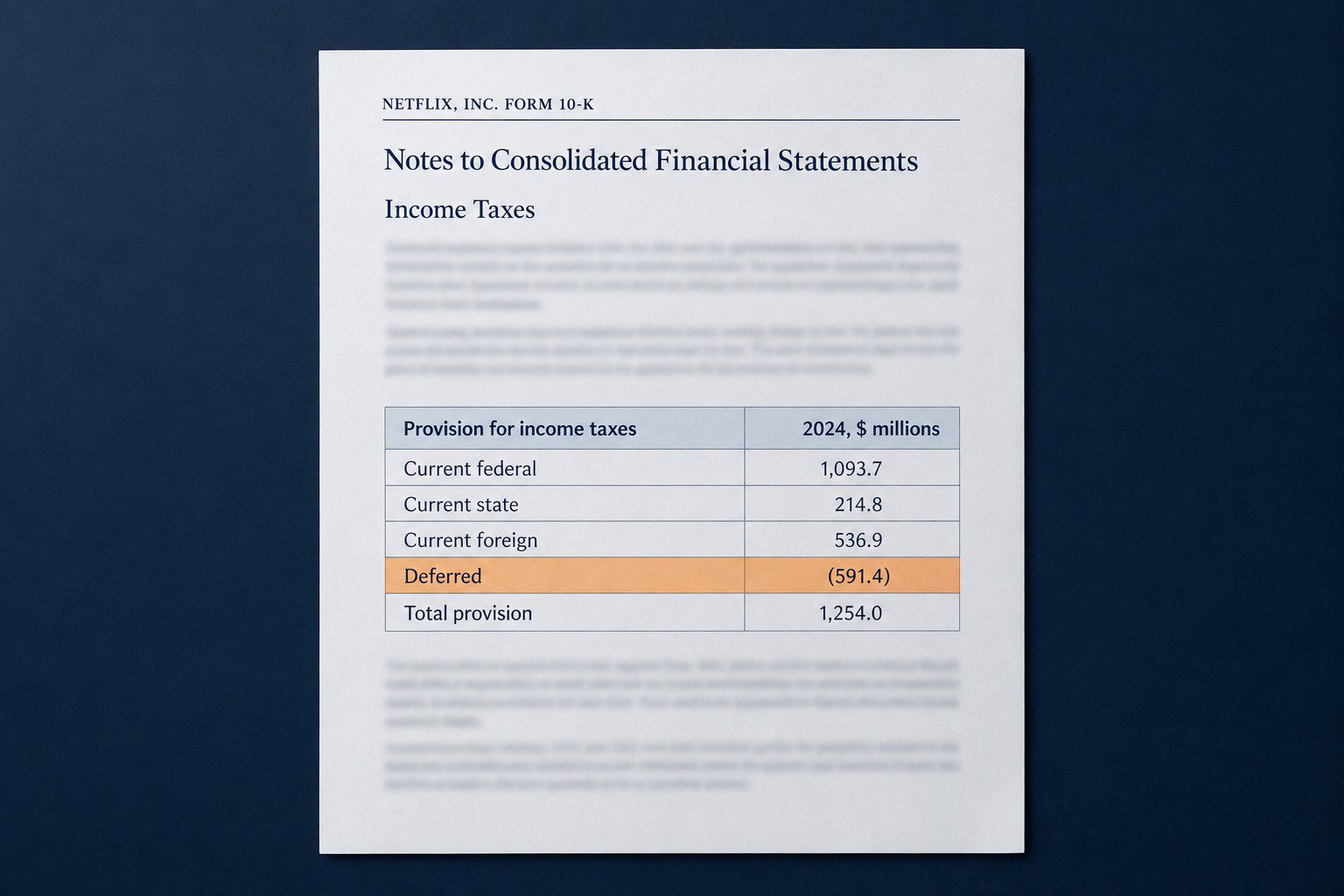
Say a client owns a stock that fell 9% on a quarter that beat, and they want to know why. You’ve got the 10-Q in one tab, the earnings call transcript in another, and maybe 45 minutes before you meet with the client.
Here’s where to spend them. Read the MD&A, the prepared remarks, and any adjusted number the company leads with. Those are management’s account of the quarter. Also review the audited statements and the notes attached to them. Those are your metrics. Reading a filing well mostly means familiarizing yourself with all of those documents. But don’t let management’s account answer a question that only the audited numbers can answer.
Key points
- Treat management’s discussion and Risk Factors as testimony, and trace each claim to something audited.
- Go to Item 8 and its notes for measurement, since the notes disclose the accounting choices.
- Disney beat Netflix on as-reported ROA in 2019, yet Netflix led by a wide margin on a Uniform basis.
- Read the non-GAAP reconciliation line by line, because an add-back that recurs is the run rate.
- Check Item 1B, Item 9, and Exhibits 31 and 32, three 10-K sections most guides skip.
Should You Start with the MD&A?
Every guide says yes, and most call it the most valuable section in the document. The SEC’s own investor bulletin describes Item 7, the MD&A, as the section that “allows company management to tell its story in its own words.”
Read that description again. The section is management telling its own story. That story is worth your time, because nobody knows the business better. But a section built to tell the company’s story can’t also referee how the business performed.
So take what the MD&A gives you. The critical accounting estimates tell you which numbers lean on judgment, and the known trends tell you what management already knows you’ll ask about. Treat both as hypotheses you’ll test in the audited pages.
Risk Factors gets the same read. The bulletin notes that the section covers the risks themselves rather than how the company addresses them. So don’t hunt there for what changed this quarter. Ask a sharper question instead. If one of those risks were already biting, which line of the financials would carry it?
That habit, tracing every claim back to an audited number, is what forensic accounting does all day. An advisor with 45 minutes can run a small version of it.
Where Does the Filing Measure Performance?
Item 8. That’s the company’s audited financial statements, and the SEC’s bulletin adds the line most readers skim past. Those statements “are accompanied by notes that explain the information presented in the financial statements.”
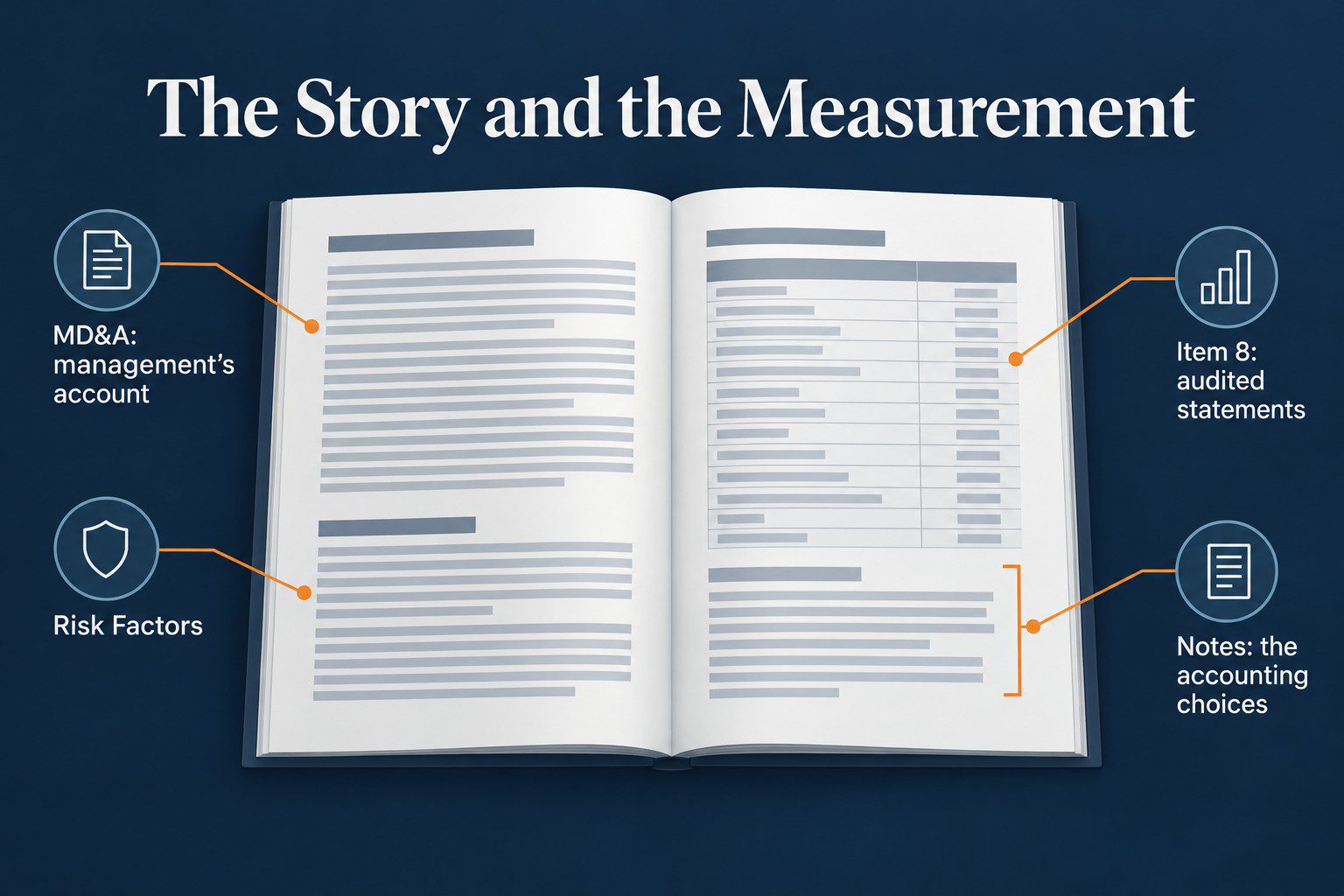
The statement pages are a summary. The notes disclose the accounting choices that built it. Nothing there is hidden. The notes are required, audited disclosure, and they’re where you learn what the income statement and balance sheet are made of.
The notes carry that much weight for one reason. The standards let two companies in the same business report numbers that don’t mean the same thing, depending on how each company got there. Uniform Accounting exists for that problem. It applies over 130 adjustments for material inconsistencies in as-reported statements, so you can compare performance across peers, industries, and time.
And when the clock is running, the cash flow statement is usually the fastest check on whether a beat came from operations or from timing.
How Much Can the Accounting Basis Change the Answer?
Enough to reverse a ranking. As reported in 2019, Disney showed the higher return on assets, close to twice Netflix’s. Disney looked like the more profitable business.
On a Uniform basis, the order reversed. Netflix’s Uniform return on assets (“ROA”) came out well ahead of Disney’s.
Neither business changed between those two readings. Only the accounting basis did. Uniform Accounting removed several distortions to get there, including R&D capitalization versus expensing, stock option expense, and acquisition distortions.
Those readings are seven years old, and they’re cited here as a dated example of an accounting point rather than a view on either stock. The point still holds. Careful reading of two numbers that were never comparable produces a well-defended wrong answer, and a value trap works the same way.
What Do You Do with Adjusted EBITDA?
Go straight to the reconciliation table. Regulation G bars a company from disclosing a non-GAAP measure without the most directly comparable GAAP measure and a reconciliation of the two (SEC Release 33-8176). Inside SEC filings, Item 10(e) of Regulation S-K goes further and requires the GAAP measure to get equal or greater prominence.
The SEC’s bulletin gives you the judgment on purpose. Companies “are permitted to present non-GAAP measures,” they “must also show how they differ from the most comparable corresponding GAAP financial measure,” and “it is up to you to decide how much weight to give to non-GAAP measures.”
So read the reconciliation line by line and let the headline number wait. The table is an itemized list of everything management would rather set aside. An add-back that recurs every quarter for four years has stopped being unusual. That’s the run rate, and the run rate belongs in what you tell the client.
How Should You Read the Earnings Call?
After the filing, and against it. Regulation FD, adopted August 15, 2000 and effective that October 23, made the call open to everyone. The same rule explains why the prepared remarks are the most carefully written document the company produces all quarter. Management knows exactly who’s listening.
So don’t mine the call for facts. Test its claims. When management calls margin pressure temporary, your next stop is the statements and the notes, to see if the disclosures back the word up.
Altimetry runs the same test on the audio itself. “We measure inflections in their speed of speech, tone, hesitation levels, and even changes in ‘breathiness.’ Then we compare that against their spoken words and the numbers.” Read that as a gauge of confidence and conviction. The filing still makes the ruling.
Where Should the 45 Minutes Go?
Toward the short sections nobody assigns. You were never going to read the whole document anyway. The median 10-K more than doubled from a little more than 23,000 words in 1996 to over 49,000 in 2013, so the real skill is choosing.
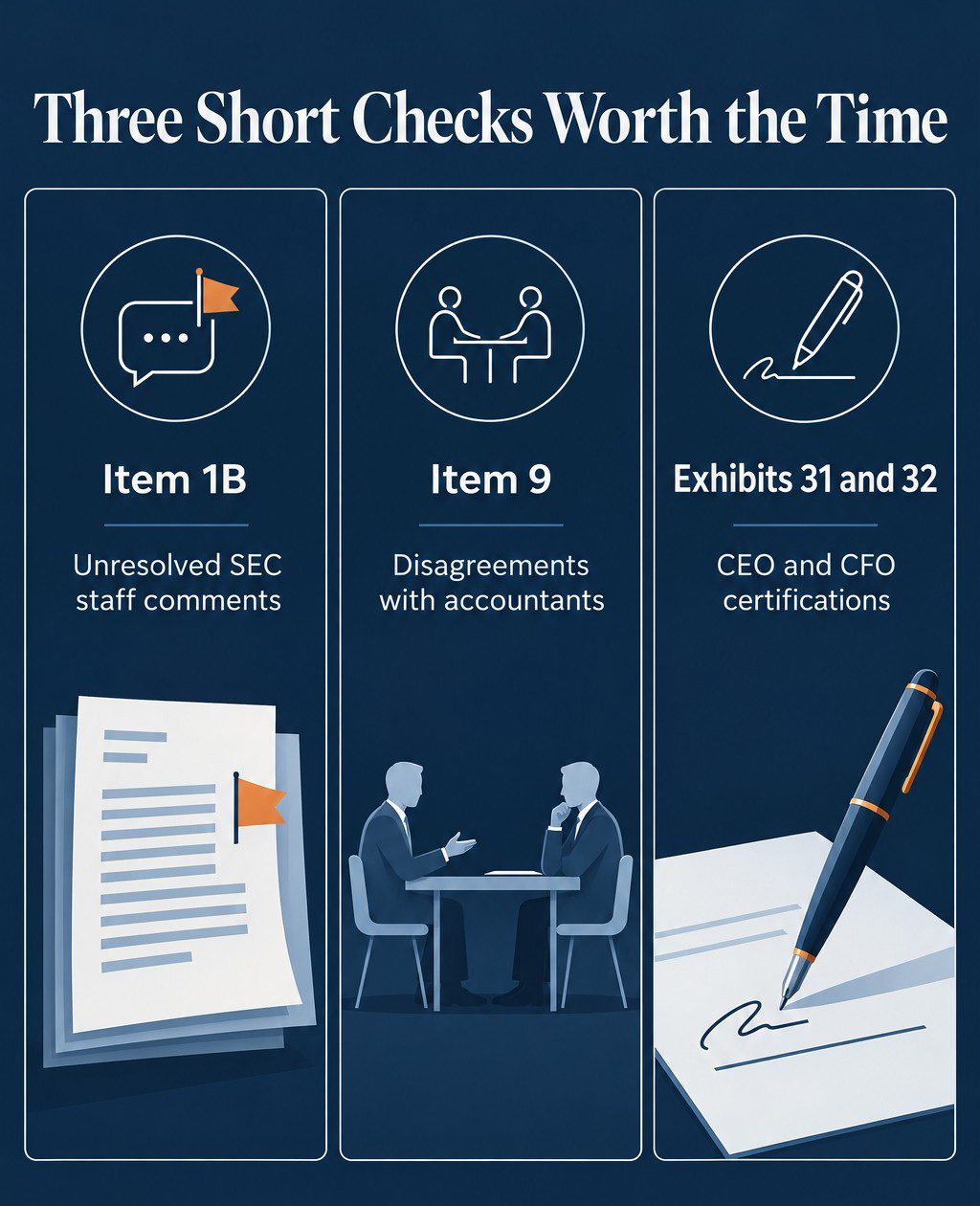
Three checks cost minutes and say a lot.
- Item 1B, Unresolved Staff Comments: The company has to explain SEC staff comments on earlier filings it hasn’t resolved.
- Item 9, disagreements with accountants: The SEC’s bulletin says many investors view this disclosure as a red flag.
- Exhibits 31 and 32: The CEO and CFO certifications required under Sarbanes-Oxley, attesting the filing is accurate and complete.
Then make the call. Did anything in the filing change your read of the risk, or the meaning of the numbers? You’ll come back to the client with fewer adjectives and an answer you can defend.
Do this for every holding across every client and it stops being a reading problem. It turns into a data problem, and that’s the job the research platforms are built for.
Key takeaways
- Read the MD&A, Risk Factors and the earnings call as management’s account, and test each claim against the audited statements.
- The notes to the financial statements disclose the accounting choices, and they’re where two companies’ numbers become comparable.
- Read a non-GAAP reconciliation line by line. An add-back that recurs every quarter is part of the run rate.
- Spend 10-K time on three sections most guides skip, Item 1B, Item 9, and the Exhibit 31 and 32 certifications.
Frequently Asked Questions
Where Should You Start in a 10-K?
With the question you’re trying to answer. For performance, start in Item 8, the audited financial statements, and read the notes with them. The MD&A is management telling its story in its own words, per the SEC’s bulletin, so read it for management’s view rather than for measurement.
Why Don’t Reported Numbers Match Between Companies?
Because accounting standards let identical economics get booked in different ways. Uniform Accounting applies over 130 adjustments for those inconsistencies, which puts peers, industries, and time periods on one comparable basis.
What Is a Non-GAAP Reconciliation For?
For seeing what got left out. Regulation G requires every non-GAAP measure to come with the most directly comparable GAAP measure and a reconciliation between the two. Read the reconciliation line by line, and watch for add-backs that recur year after year.
How Much Weight Should an Earnings Call Carry?
Less than the filing. Regulation FD made the call public in 2000, and the prepared remarks are the most scripted thing a company says all quarter. Take management’s framing from the call, then check it against the audited statements and the notes.
Which Parts of a 10-K Do Most Advisors Skip?
Item 1B, where unresolved SEC staff comments have to be explained. Item 9, which covers disagreements with accountants. And Exhibits 31 and 32, the CEO and CFO certifications that Sarbanes-Oxley requires.
Get one forensic insight like this every day
FA Alpha Daily applies this to one company, metric, or market signal every morning, free for financial advisors.