
AI in Investment Research: Right Math, Wrong Inputs
October 6, 2026
Advisors who already use AI in investment research know it’s very good at reading. That part isn’t in dispute. It’ll summarize a 300-page 10-K and pull the figures you name from it. It’ll condense an earnings-call transcript, find a pattern across thousands of companies, and answer a macro question in words a client can follow. Most advisors already use it. In a Morning Consult survey of 201 advisors in May 2026, reported by Edward Jones, 82% said they already use AI tools in their practice.
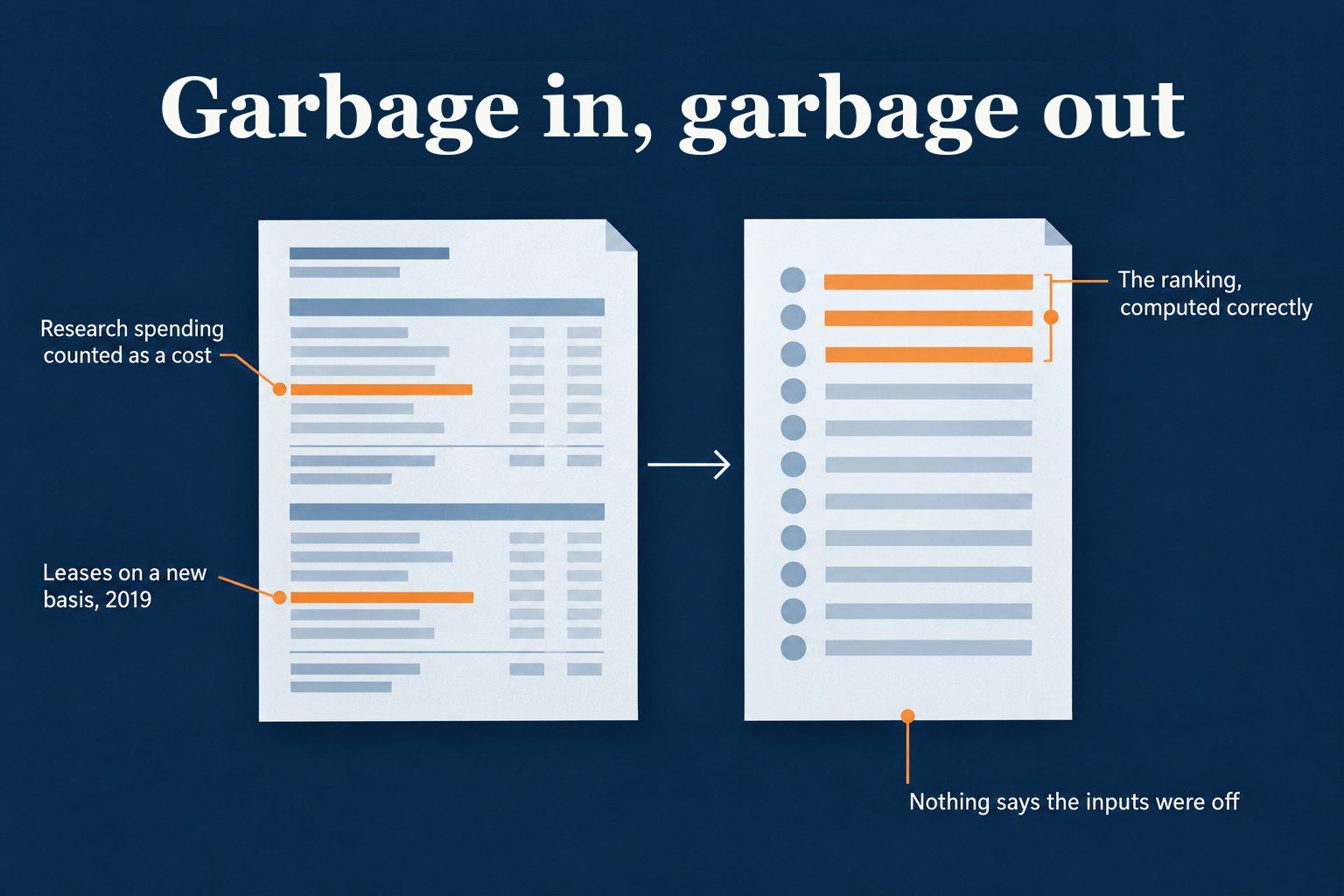
What it’s bad at is narrower than the often-cited hallucination worry. You can always look up an invented number. But a ranking computed correctly from financial statements that the accounting rules distorted before the model read them isn’t fixed so easily. Every ratio ties out, and the ranking still comes out wrong. Below, we’ll show you what to trust, what to check, and what stays with you.
Key points
- In the 2026 surveys, 82% and 63% of advisors use AI tools, mostly for scheduling, notes, and emails.
- The paper that said GPT-4 reads financial statements better than analysts was withdrawn in 2025.
- R&D and lease rules distort the as-reported inputs before any model computes on them.
- You still check the inputs, judge management, and assign someone to argue against the model’s finding.
- The SEC has fined advisers for claiming AI they didn’t use, so say what the tool does and no more.
What Is AI Good at in Investment Research?
AI handles reading and rewriting well, and the surveys show that’s mostly how advisors put it to work. The Edward Jones survey put the top uses at scheduling and meeting prep (59%) and routine client emails (53%). Schwab’s January 2026 study of 533 RIAs found 63% using AI tools in some capacity, concentrated on notetaking and email drafting. Nobody has measured the research use, and that’s the use this page is about.
AI is also good at explaining. Ask it if the Shiller CAPE, price divided by ten years of inflation-adjusted as-reported earnings, overstates how expensive the market is because as-reported earnings understate profits. At about 40.7 by Robert Shiller’s published data for October 2026, the question matters, and the tool will usually give you a sensible answer about the rules counting research spending as a cost of the year. That’s a good use.
Then ask it for the corrected figure. It has nothing to compute from, and the rest of this page is about why.
What Is AI Bad At?
AI is bad at two things. Both are narrower than “AI can’t do research.” Neither is the made-up figure most advisors worry about. The first is the claim you’ve probably heard, that a large language model reads financial statements better than analysts do. The most-cited version is a 2024 University of Chicago Booth working paper by Alex Kim, Maximilian Muhn, and Valeri Nikolaev. It said GPT-4 “outperforms financial analysts in its ability to predict earnings changes directionally” from standardized, anonymized statements. The authors temporarily withdrew it on Feb. 20, 2025, after a co-author “identified inconsistencies in the data” while trying to replicate its results. They wrote that they were holding it back “while we review the research findings.” Vendor pages and conference talks still quote it as if it stood. The headline traveled further than the retraction.
The second is harder to catch than a hallucination because it looks like competent work. Matthew Shaffer of the University of Southern California and Charles C.Y. Wang of Harvard Business School asked GPT-4o to compute a company’s core earnings from its 10-K, the persistent profit from the main business with one-time items removed. Out of the box it made “systematic and significant errors.” It adjusted for interest expense, stock-based compensation, and depreciation, all of them recurring costs. Its output followed the EBITDA-style write-ups that fill its training data “rather than hewing to our provided definition.” A structured three-pass prompt did better. Their conclusion was that analysts can’t fully hand the work to a model, and that trusting the output can introduce errors that are hard to detect.
So the model adjusts the way its training data adjusts, and its training data is as-reported. The computation is clean. The ranking is wrong anyway.
Why the Model Is Right and the Inputs Are Wrong
So where does it go wrong? When an AI tool ranks companies by return on assets, it usually computes the ratio correctly. The failure happens one layer earlier. U.S. GAAP counts economically different things the same way, and it counts the same thing differently before and after a rule change. Checking the formula won’t catch that, because the distortion got in before the model touched the file.
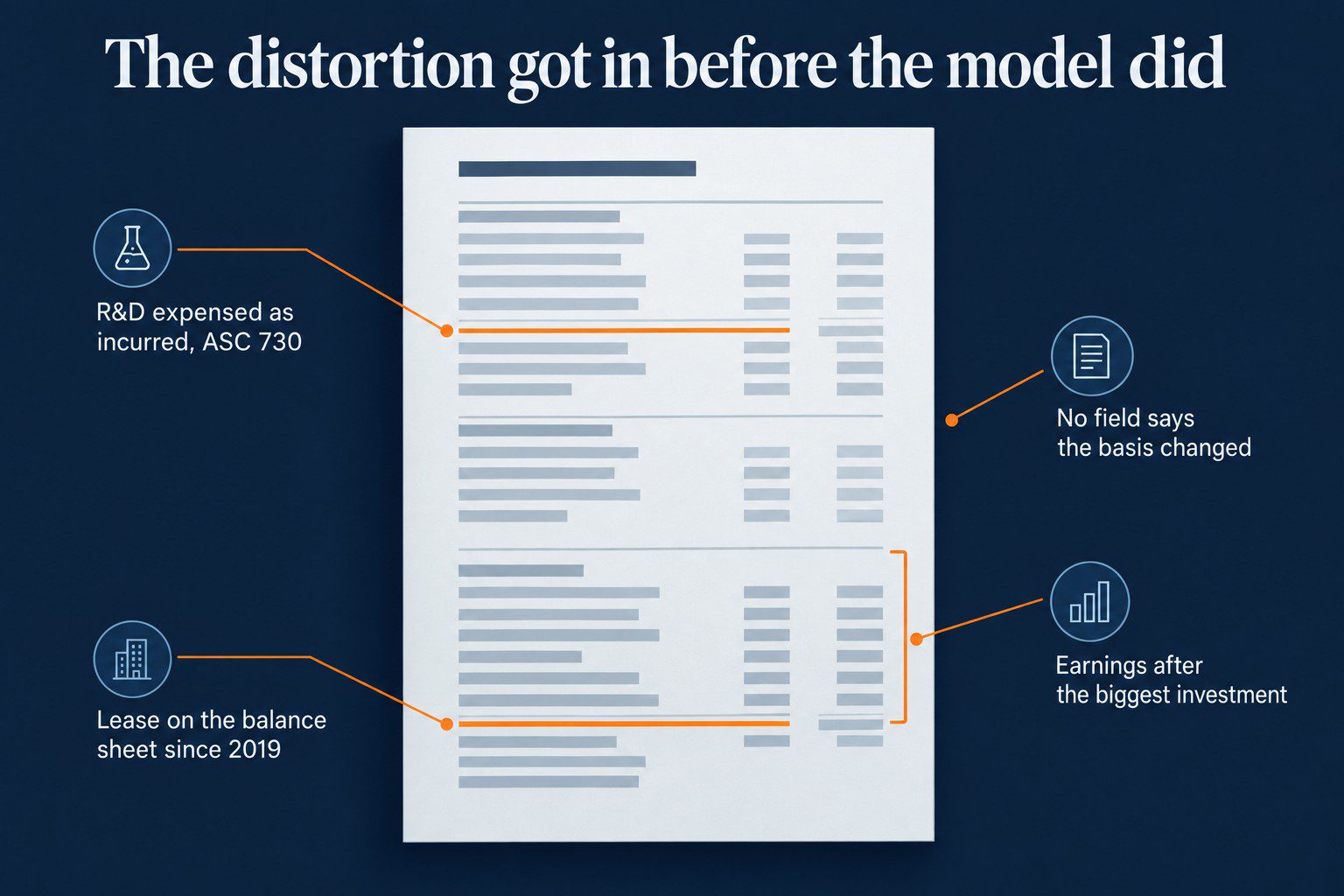
U.S. GAAP requires companies to expense R&D as incurred. So a business that invests heavily in research reports lower earnings for doing so, and a smaller asset base than the economics justify. Any return computed on those as-reported figures counts the investment as a cost of the year. Early in a company’s life, expensing front-loads the cost and pushes the reported return down. Late in its life, a company that cuts research looks more profitable for it. A screen that ranks 500 companies by as-reported ROA ranks the ones that invest in research low and the ones that cut it high, and it computes every ratio correctly. Where research spending goes in the statements decides the ranking before the model sees it.
Leases create a different kind of problem, a change of basis over time. FASB’s ASU 2016-02, Topic 842, effective for public companies for fiscal years beginning after Dec. 15, 2018, says “a lessee should recognize the assets and liabilities that arise from leases,” which put a right-of-use asset and a lease liability on the balance sheet. Topic 842 makes for slow reading, and it moved a lot of balance sheets. Two problems follow for a model. First, one trained on commentary written before 2019 will still tell you an operating lease stays off the balance sheet, which was true under the old rule and isn’t now. Second, the history before 2019 isn’t on the same basis as the history after it, and no field in the data says so. A model works from what companies wrote down and disclosed. The numbers don’t disclose a break in comparability anywhere, so there is nothing in the file for it to notice.
Putting the inputs on one basis is a job in itself. Uniform Accounting is Valens Research’s method, more than 130 adjustments applied to the as-reported statements so every company is comparable before anyone ranks it. Uniform ROA is Uniform earnings divided by Uniform net assets, and R&D expense is among the items it adds back. It adjusts the reported statements, and it never restates them.
So when you ask an AI tool for a ranking, don’t spend your checking on the formula. Spend it on the inputs, and ask if they describe the businesses on one basis. That’s what forensic accounting does, and it’s why GAAP earnings can distort profitability even when every number ties out.
What the Advisor Still Does
You keep four jobs, and the table shows where each one falls. None of them is reading.
| Workflow step | AI is usually good at | Advisor still does |
|---|---|---|
| Document work (10-Ks, transcripts) | Summarizing and pulling out the items you name | Deciding what matters and checking any figure before using it |
| Metrics and rankings (ROA, margins, screens) | Computing the ratio from the inputs it was given | Checking that the inputs are on one basis and the metric matches the definition |
| Management and the business | Organizing the qualitative points from the text | Deciding if you believe management |
| Conclusions from patterns | Finding correlations across large data sets | Assigning someone to argue against the finding |
| Client and compliance communications | Drafting routine language | Owning the judgment, and keeping every claim about AI use accurate |
Before you trust a ranking, check that the inputs are on one basis and that the earnings figure holds up. Decide if you believe management, which a transcript summary doesn’t settle. Decide if the historical pattern still applies, which is a call about the future, and no file contains it. And assign someone to argue against the model’s finding, because a correlation nobody attacked isn’t a conclusion.
Uniform Accounting works less well on early-stage businesses with no revenue and on financial institutions with opaque capital structures. Doing the one-basis work across every holding is a data job, which is why advisors lean on research platforms built for it. The FA Alpha 50 highlights 50 stocks each month on the same Uniform basis, for financial advisors. FA Alpha’s position is that AI won’t replace advisors, and that advisors who use it will replace advisors who don’t.
What You May Say About Using AI
Regulators have already put a price on overstating it. On March 18, 2024, the SEC charged two investment advisers, Delphia (USA) Inc. and Global Predictions Inc., with false and misleading statements about their use of AI. Delphia paid a $225,000 civil penalty and Global Predictions $175,000, and the SEC called the conduct “AI washing.” Chair Gary Gensler put it plainly. “Investment advisers should not mislead the public by saying they are using an AI model when they are not.” In October 2024 the SEC settled with Rimar Capital and its owner for $310,000 in civil penalties over false descriptions of an AI-driven trading platform.
FINRA’s Regulatory Notice 24-09 says the same for member firms. Its rules are “technologically neutral” and apply to generative AI the same way they apply to “any other technology or tool.” Say what the tool does and no more, and have someone read any AI claim on your website or in a deck before it goes out. The rules didn’t change because the tool did.
Key takeaways
- AI is good at reading, summarizing, and explaining, and that’s where most advisors use it today.
- The paper claiming GPT-4 reads financial statements better than analysts was withdrawn for review in February 2025, so don’t cite it as settled.
- A model can compute every ratio correctly on inputs that R&D expensing and the 2019 lease rule already distorted, so check the inputs rather than the formula.
- Say what the tool does and no more, because the SEC has fined advisers for claiming AI they didn’t use.
Frequently Asked Questions
Is AI Good for Investment Research?
Yes, for reading and summarizing long documents and pulling named figures out of filings. It also finds patterns across large data sets and explains a macro question in words a client can follow. The 2026 surveys show most advisors use it, mostly for scheduling, notes, and emails.
Can AI Analyze Financial Statements?
It can compute ratios and rankings from as-reported statements, and it can sound persuasive doing it. It adjusts the way the documents it learned from adjust, which is the as-reported way, so someone has to put the inputs on one basis before the result means what you think it means.
What Are the Risks of Using AI in Investment Research?
The invented number is the risk everyone names, and you can often catch it by looking it up. The one nobody names is a correct computation on inputs the accounting rules distorted before the model read them, because nothing in the output says so. Separately, what you claim about your own AI use is an enforcement matter.
Will AI Replace Financial Advisors?
FA Alpha’s position is that it won’t, and that advisors who use it will replace advisors who don’t. The tool speeds up the reading and the drafting. You still decide what the inputs are worth, if you believe management, and if the pattern still holds.
One company on the numbers, every morning
FA Alpha Daily applies this to one company, metric, or market signal every morning, free for financial advisors.