Advisor Practice Management and Growth: A Working Guide
October 22, 2026
Growing an advisory practice is mostly a time problem and a differentiation problem. Advisors who grow protect their prospecting hours, and they give clients a reason to repeat their name.
Below, you’ll see how to do both. You’ll find out where the hours go, how commentary turns retention work into referrals, and what it means to run your practice like a business you’d analyze.
Key points
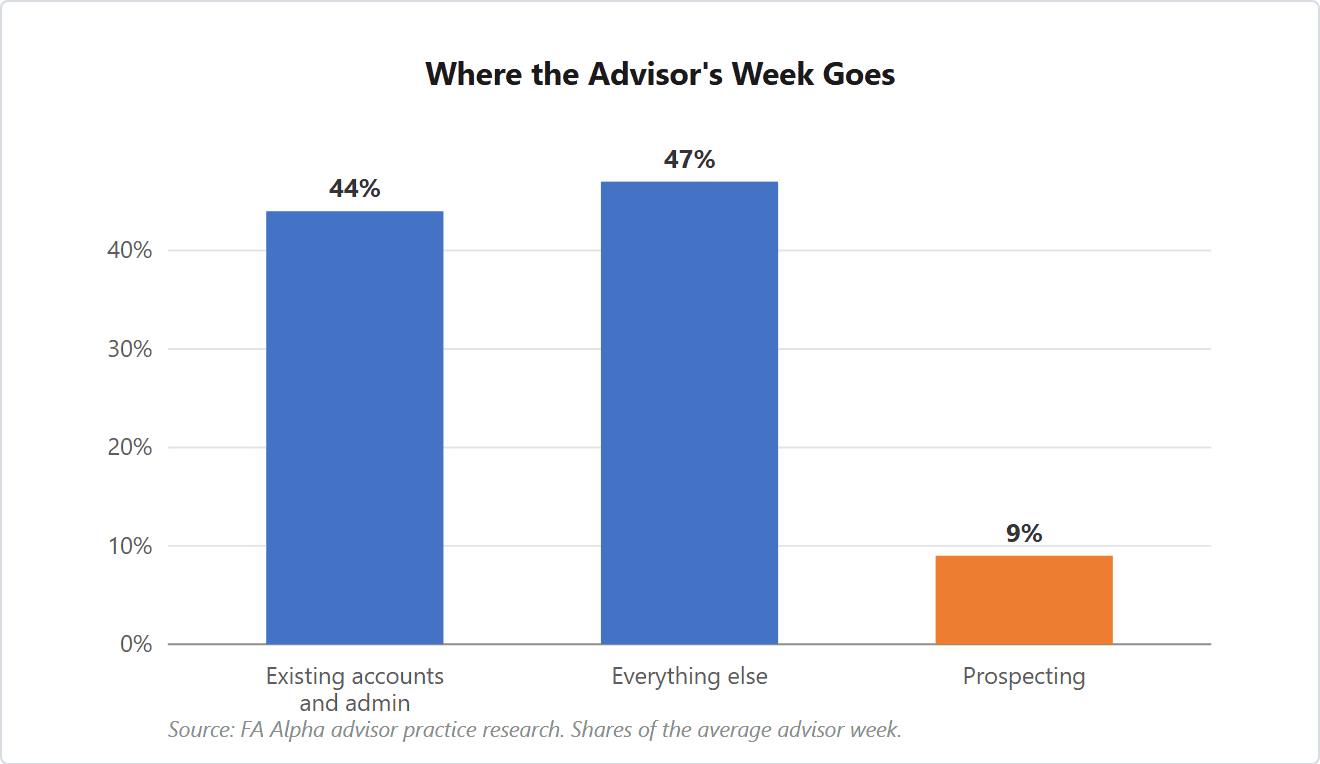
- In FA Alpha’s work with advisors, about 44% of the week goes to servicing and under 10% to prospecting.
- One framework-anchored note lets you tell five nervous clients the same clear thing.
- A view built on Uniform Accounting gives clients something specific to say about you.
- Apply Return Driven Strategy to your practice by naming the unmet need you fill and for whom.
Where Your Week Goes
In FA Alpha’s work with advisors, the average week skews hard toward servicing. Roughly 44% goes to managing existing accounts and administrative work. Less than 10% goes to prospecting.
Outside research agrees on the direction. Kitces Research finds the typical advisor spends no more than about half the week on direct client activity, and barely 20% of it meeting clients. The rest disappears into preparation, follow-up, and paperwork.
Track your week for five days across four buckets. Client servicing, meetings, compliance and operations, prospecting. Then look at what happened to the prospecting block the last time clients got nervous.
If it vanished, the next section is the fix.
The Retention-to-Referral Loop
Retention gets easier when you stop improvising.
Picture a red week where five clients call on the same day. With one framework-anchored note written that morning, you say the same clear thing five times. Each client hangs up with a sentence they can repeat to a friend. That’s the loop. The work that keeps clients becomes the work that brings new ones.
Most of the job in a drawdown is emotional regulation, for the client and for you. A framework makes keeping clients invested through volatility a repeatable job instead of a heroic one.
A consistent market-cycle framework also lets you explain why your positioning changed, or why it didn’t, without sounding like a headline recap. In other words, adding unique macro insight to client conversations does double duty. It calms the client in front of you and arms the referral you haven’t met yet.
Research as Conversational Currency
Consensus commentary makes you interchangeable. When your market take sounds like the headline the client already read, they can’t tell your advice from the last advisor’s. In a drawdown, they’ll shop for reassurance somewhere else.
A differentiated view means you bring numbers and signals your client can’t get from the news. FA Alpha’s version rests on Uniform Accounting and on macro signals read through one framework. Uniform Accounting cleans more than 130 accounting distortions out of reported financials, so companies can be compared on the same basis.
The job of that research in your practice is credibility, never a performance claim. A distinct view gives a client something specific to say about you, which no model portfolio ever did.
You don’t have to build it yourself. Plenty of advisors assemble it from the research platforms advisors rely on. That’s also why FA Alpha publishes FA Alpha Pulse, a macro brief built for these client conversations.
Run the Practice Like the Businesses You Analyze
A prospect sits down, you deliver a polished story about yourself, and they leave with nothing to tell their spouse. The miss is almost always the same. The pitch named your credentials instead of their need.
Return Driven Strategy is the framework FA Alpha applies to companies. It says a business wins by fulfilling an otherwise unmet need for the right customer group, with processes that deliver it over and over. Your practice is a business, and it deserves the same analysis.
So name the need you fill and for whom. Redesign the meetings, notes, and follow-ups that eat your calendar until you deliver that need consistently. And treat your expertise and your process as the genuine asset you’re building, because they’re the one thing another firm can’t copy.
Succession belongs in the same analysis. If most of your book is one generation, keeping the next generation of clients is a decision you make years early, then keep making.
| Practice Move | What It Changes | First Step This Week |
|---|---|---|
| Systematize commentary | Replaces reactive “are we okay?” calls with a repeatable message clients can pass along. | Draft one weekly, framework-anchored note you reuse across calls. |
| Differentiate the research | Gives clients a distinct view built on Uniform numbers instead of consensus recaps. | Standardize the inputs and the framework behind your market view. |
| Fix the pitch | Centers the first meeting on the prospect’s unmet need instead of your credentials. | Open with a question about what felt unclear in prior advice. |
| Protect prospecting time | Keeps growth work from being raided by ad hoc servicing. | Block a recurring prospecting slot and time-track your week. |
Example: Turning 7 Growth Hours Into 12
You don’t need more hours to grow.
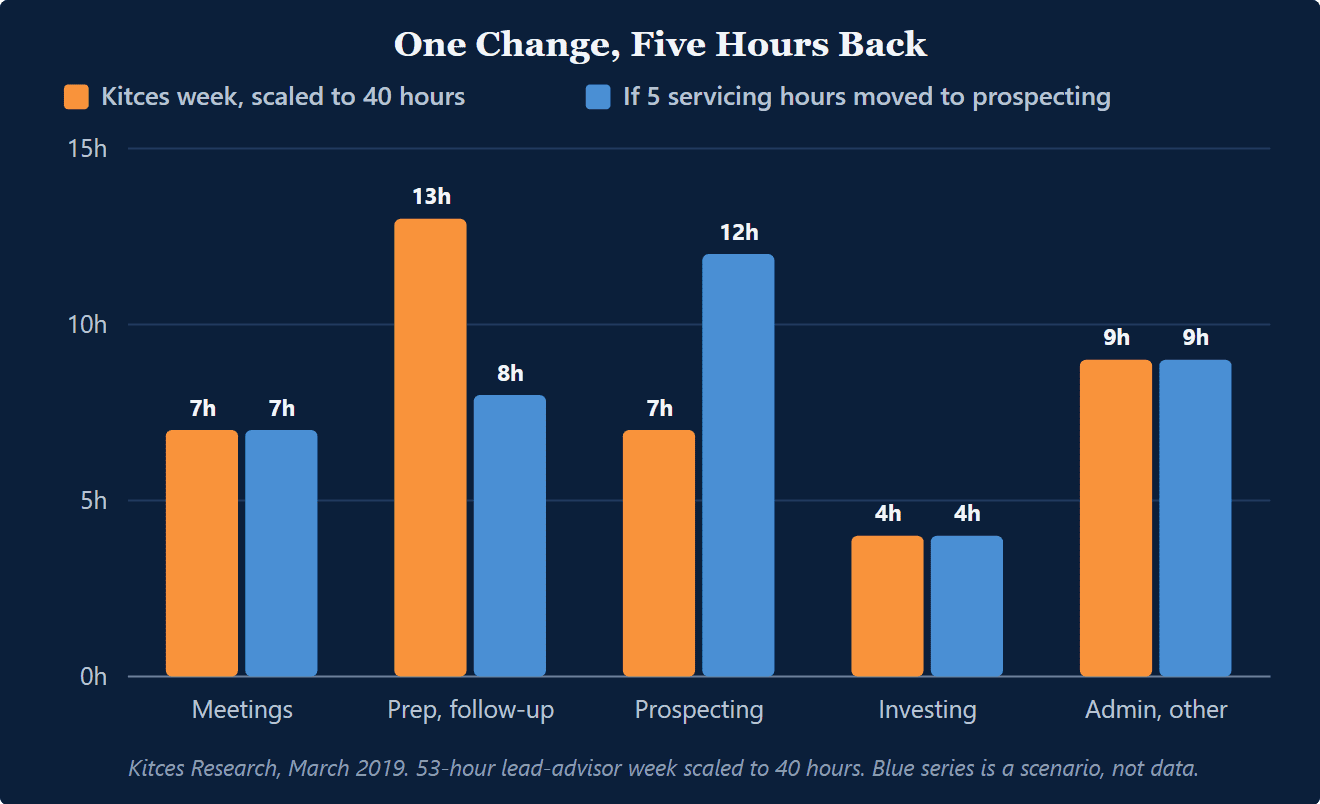
Start with a measured week. In Kitces Research’s time study (March 2019), the average lead advisor’s tasks add up to 53 hours a week. Scaled to a 40-hour week and rounded to whole hours, that is 7 hours in client meetings, 13 on meeting prep, planning work, and client follow-up, 7 on prospecting and business development, 4 on investment management, and 9 on administration, management, and professional development.
Then comes one change. The market commentary becomes a weekly, framework-anchored note, reused on every nervous-client call. If that freed 5 of the 13 prep-and-follow-up hours, and you redirected them, growth time would go from 7 hours to 12 without touching a client meeting.
What to Say When It’s Tense
When the markets drop, you need a repeatable script you can use to soothe your clients’ anxieties. The two statements below can get you started.
A Nervous Client Calls After a Red Week
“Rather than guessing what will happen next week, let me show you what changed and what we’re watching, so we can make decisions on evidence. The worst thing we can do here is let ourselves be guided by headlines.”
A Prospect Asks What Makes You Different
“You’re not hiring a résumé here, but a process. Tell me what felt unclear in your last relationship, and I’ll show you exactly how we handle that.”
Key Takeaways
- Growth is a time-allocation problem before it’s a marketing problem, so measure your week and protect the prospecting block.
- Systematize market commentary so one framework-anchored note serves every nervous-client call.
- Bring a differentiated research view, so clients have something specific to repeat.
- Lead the pitch with the prospect’s unmet need, then show the process you run.
Frequently Asked Questions
What Is Practice Management for Financial Advisors?
Practice management covers how an advisory firm runs its service model, communication rhythm, and calendar. The test of good practice management is simple. Client service and growth stop competing for the same hours.
How Do Financial Advisors Grow Their Client Base?
Mostly through referrals and repeated visibility, and both are built at home. Clients refer when they can explain what makes you different in one sentence. Protected prospecting time turns that word of mouth into meetings.
How Much Time Should an Advisor Spend Prospecting?
There’s no universal number, because capacity, client mix, and meeting cadence all differ. You can control two things. Give prospecting a recurring block on the calendar, and make sure the block survives busy weeks.
What Is Return Driven Strategy?
Return Driven Strategy is a framework for how businesses create wealth. Fulfill an otherwise unmet need for the right customer group, and build repeatable processes that deliver it. Applied to a practice, it means naming the need you fill, narrowing who you serve best, and designing your calendar around delivering it.