
Fed Decision Making Analysis
October 22, 2026
Two days before the Federal Open Market Committee meets, you’re writing the firm’s quarterly client letter. You need something useful to say about the meeting without guessing what the committee will do.
Here it is. A rate decision doesn’t reach a company. It reaches a maturity, which is the date a specific bond or loan comes due and has to be refinanced at whatever the market charges that week. If nothing your client owns has to roll soon, the decision changes the cost of capital on paper and changes nothing about what those businesses can pay.
So the useful version of fed decision analysis is a calendar, and you can build it from filings you already have.
Key points
- Three voters dissented from the July 29, 2026 FOMC hold, so don’t try to forecast the Fed.
- A rate decision reaches a company only when its debt comes due and has to be refinanced.
- Bausch Health reported $9.6 billion of 2025 refinancing without waiting on the Fed.
- Start with the issuers that have the least refinancing access, and work toward those with the most.
- Set each holding’s next two to three years of maturities against the cash it generates and holds.
Don’t Forecast the Fed
Start with the committee.
On July 29, 2026, the FOMC held the target range at 3-1/2 to 3-3/4 percent. It wasn’t unanimous. The vote was 9 to 3, and Beth M. Hammack, Neel Kashkari and Lorie K. Logan voted against because they preferred to raise the range by a quarter point. Three of the voters in that room wanted to move in the opposite direction from a hold.
That’s strictly a fact about the committee. It isn’t a signal about the next meeting, and anyone selling it as one is guessing. The narrower and more useful point is this. If the voters who set the rate can’t agree with each other, an advisor who spends Monday morning predicting them has picked a job with no reliable output.
The next scheduled decisions are September 16, then October 27 to 28, and December 8 to 9, 2026. You don’t need a view on any of them to do the work that follows.
Rates Reach a Company When Its Debt Comes Due
Rates matter. They matter in one specific place. And it’s really important to understand this.
Higher rates reach a business when it has to replace debt that’s coming due. Until that happens, the coupon on existing debt is already fixed and the schedule is already set. That’s why two companies with identical leverage can have completely different exposure to the same decision.
There are three key terms here. A debt maturity headwall is a stretch where a large share of a company’s debt comes due in a short window, so refinancing stops being routine. Credit Cash Flow Prime stacks what a company owes each year against the cash it generates and the cash it holds, which turns a leverage question into a calendar you can read. And Uniform Accounting adjusts the reported statements so companies can be compared on one consistent basis. It doesn’t restate anything, and it doesn’t imply management did anything wrong.
Altimetry keeps separating rate moves from recessions for the same reason. As they wrote in Rate Hikes Won’t Force a Recession on August 1, 2022, “Credit destruction is what causes a recession. When a borrower can’t service its debt, it causes a chain reaction.” Rates are the input. Credit is the mechanism, and it only engages at a maturity.
How Big the Maturity Calendar Is
The scale is important here. About $12.4 trillion of rated corporate debt is scheduled to mature globally from 2025 through the end of 2029, and the US carries $5.898 trillion of it.
| What the figure describes | Figure | Scope and timing |
|---|---|---|
| Rated corporate debt scheduled to mature | $12.4 trillion | Global, 2025 through 2029 |
| Speculative-grade share of those maturities | 27 percent, or $3.4 trillion | Global, 2025 through 2029 |
| US share of the total | $5.898 trillion | US, 2025 through 2029 |
| US speculative-grade nonfinancial maturities | $360 billion, then $682 billion | 2027, then 2028 |
S&P Global Ratings Investor Fact Book, “Global Corporate Debt Maturities Through 2029.” Data as of January 1, 2025.
There’s one thing about that table that might elude you. Every dollar in it carries a rating, which means an agency has already published an opinion on all of it. That opinion summarizes how the last few years went for the borrower. The maturity date is the thing that forces a decision, and the balance sheet tells you what still has to be paid.
Bausch Health Moved Its Maturities
Bausch Health Companies (NYSE: BHC) is a great example of this.
Altimetry called this out in This Pharma Company’s ‘Crown Jewel’ Is Up for Grabs on February 20, 2024: “While Bausch has paid back some of its debt in the intervening years, it still sits at $21.9 billion.” That number matters less as a headline than as a schedule.
The debt was built earlier, under a different name. As Valeant Pharmaceuticals, the company grew through acquisitions and price increases from 2013 to 2015, long-term debt topped $30 billion in 2015, and the stock went from $47 at the start of 2012 to more than $250. The Solta Medical spin-off announced in 2021 was never completed, weak IPO markets in 2022 changed the plan, and Bausch + Lomb, the eye-care business, was spun off instead in May 2022.
Altimetry’s Credit Cash Flow Prime view is the part an advisor can reuse. It showed obligations running through 2029 outpacing available resources, with cash flow no longer covering all obligations starting in 2025. That’s what a headwall looks like from the inside, and it reads as a year rather than as a ratio.
The Company Acted Before the Fed Did
Then comes the part that matters most. Bausch didn’t wait for a meeting.
In its results release of February 18, 2026, the company reported “$9.6 billion in total refinancing for the Full-Year 2025, extending near- and medium-term maturities.”
One piece of that was an exchange of senior notes in the fourth quarter. The company said it extended “$1.6 billion in aggregate debt maturities to 2032 from 2028.” A $1.7 billion debt exchange offer ran in the same quarter.
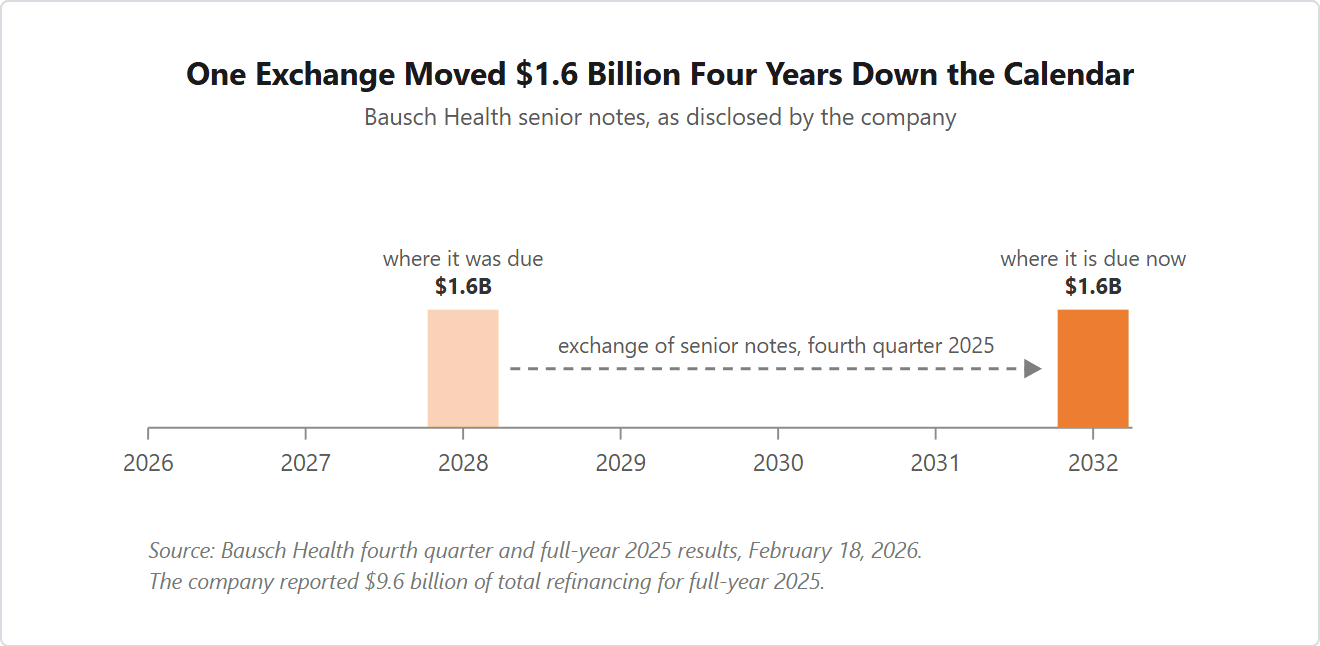
How that turned out for the company isn’t the subject here, and we take no view on it. The mechanism matters. Management reached the maturity before the market did, and once the date moved, the next rate decision met a different schedule than the one Altimetry had charted.
Where to Look First in Client Portfolios
Refinancing pressure isn’t spread evenly, so scanning the names clients recognize is usually the slowest way to start.
Valens made this point years ago. The dates matter, because this is dated analysis and not a forecast. In the US Market Phase Cycle Monitor and Corporate Credit Macro View of April 19, 2018 (p.62) and January 17, 2019 (p.62), the S&P 1500 in aggregate showed no material debt maturity headwall over a five-year horizon. Gross cash earnings matched operating obligations, debt obligations and forecast buybacks, with cash on hand as a cushion.
The smaller-company picture in the same series looked different. The reports of August 22, September 19 and October 17, 2019 (all p.72) found a genuine headwall among S&P 1000 names, where debt service and maturities grew faster than gross cash earnings. Smaller companies also have less access to credit markets, so the same rate does different damage depending on who has to borrow.
That gives you a handy triage rule. Work from the issuers with the least refinancing access toward the ones with the most, rather than from the largest holding down. The macro credit framework sorts the same way.
What to Tell the Client
The calendar is your edge. Before the meeting you can already know which holdings face a refinancing decision in the next two to three years, and which ones can treat the announcement as noise because nothing material comes due.
Run this on a single holding.
- Pull the debt maturity schedule out of the filings and circle everything due in the next two to three years. This is ordinary forensic work, and it lives in the notes rather than the headline figures.
- Set those maturities against the cash the business generates and the cash it holds. Reported operating cash flow carries its own distortions, so treat the cash flow statement as a screen rather than the verdict.
- Look for refinancing the company has already announced. Companies systematically refinance years ahead of a maturity, which pushes headwalls out, as the Valens reports of June 21, 2018 (p.63) and October 17, 2019 (p.72) describe.
What to Say to the Client
Answer the email like this.
“We’re not trading the headline. The smarter play here is to check if anything we own has to refinance in the next few years, because that’s where a rate decision bites.”
“If a holding has nothing coming due soon, the decision may move sentiment, and it doesn’t change what that business owes this quarter.”
“If a holding does have a maturity coming up, we’re watching the refinancing plan, not trying to outguess a committee.”
One caution. The macro version of this analysis leaves out banks, financials and real estate, whose balance sheets work as funding mechanisms rather than ordinary corporate debt stacks (Valens Research, November 13, 2023). It also reads poorly when a large share of the obligations are discretionary, since buybacks, dividends and non-essential capital spending can be cut, so a shortfall on paper isn’t necessarily credit risk (Valens Research, June 1, 2020).
Key takeaways
- A rate decision reaches a maturity. If nothing your client owns has to be refinanced soon, the decision changes the cost of capital on paper and little else.
- The FOMC held at 3-1/2 to 3-3/4 percent on July 29, 2026 by a 9 to 3 vote. A committee that splits three ways is not a committee you can forecast.
- Bausch Health disclosed $9.6 billion of refinancing for full-year 2025, including an exchange that moved $1.6 billion of maturities to 2032 from 2028. Companies act on the calendar without waiting for a meeting.
- Refinancing pressure is uneven. Valens found no aggregate headwall in the S&P 1500 in 2018 and 2019, and a real one among smaller S&P 1000 names in the same reports.
- The check is three steps: what comes due, what cash covers it, and what has already been refinanced.
Frequently Asked Questions
What Should an Advisor Do Before the September 2026 Meeting?
Run the same check you’d run before any meeting. Find which holdings have meaningful maturities in the next two to three years, look at the cash those businesses generate and hold against those obligations, and see if management has already announced refinancing or an exchange. None of that requires a view on the decision itself.
If the Fed Holds Rates, Does Anything Change?
A hold can move sentiment and pricing, and it doesn’t change what a company owes this quarter. At the holding level the question stays concrete. Does this issuer have to refinance soon, and if it does, can it get terms it can live with?
When Does a Refinancing Announcement Matter More than the Fed Headline?
When it changes the maturity calendar, because that calendar is the channel that turns rates into credit stress. If management extends maturities years ahead of schedule, the next decision may change the cost of capital on paper while the near-term picture stays broadly as it was.
Get one forensic insight like this every day
FA Alpha Daily applies this to one company, metric, or market signal every morning, free for financial advisors.