
Why Does a Stock Bounce Sharply When There’s No Good News?
October 20, 2026
Quick answer
A stock bounces sharply with no good news because of positioning, most of the time. Short covering, the end of forced selling, and buyers who were waiting on a price each create demand without any change in the business. The bounce tells you who was positioned how, not that the business improved.
Whether it holds depends on the fundamentals underneath, so check those before treating it as a recovery.
You don’t have to label the move in real time. Treat the bounce as a working hypothesis, and write down what would have to change before you’d call it a turn. This page covers single stocks. A dead cat bounce at the market level has its own page.
Three Mechanics Behind a No-News Bounce
Three kinds of buying can move a stock hard without any news.
| Mechanic | Typical trigger | What it does to price | What it doesn’t tell you |
|---|---|---|---|
| Short covering | Shorts buy shares to close | Fast, mechanical demand | That the business improved |
| Seller exhaustion | Forced selling ends | A pop after the dumping stops | That fundamentals changed |
| Price-based buyers | The stock reaches a watched price level | Demand arrives without news | That new information exists |
Short covering is mechanical buying. A short seller closes the position by buying shares back, and in a heavily shorted name that demand can move the price a long way fast. FINRA’s short interest data shows how large those open positions can get.
Seller exhaustion is the end of forced selling. When margin calls or redemptions force selling, the price can fall past what the business justifies. The rebound starts the moment that supply shuts off.
Price-based buying is the third flow. Some buyers decide in advance what they’ll pay, and a decline through that level fills their orders whether or not anything happened at the company. The demand is real. It just isn’t information about the business.
In a thinly traded, sold-off name, every one of these flows moves the price more than it should.
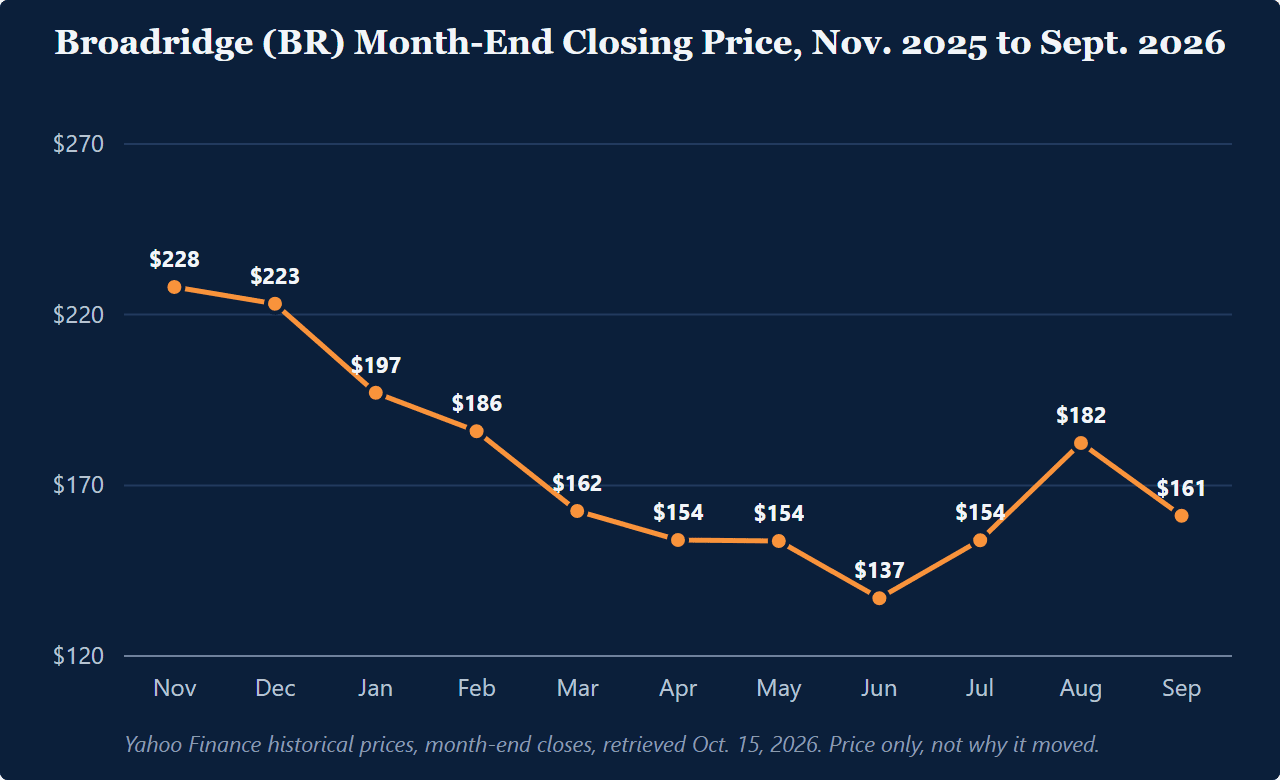
The chart below is a real price path. Broadridge Financial Solutions (BR) closed November 2025 at $228.09 and June 2026 at $136.95, a fall of 40%. It then closed August 2026 at $182.38, up 33% in two months, and September at $161.10 (Yahoo Finance historical prices, retrieved Oct. 15, 2026). The chart shows price only. It doesn’t show why the stock moved. No price chart does.
How to Tell Whether the Bounce Holds
Price alone can’t answer that. You’ve learned who stopped selling and who got forced to buy, and nothing more.
Step away from the chart and check two things. Have consensus estimates stopped falling? And do the company’s underlying earnings support the higher price?
Uniform Accounting is how FA Alpha tests that second question. It’s Valens Research’s method for adjusting reported financials onto one consistent basis. Compare the post-bounce price with the company’s Uniform history to see what the new price now assumes. When the price jumps but the Uniform numbers don’t improve, the story is moving faster than the business. The two bases give different earnings for the same company. Broadridge, the company in the chart, earned Uniform EPS of $11.93 in its most recent fiscal year against as-reported EPS of $9.67 (Valens Research data, Oct. 15, 2026). The earnings a post-bounce price gets measured against change with the basis, so the check uses the Uniform figure.
Give the check a deadline too. A bounce that holds for a quarter while estimates stabilize has told you something. Three green days have not.
A no-news bounce can still mark a real bottom. After forced selling, a stock can trade below what its underlying earnings support, and buying on price alone is how those situations resolve. The guide on how to find undervalued stocks without falling for value traps covers how to tell the two apart.
What to Say to the Client
Clients who see the jump often want to add before it gets away. The bounce becomes a discipline problem. That’s why keeping clients invested through volatility takes a script, and the script should exist before the move.
When a Client Wants to Buy More Because It’s Turning Around
“A 15% jump with no news is usually a flow move. Let’s see whether estimates stop falling and whether the underlying numbers support this price before we change the plan.”
Key points
- Short covering, the end of forced selling, and price-based buyers can each lift a stock with no news.
- A no-news bounce shows how investors were positioned, not whether the business improved.
- Check whether consensus estimates stopped falling and whether Uniform earnings support the price.
- A bounce that holds for a quarter tells you more than three green days.
One company a day, on the numbers
FA Alpha Daily applies this to one company, metric, or market signal every morning, free for financial advisors.