
Whenever an individual applies for a credit card, mortgage, or a car loan, lenders need to know that person’s credit history, and whether he or she has a history of paying back debts on time.
Collecting consumer financial data is a time-consuming and labor-intensive process, that’s why instead of gathering that information themselves, lenders acquire that data from one of the three major credit bureaus in the U.S., namely Experian (LSE:EXPN), Equifax (EFX), TransUnion (TRU).
While TransUnion is often associated with providing lenders with credit reports, it provides other services that enable it to generate profits.
TransUnion operates as a global information and insights company, providing services across five key areas: Credit, Consumer, Marketing, Identity, and Fraud.
Through its OneTru platform, the company provides marketing, fraud prevention, risk management, advanced analytics, consumer engagement, investigative, and communications solutions to businesses, lenders, and other clients.
TransUnion derives its revenue from selling Software as a Service (“SaaS”) solutions and by making its vast pool of analytics data lenders, businesses, and other customers. It also benefits from high switching costs.
Once a customer makes use of its services, switching becomes prohibitively expensive and time-consuming.
TransUnion has leveraged all of this to deliver billions in dollars in revenue over the past several years. It has grown its revenue from nearly $3 billion in 2021 to $4.5 billion in 2025.
The credit bureau’s returns have been strong as well. Since 2020, its Uniform return on assets (“ROA”) have exceeded 20%. Last year, it generated a Uniform ROA of 33% alongside an asset growth of 20%.
Even though TransUnion has delivered above-average returns over the past few years, it currently trades at a below-average Uniform P/E of 14x. The market also thinks its returns won’t improve that much in the next few years.
We can see this through Valens’ Embedded Expectations Analysis (“EEA”) framework.
The EEA starts by looking at a company’s current stock price. From there, we can calculate what the market expects from the company’s future cash flows. We then compare that with our own cash-flow projections.
In other words, the EEA shows how well a company has to perform in the future to be worth what the market is paying for it today.
At current valuations, Wall Street analysts expect TransUnion’s returns to reach 43% in the next two years (light blue bars). However, investors expect the company’s Uniform ROA to dip to 29% by 2030, slightly below what it had delivered last year.
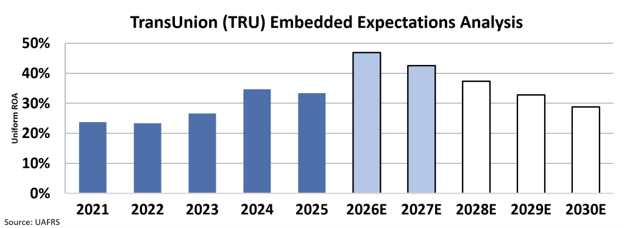
Investor expectations indicate the market appears to be adopting a balanced (if not slightly pessimistic) outlook on TransUnion amid credit cycle uncertainty.
That said, TransUnion’s recurring subscription revenue and expanding data analytics solutions should support earnings growth and enable it to meet, if not exceed, expectations.
Best regards,
Joel Litman & Rob Spivey
Chief Investment Officer &
Director of Research
Today’s article only scratches the surface of what we share with our FA Alpha Members. If you want to get an in-depth analysis of market trends, uncover undervalued stocks, and more, become an FA Alpha Member today.
at Valens Research