
Food service giant Aramark (ARMK) is known for operating dining halls, arenas, and hospital cafeterias. But lately, it has been feeding a new customer: the crews building AI data centers.
Earlier this month, Aramark signed on to serve a workforce community of up to 4,000 trade workers at a new AI data center in Texas. That means meals around the clock, housekeeping, gyms, and even “resort style” entertainment.
That sounds like overkill for a construction site, but electricians and plumbers are scarce talent so developers have to do what they can to keep them.
Microsoft president Brad Smith called the electrician shortage the single biggest obstacle to the company’s U.S. data-center expansion. And Aramark CEO John Zillmer told an investor conference this month that the U.S. could be short about 500,000 skilled laborers by 2028.
For Aramark’s part, it expects $400 million to $500 million in added revenue from data-center contracts in fiscal 2027 and 2028. It has raised its guidance twice this year.
The market has noticed this ascent, bidding shares up 45% this year. It has more than doubled over the past five years.
While these AI-related contracts are a boon for Aramark, there might not be enough runway for its growth to rise higher.
Aramark earns money per person it feeds and houses. So more workers on a site means more revenue. But when construction wraps up, most of the crew moves on and so does all that revenue.
Citi analyst Leo Carrington told Bloomberg that caterers’ data-center revenue is “effectively linear” to headcount. That means as projects near completion, revenue will drop alongside headcount.
Meanwhile, the clock is ticking for data-center caterers. Bloomberg’s research arm expects the whole market to peak at about $3.2 billion per year in 2032 then shrink by half as the building frenzy slows.
Aramark’s revenue peak tops out around $1.2 billion per year in 2033.
Investors are right that data centers brought in some cash for Aramark. But the company already generates nearly $20 billion annually. Even at the peak, these AI contracts would add less than 6% to sales.
So while Aramark is an interesting beneficiary of the AI revolution, we don’t expect to see anything transformative in its numbers.
Investors disagree. They think the business is booming and still has room to grow further.
We can see this through Valens’ Embedded Expectations Analysis (“EEA”) framework.
The EEA starts by looking at a company’s current stock price. From there, we can calculate what the market expects from the company’s future cash flows. We then compare that with our own cash-flow projections.
In short, it tells us how well a company has to perform in the future to be worth what the market is paying for it today.
Aramark’s Uniform return on assets (“ROA”) held steady at roughly 20% from 2014 through 2018. Then the pandemic shut down stadiums and college campuses.
Returns crashed to 4% in 2020. They’ve been climbing back ever since, reaching 15% last year. Wall Street analysts expect Aramark to hit 17% this year and 20% next year (light blue bars).
That’s already an impressive rebound. But at today’s price, investors expect Aramark’s Uniform ROA to reach 21% by 2030.
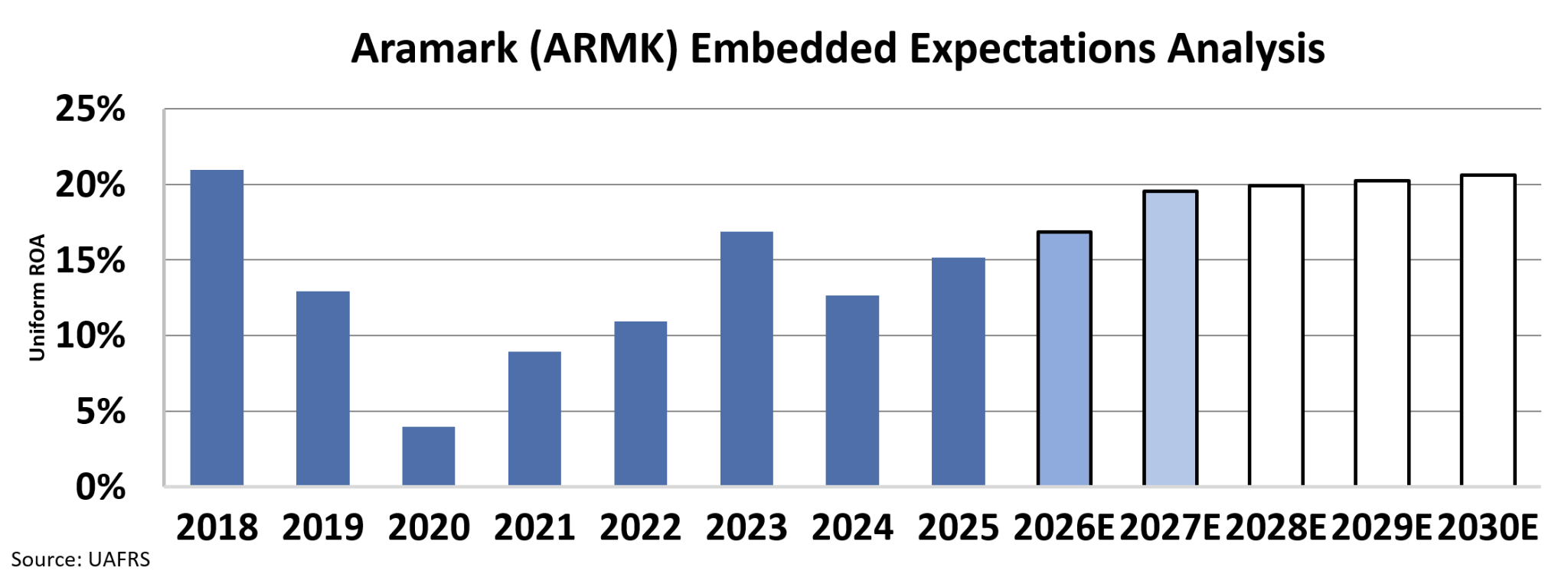
In other words, the market is assuming analysts are right about their projections for the company in the next two years. They’re also convinced Aramark will hold onto those gains even after data-center crews go home.
Aramark’s remarkable growth won’t carry on forever. Its data-center revenue represents only a small slice of a $20 billion business.
After a 45% run this year, Aramark’s stock is priced for far too much. Its AI boost won’t be enough to carry it back to its pre-pandemic returns.
Best regards,
Joel Litman & Rob Spivey
Chief Investment Officer &
Director of Research
at Valens Research
Today’s analysis only scratches the surface of what we share with our FA Alpha Members. If you want to gain an in-depth analysis of market trends and uncover undervalued stocks, become an FA Alpha Member today.