AI is changing how organizations operate.
Businesses are using it to automate routine tasks, analyze vast amounts of data, and make decisions faster.
The U.S. government is no exception.
Defense, intelligence, space, and civilian agencies are looking for ways to bring AI into their operations.
However, adopting new technology isn’t as simple as buying new software. These agencies handle sensitive information and mission-critical work. They need AI systems that are secure, reliable, and able to work with the technology they already use.
AI adoption is creating an opening for experienced government technology providers, positioning Science Applications International (SAIC) to benefit.
SAIC helps the U.S. government modernize its technology. The company works with defense, space, intelligence, and civilian agencies. It provides services in cybersecurity, cloud infrastructure, engineering, and AI-powered data analysis.
The company has spent years focusing its efforts on these higher-value technology services. It sold its logistics and supply chain business in 2023, leaving it to focus on areas where government customers are investing to upgrade their operations.
AI is becoming an increasingly important part of mission-critical work due to the efficiency gains it brings.
SAIC’s Tenjin platform helps government employees train, test, and use AI models inside secure environments. Its Mission Accelerators also provide ready-to-use AI tools for jobs like computer vision and data analysis.
These tools are already producing results. SAIC says one Tenjin deployment for the Navy’s Electronic Warfare Data System reduced analyst workload by 99%.
SAIC has expanded its capabilities further. Last year, it acquired SilverEdge Government Solutions for roughly $205 million. The business works with intelligence and defense customers across cybersecurity, generative AI, and data analytics.
This acquisition provides SAIC with more exposure to some of the Federal government’s fastest growing technology needs.
These results and strategic moves are paying off for the company.
SAIC’s second-quarter revenue for FY 2027 grew 6% year-over-year to nearly $1.9 billion. Even when acquisitions are excluded, revenue growth still sits at 5%.
Adjusted operating margins also went up 11% through the first half of the year, up 9% a year earlier.
Uniform Accounting shows just how profitable SAIC is. During its 2026 fiscal year, the company delivered a Uniform return on assets (“ROA”) of 65% alongside an asset growth of 16%.
Despite this, SAIC is only trading at a below-average Uniform P/E of 12.4x. This valuation indicates investors expect the firm’s returns to deteriorate in the next few years.
We can see this through Valens’ Embedded Expectations Analysis (“EEA”) framework.
The EEA starts by looking at a company’s current stock price. From there, we can calculate what the market expects from the company’s future cash flows. We then compare that with our own cash-flow projections.
In other words, the EEA shows how well a company has to perform in the future to be worth what the market is paying for it today.
At current valuations, investors expect SAIC to deliver a Uniform ROA of 39% by 2031, well below what it has generated over the past few years.
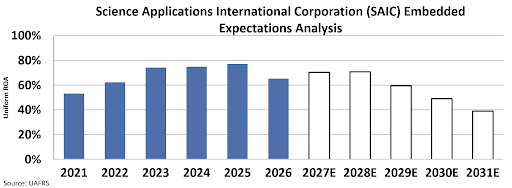
Those expectations are too pessimistic for a company whose margin and revenue is growing and is exposed to growing government expenditure in areas such as AI and cybersecurity.
SAIC already has the government relationships and technical experience needed to compete. All it has to do is to keep working with its customer base to put new tech to work.
If the firm can execute on its strategy, it should be positioned to support earnings growth and outperform expectations.
Best regards,
Joel Litman & Rob Spivey
Chief Investment Officer &
Director of Research
at Valens Research
Today’s article only scratches the surface of what we share with our FA Alpha Members. If you want to get an in-depth analysis of market trends, uncover undervalued stocks, and more, become an FA Alpha Member today.