
Markets can react sharply to new information, especially when it challenges expectations surrounding the biggest names in a booming industry. But before investors rush to reassess a company’s prospects, it’s worth asking whether the underlying business has changed or simply the way its performance is measured. In today’s FA Alpha Daily, we examine what a sudden selloff in AI stocks reveals about the importance of looking beyond reported numbers.
FA Alpha Daily:
Stock Analysis
Powered by Valens Research
Last week, a sales figure and an accounting quirk wiped off $169 billion from Nvidia’s (NVDA) market cap in a single day.
ChatGPT maker OpenAI doesn’t publish financial statements. It isn’t a public company, so investors piece together its sales from leaks and investor pitches.
Then the Financial Times reported that OpenAI told investors its annualized revenue was close to $50 billion.
Annualized revenue, or “run rate,” takes recent sales and projects them out over a full year. That’s about $20 billion less than the figure of nearly $70 billion that had been making the rounds.
Wall Street panicked, and as a result, Nvidia fell 2.9%, erasing roughly $169 billion in market value.
Cloud-database leader Oracle (ORCL), which has big contracts with OpenAI, dropped 5.5%. And the tech-heavy Nasdaq Composite had its worst day since mid-August.
The rationale behind the selloff was simple: If the biggest name in AI is selling less than everyone thought, maybe the hundreds of billions of dollars going into AI chips and data centers won’t pay off.
That said, there’s a deeper story than what the headline suggests.
Last week’s selloff had a lot more to do with how revenue gets counted than with AI demand.
The “missing” $20 billion comes down to one accounting choice.
Companies can count their sales in two ways. Gross revenue is the full amount a customer pays while net revenue is what’s left after a partner takes its cut.
That matters for AI because plenty of businesses don’t buy AI models directly. They buy them through big cloud-computing companies—the same way an individual might buy an app through an app store.
Say a business pays $100 to use an AI model through a cloud partner, and the cloud company keeps $30.
One AI firm might book the full $100 as sales. Another might book only the $70 it keeps.
In other words, same customer, same purchase, yet two totals that are $30 apart.
OpenAI’s chief rival, Anthropic, counts the full amount of sales made through its cloud partners.
OpenAI on the other hand, only counts its share.
So OpenAI’s own investors had been adding the partner sales back in to compare the two companies evenly. That’s where the bigger number came from. OpenAI never reported it.
Meanwhile, the business kept growing. OpenAI told investors its run rate grew 77% in the third quarter. Its sales to businesses grew even faster, at 107%.
This kind of panic selling isn’t new.
In 2011, daily-deal site Groupon (GRPN) was getting ready to go public. Its first filing showed 2010 revenue of $713 million.
That counted the full price of every coupon it sold, even though a big chunk of that money went straight to the restaurants and spas offering the deals.
A few months later, Groupon switched to counting only its cut. Its 2010 revenue fell to $313 million overnight. But its costs fell by the same amount, so its profit didn’t change.
The deals were the same. Only the yardstick moved.
OpenAI’s news is the same type of change. And the market’s reaction was far out of proportion to it.
Take a look…
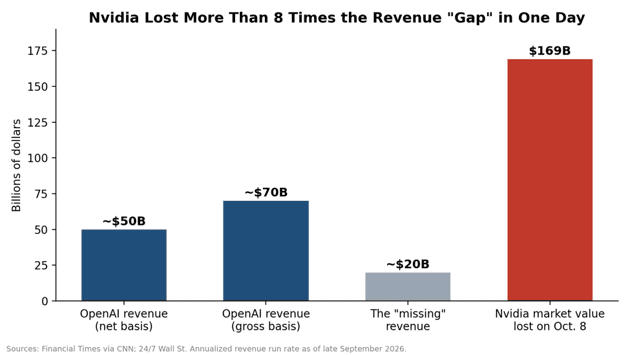
In one day, Nvidia alone lost more than 8 times the revenue that supposedly went missing. And none of that revenue went anywhere.
The market seemed to figure that out fast, so by Friday’s close, the Nasdaq had won back about half of Thursday’s drop.
Last week’s reporting of revenue knocked hundreds of billions of dollars off AI stocks. The demand behind the number is still growing fast.
This happens more often than most investors realize. Revenue can be gross or net. Earnings can be by-the-book or “adjusted.”
Every company has room to pick its own rules, which is why we use Uniform Accounting to put every firm on the same footing.
Last week’s selloff offers a valuable lesson to investors each time revenue is analyzed: Was revenue counted the same way as it’s being compared to?
If the answer is no, then it might present an opportunity to capitalize on.
This doesn’t mean AI stocks can’t fall. A real slowdown would show up in hard numbers, like spending cuts from AI’s biggest buyers.
Nvidia’s next quarterly report, where it expects about $108 billion in sales, will be a good test of that.
Best regards,
Joel Litman & Rob Spivey
Chief Investment Officer &
Director of Research
at Valens Research
Today’s analysis only scratches the surface of what we share with our FA Alpha Members. If you want to gain an in-depth analysis of market trends and uncover undervalued stocks, become an FA Alpha Member today.