
Discounted Cash Flow: A Sound Formula, Distorted Inputs
October 23, 2026
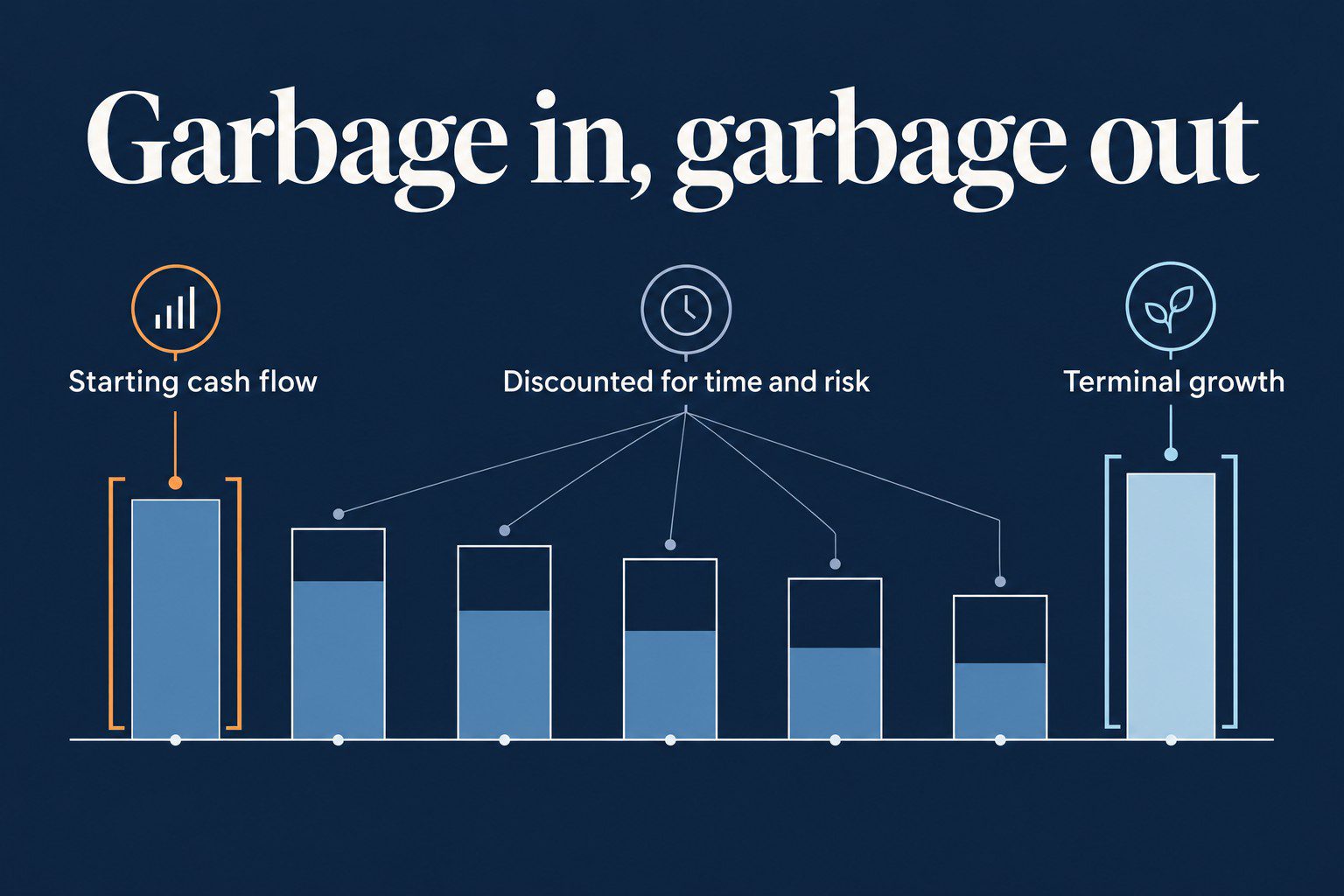
Discounted cash flow is a valuation method that prices an asset at what its expected future cash is worth today, marked down for time and risk. There’s nothing wrong with the formula. The trouble starts when you feed inputs like as-reported cash flow from operations, or a terminal growth rate, to the model. Interestingly, the market already prices in its own forecast.
When you read a price target built on a DCF, the real question is whether the starting cash flow is clean, and whether the analyst’s assumptions differ from what today’s price already implies.
Key points
- From 2006 to 2007, Dow Chemical’s Uniform earnings fell 9% while reported operating cash flow rose 8%.
- Run the DCF backward, holding the price fixed and solving for the Uniform ROA it implies.
- A stock price can imply falling returns even when analysts expect a climb.
- Ask any DCF what cash flow it starts from and how much value sits in the terminal value.
What Is a Discounted Cash Flow?
A discounted cash flow analysis adds up the future cash you expect an asset to produce, with each year’s cash marked down for how long you wait and how risky it is. In equity research, the discount rate is usually the company’s WACC, and the mechanics follow the standard discounted cash flow formula.
DCF = CF1/(1+r)^1 + CF2/(1+r)^2 + … + CFn/(1+r)^n
A DCF never forecasts every year a business will exist. It runs an explicit forecast for a limited period, then collapses everything after that into a terminal value.
What Assumptions Impact a DCF Most?
Most of the value in a sell-side DCF comes from the terminal value. Wall Street Prep says, “Usually, the terminal value contributes around three-quarters of the total implied valuation derived from a discounted cash flow (DCF) model.” That means two long-run inputs, the discount rate and the terminal growth rate, can dominate the valuation even when the year-by-year forecast looks disciplined.
Here’s how much those two inputs matter on a real company’s cash flow. In fiscal 2025, Coca-Cola reported $7.408 billion of cash from operations and spent $2.112 billion on property, plant, and equipment, which leaves $5.296 billion of free cash flow (Coca-Cola annual report on Form 10-K, SEC XBRL data, retrieved Oct. 15, 2026). That operating line already holds a one-off, since the 10-K says it includes $6.1 billion of the final fairlife milestone payment, so take it as a starting input and not a run rate.
Now assume that cash flow grows 3% a year forever and discount it at 9%. Both are stated assumptions, not data, and the 9% is a few points above the 10-year Treasury yield of 5.28% on Oct. 2, 2026 (Federal Reserve Bank of St. Louis, FRED series DGS10, retrieved Oct. 15, 2026). The perpetuity formula gives $5.296 billion / (0.09 – 0.03) = $88.3 billion. Drop the discount rate one point to 8% and it’s $105.9 billion. Keep the 9% rate and raise growth one point to 4% and it’s also $105.9 billion.
One point on either input moves the value 20%, so a price target quoted to the dollar often reflects precision the model never had. This is a sensitivity run on one company’s reported cash flow, not a valuation of Coca-Cola.
Check the Starting Cash Flow
A DCF is only as credible as the cash flow you feed it. The most common mistake is starting from as-reported cash flow from operations. Valens Research puts it bluntly, writing, “Many use the statement of cash flows (such as ‘cash flows from operations’) for judging earnings quality, measuring performance, and as key elements of discounted cash flow analysis. The cash flows reported from operations, however, are not truly from operations.”
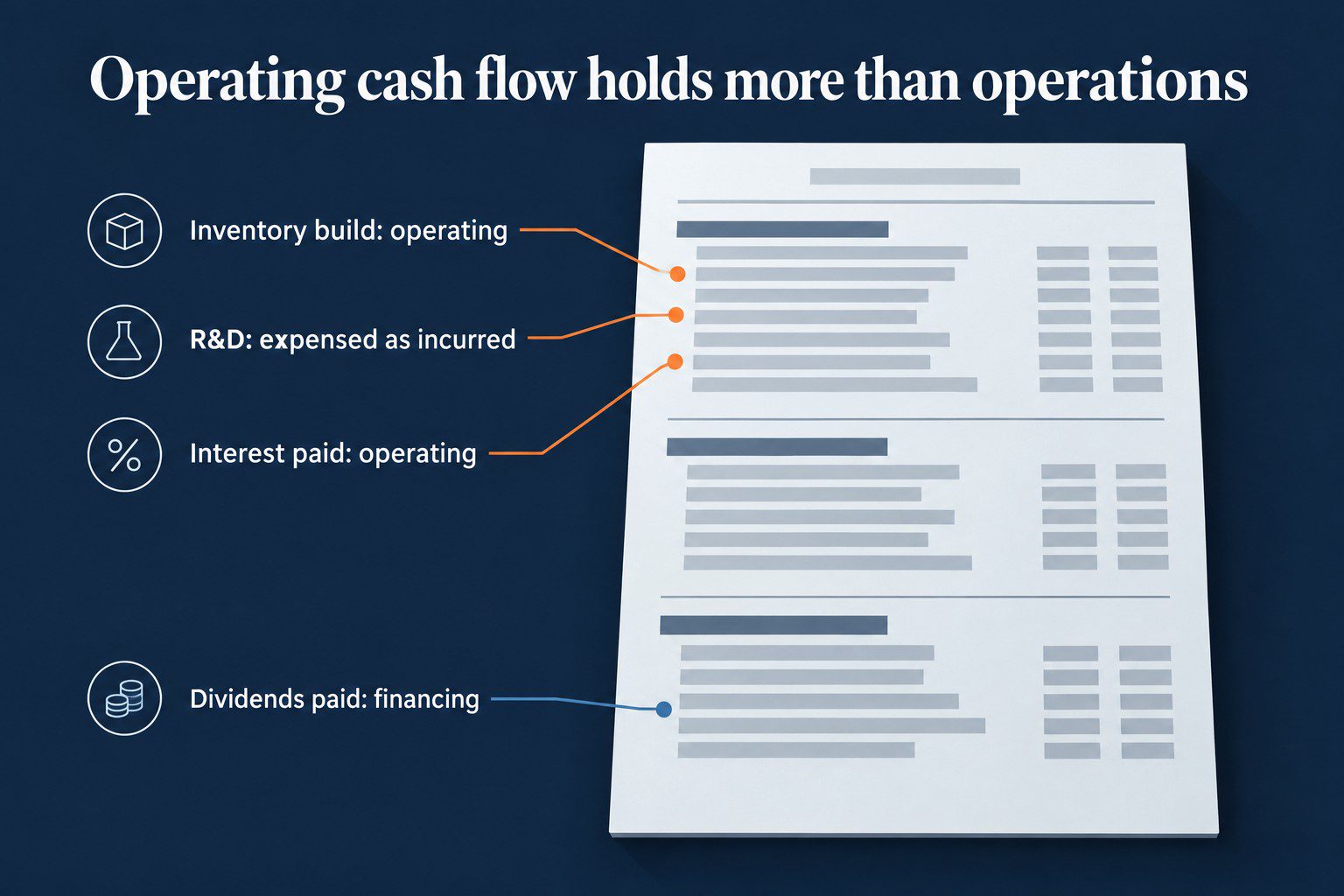
That quote describes what U.S. GAAP requires the cash flow statement to call operating, and it says nothing about how any management team behaves.
Why Does Working Capital Count Against Operating Cash Flow?
Working capital is the first distortion. Valens writes that under GAAP, “an increase in working capital, such as inventory, is seen as a negative operating cash flow,” and it’s “treated more like an expense.” Building inventory or receivables puts capital into the business to support sales.
The bigger trap runs the other way. Valens notes that “companies in liquidation can show higher operating cash flows when they are actually disposing of working capital.” If you accept as-reported cash flow from operations at face value, the model can reward shrinkage with a higher starting cash flow.
Why Does R&D Spending Lower Operating Cash Flow?
R&D is the second distortion, because U.S. GAAP requires companies to expense research and development costs as incurred (ASC 730, summarized in PwC Viewpoint 8.3). So when a company spends more on future products, reported operating cash flow goes down. And in Valens’ words, “When a business reduces its R&D activities, it will report increasing cash flows from operations.” A DCF that starts from as-reported cash flow from operations can treat investment as underperformance.
Why Is Interest Paid Inside Operating Cash Flow?
Interest is the third distortion. Many advisors assume operating cash flow comes before financing costs. U.S. GAAP, though, classifies interest paid as an operating cash flow and dividends paid as financing cash flows (ASC 230, summarized in PwC Viewpoint 6.7).
Valens calls that split “one of the great mysteries of the common-sense universe.” When you start a DCF from as-reported operating cash flow, you may be mixing operating performance with capital structure.
How Far Apart Can the Two Numbers Get?
Valens gives a concrete case. From 2006 to 2007, Dow Chemical’s Uniform earnings fell 9% while as-reported cash flow from operations rose 8%. If those two lines can diverge that much, the first question is what the DCF treats as operating cash.
Uniform Accounting applies over 130 adjustments to the reported financial statements so you can compare companies on one basis. When you read a sell-side DCF, you don’t need to rebuild anything to check the starting point. You can ask what the model uses as cash from operations, and whether the business puts capital in or takes it out. The base cash flow deserves the same skepticism you’d bring to any line on the cash flow statement when you read it the way a forensic accountant does.
What Does the Current Price Already Assume?
Even a clean-looking DCF can repackage what the market already priced in. Make the market’s forecast explicit first, and any disagreement becomes a claim about the business that you can check.
A forward DCF asks, “What’s this worth?” A more useful starting question is, “What performance does today’s price already require?” Valens writes, “Embedded in every company’s stock price is the market’s forecast for the future performance of the firm.” Those are embedded expectations, the business performance the current price implies before you add your own view.
Most investors still miss the first step when they build a DCF model. They never solve for the current market price to understand the company’s embedded expectations.
Bill Miller, former chief investment officer at Legg Mason, said, “Unless an analyst explicitly addresses the expectations embedded in the stock and then clearly explains how his or her view differs from what the market’s implied expectations are… one can be sure that any relation between the rating and the subsequent performance of the stock is pure accident.”
Running a DCF backward means holding the stock price fixed and solving for the business performance that supports it. Valens expresses that performance as Uniform ROA, return on assets calculated on a Uniform Accounting basis.
A Reverse DCF Example
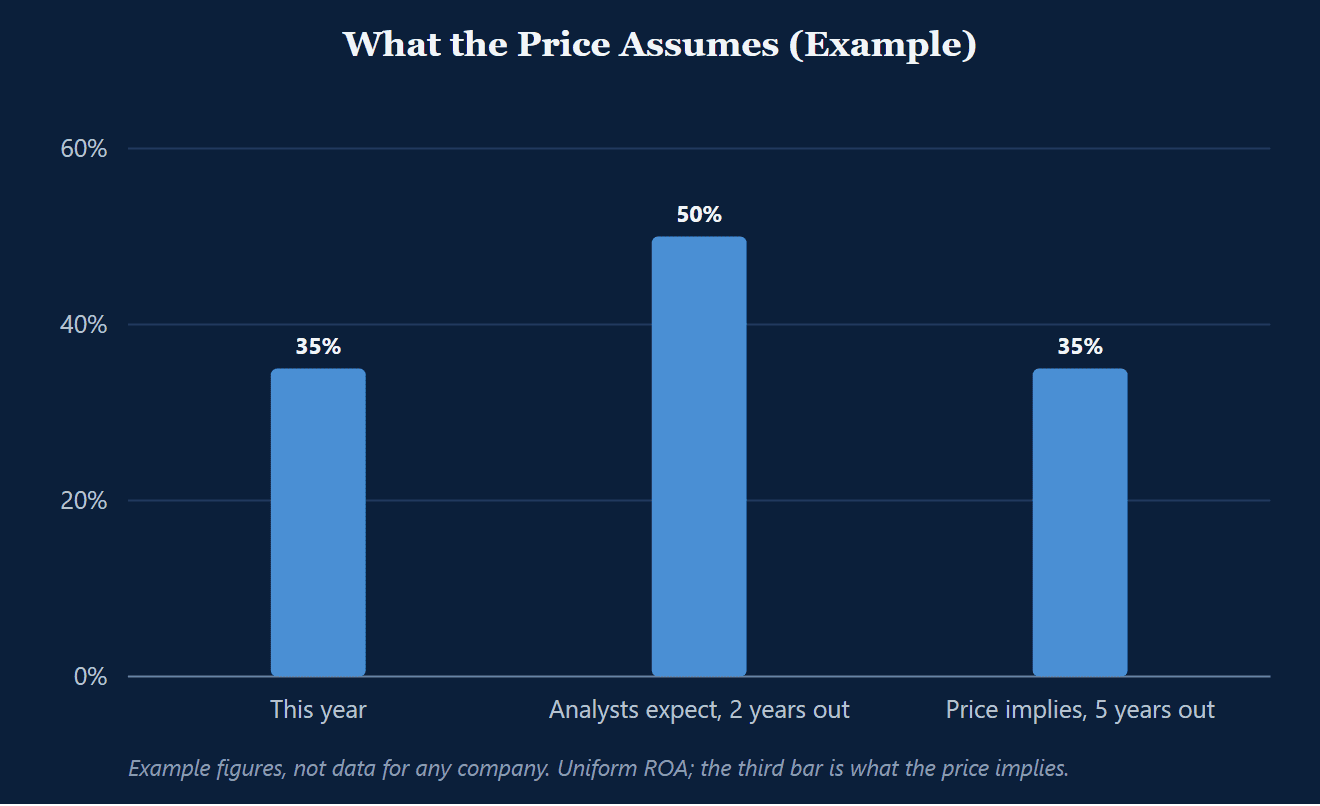
Let’s say a company earns a 35% Uniform ROA this year. Analysts expect 50% within two years, but the stock price implies a return to 35% within five years.
Three Questions to Ask About Any DCF
A DCF-based price target is only as good as the cash flow, WACC, and terminal growth rate behind it.
- What cash flow did it start from, as-reported cash flow from operations or a Uniform basis?
- How much of the value comes from the terminal value?
- What performance does today’s price already assume, and where does the analyst’s forecast differ?
FAQ
What Is the Discounted Cash Flow Formula?
DCF = CF1/(1+r)^1 + CF2/(1+r)^2 + … + CFn/(1+r)^n, as laid out by Corporate Finance Institute. In equity research, the discount rate is usually WACC.
Why Is the Terminal Value Such a Large Share of a DCF?
The model forecasts a limited number of years and collapses everything after that into a terminal value. Wall Street Prep puts that share at around three-quarters of the total implied valuation.
Is Cash Flow Harder to Distort Than Earnings?
Not automatically, because the statement of cash flows follows classification rules, too. Valens Research writes, “The cash flows reported from operations, however, are not truly from operations.” Working capital changes, R&D spending, and interest paid all run through the operating section under U.S. GAAP.
What Is a Reverse DCF?
A reverse DCF holds today’s stock price fixed and solves for the business performance that price already implies. Valens and Altimetry call the result embedded expectations.
FA Alpha Daily applies this to one company, metric, or market signal every morning, free for financial advisors. Get FA Alpha Daily.