How Do Accounting-Based Research and Analyst Reports Differ?
October 5, 2026
Quick answer
An accounting-based research platform adjusts the numbers under one rule set, so you can compare every company on an equal footing. A traditional analyst report gives you one firm’s rating and target, built on the figures the company filed. FA Alpha shows both views, Uniform and as-reported.
This page answers how a proprietary accounting-based research platform compares to traditional analyst reports. FA Alpha Daily, free, puts one company’s Uniform and as-reported numbers in front of you each morning.
What Does an Accounting-Based Research Platform Give an Advisor?
FA Alpha gives you Uniform and as-reported numbers side by side. Uniform Accounting makes over 130 individual adjustments to the reported statements, covering research and development, operating leases, stock options, and goodwill. Every company ends up on one comparable basis. The About Us page says “No ‘star’ analysts. No corporate advisory relationships.”
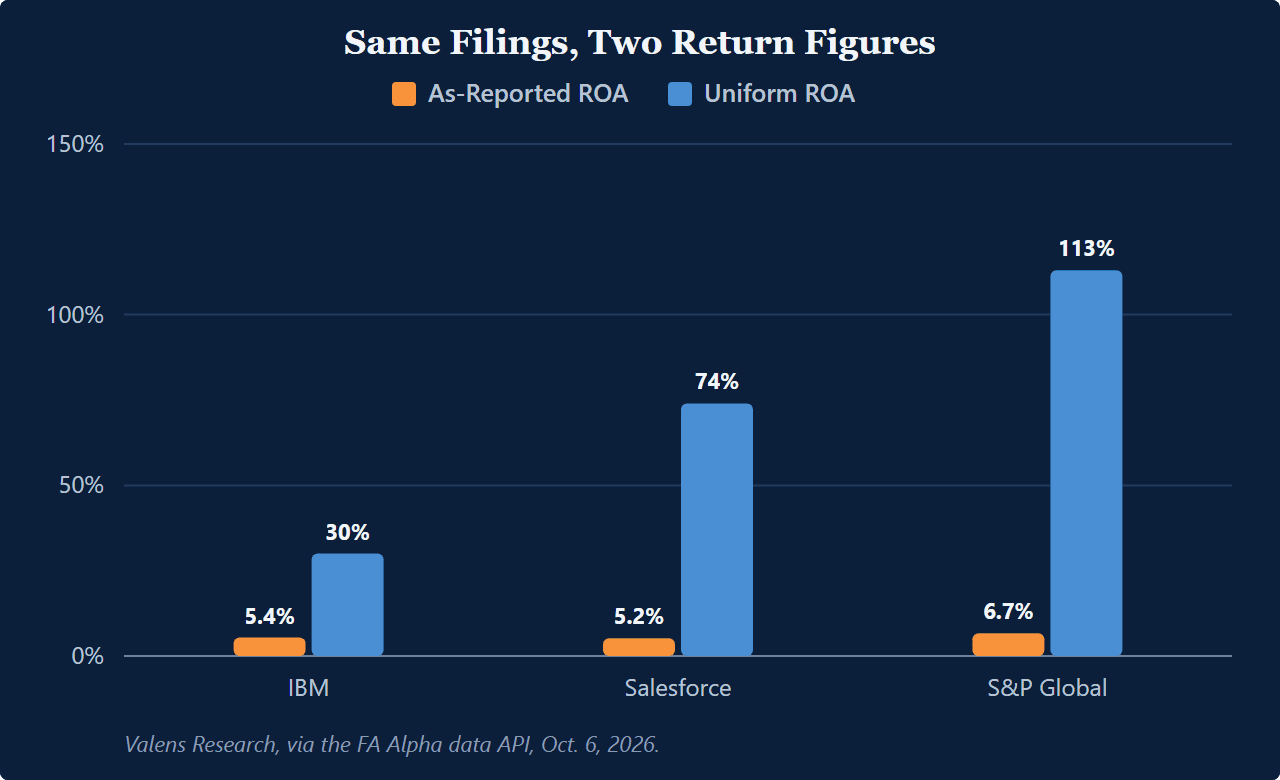
Return on assets shows the size of the input difference, because most analyst models start from what the company filed. In the most recent fiscal year, IBM’s return on assets is 5.4% as reported and 30% Uniform. Salesforce is 5.2% and 74%, and S&P Global is 6.7% and 113%.
The platform doesn’t throw out the analysts’ forecasts. Valens Research says, “We take Wall Street forecasts for GAAP earnings and convert them to Uniform earnings forecasts.” The forecast stays, and the accounting it’s measured in changes.
What Does a Traditional Analyst Report Give You?
A traditional analyst report gives you one firm’s rating and price target, with an earnings model and a written argument behind them, from an analyst employed by a broker-dealer. The model starts from the figures the company filed, and the rating turns that work into a one-word label.
On who pays for that work, the SEC is direct. “Underwriting a company’s securities offerings and providing other investment banking services can bring in more money for firms than revenues from brokerage operations or research reports.” The same guidance says “Brokerage firms’ compensation arrangements can put pressure on analysts to issue positive research reports and recommendations.” In the 2003 settlement, ten firms paid roughly $1.4 billion, $432.5 million of it to fund independent research for their customers.
Under FINRA Rule 2241, a report that carries a rating has to disclose what share of its covered securities the firm rates buy, hold, and sell. Across the market, FactSet counted 13,097 ratings on S&P 500 stocks as of late September 2026, and 59.9% were Buy, 35.5% Hold, and 4.7% Sell.
Where Does Each One Fall Short?
A report’s model starts from the as-reported filings. The IBM, Salesforce, and S&P Global figures above are the size of that difference once the same statements go on one basis. The rating is a firm-specific label, too. In the SEC’s words, “the meanings of these terms can differ from firm to firm.”
FA Alpha has limits too. It’s a research publication from Valens Research, written for advisors, and it isn’t individualized investment advice. Cleaner inputs don’t come with an opinion. Its own FAQ says you’ll probably still need a data platform for charting and proposals, and it won’t replace an analyst’s industry knowledge or a conversation with management. Our page on why Uniform metrics matter more than reported numbers works through the reason the two views differ this much.
The report tells you what one firm thinks and where its target is. The platform tells you what the business earns on one basis, beside what it filed, and converts the analysts’ forecast onto that basis.
Key points
- Uniform Accounting makes over 130 adjustments, covering R&D, operating leases, options, and goodwill.
- IBM’s return on assets is 5.4% as reported and 30% Uniform, and S&P Global’s is 6.7% against 113%.
- FactSet counted 13,097 ratings on S&P 500 stocks in late September 2026, with 59.9% Buy.
- Valens converts Wall Street GAAP forecasts into Uniform earnings forecasts.
One company, both numbers, every morning
FA Alpha Daily puts one company’s Uniform and as-reported numbers in front of you every morning, written for advisors, free.