
Why do Uniform accounting metrics matter more than reported numbers when analyzing a company?
Quick answer
Uniform Accounting metrics matter more than reported numbers because analysis is comparison, and reported numbers put every company on a different basis. Uniform metrics put every company under the same rule set, so a screen or ranking measures the business itself instead of the accounting.
GAAP results are the legal output of accounting choices that vary by company and over time, so any screen, multiple, or ranking built on them inherits those differences.
Reported Numbers Carry Accounting Choices
Two similar businesses can publish different earnings without anyone bending a rule. GAAP gives management latitude on when revenue is recognized, what gets capitalized instead of expensed, what’s labeled one-time, and how acquisitions are recorded on the balance sheet. Each choice is legal, and each one moves the reported number.
Our page on why GAAP earnings can distort profitability covers the five mechanics behind those gaps. The short version is that the distortion runs both ways. Some choices flatter earnings, and others, like expensing heavy R&D, depress the earnings of strong businesses.
That latitude feels academic until you rank a peer set. Sort ten companies on as-reported return on assets (ROA) and you’re partly ranking accounting policy. The comparison looks precise, but the denominator means something different at each company. Most earnings quality work starts from this problem.
Every Multiple and Screen Inherits Its Earnings
A ratio can’t be cleaner than its inputs. A P/E built on depressed earnings makes a strong business look expensive. The same P/E on flattered earnings makes a weak one look cheap. Your screen ranks both with the same confidence.
So judging whether a stock is overvalued starts with verifying the earnings inside the multiple. The price test only means something once the denominator does.
Management’s Adjustments Are Different from Uniform Accounting
Companies publish their own non-GAAP figures, and those can be useful context. They’re still management’s choices, made one company at a time. The SEC’s guidance on non-GAAP measures sets reconciliation and prominence rules, and a figure can follow all of them while remaining discretionary.
Uniform Accounting works the other way around. It applies the same set of more than 130 adjustments to every company. That’s the approach forensic accounting takes one company at a time, applied to the whole market. Nobody gets to choose their own definition of earnings.
Example: The Ranking Inverts
The companies below are illustrative, and the numbers are made up. Ranked on as-reported ROA, Company A leads at 12%, Company B earns 10%, and Company C trails at 8%. Under Uniform ROA, the same three earn 6%, 10%, and 18%. The ranking inverts. A screen built on the reported numbers found the opposite of what was there.
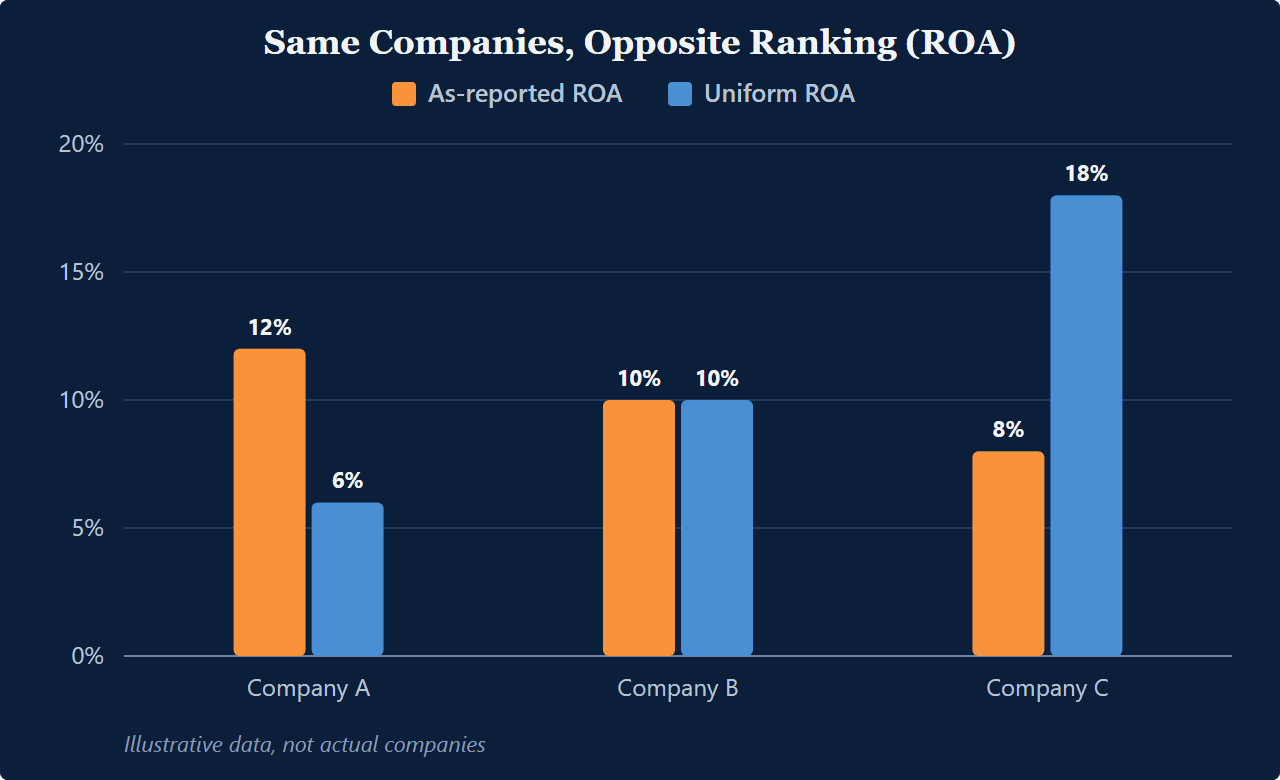
Consistency is the payoff. When the FA Alpha 50 screens the market on Uniform metrics each month, the screen measures every company in the pool the same way before it ranks anything.
What One Rule Set Changes in Practice
For an advisor, three things change. Screens stop rewarding the companies with the most aggressive accounting. Valuation multiples become comparable across a peer set, so a low Uniform P/E means what it appears to mean. And client conversations get easier, because the answer to “why do we own this” rests on a number computed the same way for every holding.
Uniform metrics don’t replace judgment. They give judgment a denominator that holds still while you use it.
Where It’s Less Reliable
The adjustments embed judgment, including useful lives and capitalization schedules. Uniform numbers are a consistent convention, not the one right answer. Financial companies need different measures entirely. That said, when the Uniform and as-reported views agree, the agreement itself is information: accounting choices probably aren’t driving your conclusion.
Key points
- GAAP leaves revenue timing and one-time labels to management, so rankings partly rank accounting policy.
- Management picks its own non-GAAP figures, while Uniform Accounting adjusts every company the same way.
- On Uniform metrics, a low P/E means what it appears to mean across a peer set.
One rule set, every company
FA Alpha Daily applies this to one company, metric, or market signal every morning, free for financial advisors.