On October 5, French energy technology giant Schneider Electric (SBGSY) made the biggest bet in its 190-year history.
Schneider Electric agreed to buy U.S. software maker PTC (PTC) for $22.6 billion, or $205 a share—a 42% premium over PTC’s last close before the deal.
Investors reacted negatively to this acquisition. Schneider’s stock fell nearly 10% following the announcement, wiping out about $17 billion of market value.
Schneider’s share price has continued sliding since then, falling from $68 per share prior to the October 5 announcement to nearly $54 per share today.
Investors have a few reasons behind the negative reaction. First, Schneider acquired PTC for a hefty premium. Second, and most importantly, the French firm bought into software—a sector investors have spent most of this year running from.
That said, a big premium doesn’t automatically make for a bad deal.
Schneider got its start by making fuses and circuit breakers. Today, it sells the cooling systems, server racks, and power gear that keep data centers running. That business is now the main driver of its earnings.
On the other hand, PTC makes software that manufacturers use to design a product on a computer screen, then manage it through production and repairs.
Schneider CEO Olivier Blum, who took over in late 2024, says PTC’s engineering data will help Schneider put AI to work inside its customers’ factories. The deal also lifts recurring software sales to about 24% of Schneider’s total.
The negative investor reaction to the deal was caused primarily by this year’s software panic
Early this year, investors started dumping software stocks. They feared AI tools would let companies replace the programs they pay for every month. Traders nicknamed it the “SaaSpocalypse,” after the software-as-a-service companies at the center of it.
Roughly $1 trillion in software market value vanished between mid-January and mid-February alone.
PTC got swept up in it. Its stock peaked at $217 in August 2025, then bottomed at $112 this June a drop of nearly half.
Schneider stepped in while PTC was still well off its highs. Even with the premium, it’s paying less than PTC traded for last summer. Global investment bank Jefferies (JEF) told clients the sell-off let Schneider buy PTC at its lowest valuation in a decade.
PTC is a far more profitable business than the one buying it. In fiscal 2019, PTC finished moving its customers from one-time license purchases to subscriptions. Since then, steady subscription payments have turned it into a cash machine.
Its Uniform return on assets (“ROA”) climbed from 15% that year to 53% in fiscal 2025. That means it produced 53 cents of Uniform earnings for every dollar of assets.
Schneider is a strong business, too. Its Uniform ROA has stayed between 18% and 26% for the past decade and sits at 24% today, roughly double the corporate average. But PTC earns more than twice what Schneider does on every dollar of assets.
Schneider didn’t pay for growth PTC hasn’t delivered.
We can see this through Valens’Embedded Expectations Analysis (“EEA”) framework.
The EEA starts by looking at a company’s current stock price. From there, we can calculate what the market expects from the company’s future cash flows. We then compare that with our own cash-flow projections.
In short, it tells us how well a company has to perform in the future to be worth what the market is paying for it today.
At current prices, investors expect PTC’s Uniform ROA to land around 51% by 2030. That’s roughly where it sits today. It’s also below the 60% analysts expect for the fiscal year that just ended.
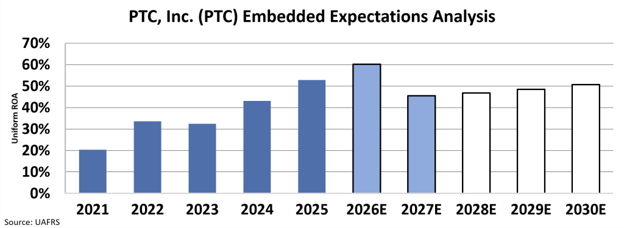
The market expects PTC’s returns to hold steady from here. At these prices, Schneider is paying for the business PTC already is.
Schneider is taking on €16 billion to €17 billion of new debt and issuing €5 billion to €6 billion of new shares to pay for PTC.
However, it bought a business that earns twice its returns, at a price that expects PTC to keep doing what it’s already doing.
In short, this acquisition positions Schneider to become a more profitable company over time.
Schneider’s acquisition of PTC also offers a valuable lesson.
Each time a company is acquired, investors should look past the premium and ask two questions:
- Does the acquisition target earn more than the buyer?
- Does the price require the target to become a better business?
If the answers to those questions are “yes” and “no” then the sell-off isn’t management’s mistake, it’s the market’s.
Schneider has passed that test, and the market hasn’t noticed yet.
Best regards,
Joel Litman & Rob Spivey
Chief Investment Officer &
Director of Research
at Valens Research
Today’s article only scratches the surface of what we share with our FA Alpha Members. If you want to get an in-depth analysis of market trends, uncover undervalued stocks, and more, become an FA Alpha Member today.