
The rapid growth of artificial intelligence is creating greater demand for electricity across the United States. At the same time, rising utility bills have turned energy affordability into a major political issue, putting the power industry under greater scrutiny. In today’s FA Alpha Daily, we explore how political decisions could reshape the outlook for major electric utilities and the broader AI infrastructure expansion.
FA Alpha Daily:
Uniform Accounting Analysis
Powered by Valens Research
Since 2020, prices at investor-owned utilities—which serve about two-thirds of U.S. households—have climbed 34%. At publicly owned utilities, they’re up 19%.
Today is Election Day, and power bills are one of the hottest issues on the ballot. Most of the anger voters feel are directed at the electricity-hungry data centers across America.
Voter sentiment is only half right. It’s the way utilities earn revenue that’s worsening the problem, and that means it’s something utility investors need to watch out for.
Investor-owned utilities get paid to build. Most of these companies are monopolies in their territories. In exchange, state regulators set their prices. A utility can bill customers enough to cover its costs, plus an approved return on the money it invests in its grid and power plants.
The more a utility builds, the more it can earn. Analysts at energy research nonprofit RMI say that pushes utilities to build even when cheaper fixes exist.
Data centers are giving utilities a reason to build more than ever before. Investor-owned utilities now plan to spend at least $1.4 trillion through 2030, up more than 27% from a year earlier. In 2025, they asked regulators for a record $31 billion in rate hikes.
Town-owned utilities like SELCO have no shareholders to pay, so they only need to cover their costs. (SELCO raised bills too, by about $10 a month in June. Fuel and equipment cost more for everyone.)
In short, this pricing model works exactly as designed for shareholders.
This can be seen in three of the biggest U.S. regulated electric utilities: Charlotte-based Duke Energy (DUK), Atlanta-based Southern Company (SO), and Ohio-based American Electric Power (AEP). (National Grid was left out because it’s based in London.)
Their combined Uniform return on assets (“ROA”) climbed every year from 3.2% in 2020 to 4.1% in 2025, its highest level in more than a decade. Meanwhile, the asset base they earn on grew roughly by 36%, nearly matching the jump in their customers’ prices.
These firms are earning a higher return on a much bigger pile of assets. And the market is betting regulators keep approving those spending plans.
We can see this through Valens’ Embedded Expectations Analysis (“EEA”) framework.
The EEA starts by looking at a company’s current stock price. From there, we can calculate what the market expects from the company’s future cash flows. We then compare that with our own cash-flow projections.
In short, it tells us how well a company has to perform in the future to be worth what the market is paying for it today.
These utilities are growing their asset bases fast, about 10% a year according to their own spending plans. Because growth is so fast, the market doesn’t need much from returns, so it’s pricing in a combined Uniform ROA of 3.6% by 2030.
That’s right where analysts expect returns to land over the next two years and below last year’s 4.1%.
In other words, investors are paying for the build-out itself. They’re betting regulators approve every dollar of those spending plans.
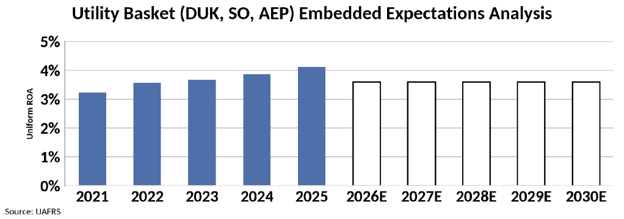
The market expects returns to slip from last year’s high and hold there, while the asset base keeps piling up.
Meanwhile, politicians in both parties are pushing the other way. Massachusetts Governor Maura Healey, a Democrat, wants lawmakers to change how utilities buy power. Pennsylvania’s Democratic governor, Josh Shapiro, told his state’s power companies that “the 20th century utility model is broken.”
Indiana’s Republican governor, Mike Braun, signed a law this year tying higher utility returns to affordability and reliability targets. Duke and AEP both run utilities there.
Data centers created the demand. The regulated-return model turned it into faster bill increases, and the market is betting that model keeps growing at full speed.
The energy infrastructure build-out will push through either way. Regulators will be the ones to determine and approve every dollar of those proposed spending plans while the voters in both parties are the ones who will push back through their representatives in the U.S. Congress.
Best regards,
Joel Litman & Rob Spivey
Chief Investment Officer &
Director of Research
at Valens Research
Today’s analysis only scratches the surface of what we share with our FA Alpha Members. If you want to gain an in-depth analysis of market trends and uncover undervalued stocks, become an FA Alpha Member today.