The growing adoption of artificial intelligence is creating opportunities for businesses that help companies integrate new technology into their operations. ExlService (EXLS) is positioning itself to benefit from this shift, yet investors may still see it as a traditional outsourcing provider vulnerable to AI disruption. In today’s FA Alpha Daily, we examine why the market may be overlooking ExlService’s transformation and the profitability potential of its growing AI business.
FA Alpha Daily:
Uniform Accounting Analysis
Powered by Valens Research
Workforce reductions due to AI are picking up steam.
Take financial technology firm Block (XYZ) for example. In February this year, the company announced a sweeping layoff of 4,000 employees.
Block CEO Jack Dorsey attributed the workforce reduction to AI efficiency gains. He even said he expects other companies will eventually take similar steps to shrink their organizations as AI continues to evolve.
Dorsey’s assessment isn’t entirely wrong. Big firms like Oracle (ORCL) and Amazon (AMZN) have cut headcount partly due to AI. Over the past 12 months, Oracle has eliminated 21,000 roles, while Amazon cut 16,000 jobs in January.
Microsoft (MSFT) has been even more aggressive, eliminating roughly 23,000 roles since May 2025. It also reportedly offered voluntary buyouts to 60,000 employees to free up room for its AI spending plans.
However, the tech industry isn’t the only one facing AI-related disruption. The business process outsourcing (“BPO”) industry is vulnerable as well.
The BPO industry was built to lower costs. Companies save a fortune by hiring workers elsewhere to manage IT support and customer service. It’s easier and cheaper than developing in-house solutions.
As AI continues improving, these back-office roles will become obsolete.
It’s no wonder then that Salesforce (CRM)—the largest customer relationship management company in the world—laid off more than 4,000 of its customer support workers in 2025 due to AI.
While the fate of the BPO industry may look grim, not every company deserves the market’s ire. ExlService (EXLS) is one such example.
To most investors, it’s a legacy outsourcing business ripe for disruption. Yet that’s only part of the story. ExlService uses technology solutions to save clients time and money. And it’s forming a competitive moat that should position it for success in today’s AI-first world.
ExlService has spent years transforming from a traditional outsourcing firm into a data and AI company. That’s why clients now hire it to integrate AI directly into the work it already handles for them, like processing insurance claims, detecting fraud in medical bills, and collecting late payments.
And that shift has started to show up in the company’s results.
In the third quarter, EXLService’s revenue grew 20% year over year to $634 million. Its data and AI-led revenue grew even faster, up 36%. That business now makes up almost two-thirds of the company’s total sales.
Management also raised its full-year outlook. It now expects 2026 revenue of $2.43 billion to $2.44 billion.
EXLService’s is expanding, too. It recently acquired iMerit, a company that labels data and helps train AI models. With that deal, EXL now covers every step of putting AI to work, from organizing a client’s data, to training and fine-tuning models, to running them inside day-to-day operations.
This isn’t a business that AI is replacing. It’s one that customers need in order to use AI in the first place.
Yet investors seem to be ignoring the shift in EXLService’s business. Even though the company’s shares have recovered after falling by nearly 40% in the first half of the year, the market still expects its profitability to drop.
We can see this through Valens’ Embedded Expectations Analysis (“EEA”) framework.
The EEA starts by looking at a company’s current stock price. From there, we can calculate what the market expects from the company’s future cash flows. We then compare that with our own cash-flow projections.
In short, it tells us how well a company has to perform in the future to be worth what the market is paying for it today.
EXLService’s Uniform return on assets (“ROA”) has risen from 28% in 2020 to 44% last year. The company’s shift towards data and AI work has helped it increase profitability.
Yet despite that improvement, investors expect the company’s Uniform ROA to fall to 36% by 2030 even as its high-growth business segment continues to expand.
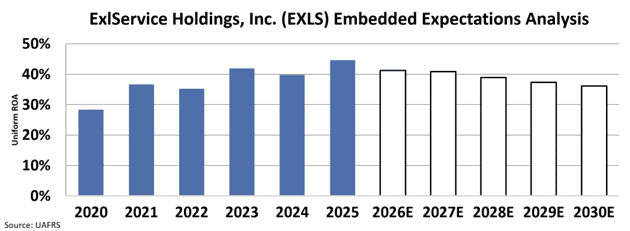
In other words, investors are pricing EXLService as if AI will erode its profitability rather than enhance it.
Its AI business grew more than 36% last quarter, management just raised guidance, and it’s adding the tools to handle every stage of a client’s AI rollout.
When expectations are this low, EXLService doesn’t need to be perfect to reward investors. It simply needs to keep doing what it’s already doing.
Best regards,
Joel Litman & Rob Spivey
Chief Investment Officer &
Director of Research
at Valens Research
Today’s analysis only scratches the surface of what we share with our FA Alpha Members. If you want to gain an in-depth analysis of market trends and uncover undervalued stocks, become an FA Alpha Member today.