Rising electricity demand is creating new opportunities for companies supporting the expansion of renewable energy. Companies that provide essential infrastructure for renewable energy projects could benefit from this shift, but changing government policies may complicate their growth prospects. In today’s FA Alpha Daily, we examine what investors may be overlooking about Nextpower’s (NXT) long-term profitability and its ability to sustain strong returns beyond the current solar boom.
FA Alpha Daily:
Uniform Accounting Analysis
Powered by Valens Research
America is about to add more clean energy than ever.
Energy research firm BloombergNEF (“BNEF”) expects the U.S. to add a record 89 gigawatts (“GW”) of clean power this year.
This is happening amid pricier financing and trade barriers. And two factors are driving this rush.
First, there’s a deadline.
Last summer, Congress passed the “One Big Beautiful Bill.” It ends the main federal tax credits for solar. Projects that started construction by July 4 of this year keep them. Anything else has to be running by the end of 2027.
The second is data centers. BNEF forecasts U.S. data-center capacity to reach 118 GW by 2030. That’s 52% more than it forecast last December.
Data center operators can’t get all the power they need from the grid or from gas.
Many new data centers plan to run on their own natural-gas plants. But BNEF expects U.S. gas supply to swing from a surplus to a shortfall as soon as 2028.
Solar is filling that gap. The Energy Information Administration expects it to become the primary power source meeting energy demand growth across both the Central and Midwest regions of America.
Big Tech is funding this solar buildout. Meta (META) and Alphabet (GOOGL) signed nearly three-quarters of the 15 GW or more of clean-power contracts announced through August.
Taken together, BNEF expects 48.9 GW of new solar capacity in 2026 alone.
That’s where Nextpower (NXT)—formerly known as Nextracker—comes in.
A solar farm is thousands of rows of panels on steel racks. Nextpower makes the trackers—motorized racks that tilt each row to follow the sun across the sky. It also sells the foundations, wiring, and software that tie a solar plant together.
Nextpower has held the top global share in trackers for 11 straight years and ships more than half of all U.S. trackers.
The rush shows up in its results. Sales hit a record $3.6 billion in the fiscal year ended March, up 20%, while its backlog topped $6 billion in the first quarter of fiscal 2027.
The deadline for solar projects has paid off for Nextpower.
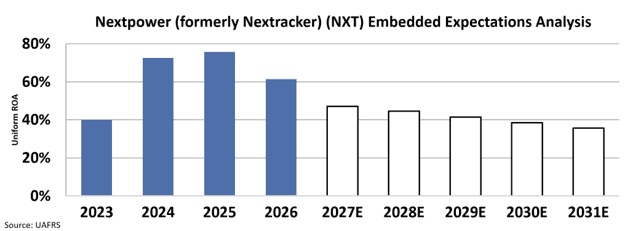
Its Uniform return on assets (“ROA”) peaked at 76% in fiscal 2025, roughly six times higher than the corporate average of 12%.
However, the company’s returns have started to slip, falling to 61% in fiscal 2026. Investors are also betting on a much steeper drop in profitability.
We can see this through Valens’ Embedded Expectations Analysis (“EEA”) framework.
The EEA starts by looking at a company’s current stock price. From there, we can calculate what the market expects from the company’s future cash flows. We then compare that with our own cash-flow projections.
In short, it tells us how well a company has to perform in the future to be worth what the market is paying for it today.
At today’s price, the market expects Nextpower’s Uniform ROA to fall to 35% by 2031, its lowest level since going public in 2023.