U.S. government agencies are investing heavily to modernize critical systems across defense, healthcare, and intelligence. Leidos (LDOS) works behind the scenes to support these efforts through technology, data, and mission-critical services. In today’s FA Alpha Daily, we take a closer look at Leidos as government modernization gains momentum.
FA Alpha Daily:
FA Alpha 50
Powered by Valens Research
Federal spending has risen in recent years, growing from $5 trillion in FY 2016 to $7 trillion in FY 2025.
Most recently, national defense has been given increasing attention.
America’s defense spending has grown considerably from roughly $705 billion in FY 2021 to $961 billion in FY 2026. For FY 2027, that figure could rise even further to $1.5 trillion provided the White House’s defense budget proposal is approved.
However, defense isn’t the only area where the government funding is flowing.
The federal government is investing heavily in other areas such as health care, transportation, and intelligence. This effort is spurred primarily by the need to modernize outdated systems.
That said, doing this isn’t as simple as acquiring and deploying new software.
Government agencies need to work with experienced and trusted partners to build mission-critical systems and handle sensitive information.
Simply said, the U.S. government is undertaking a major digital transformation. And that puts Leidos (LDOS), a defense, aviation, information technology, and biomedical research provider, in a highly favorable position to benefit.
Leidos, unlike traditional defense firms, mainly provides technical expertise.
The company’s employees help government agencies develop software, protect digital networks, analyze data, and manage complex programs, making it an essential partner for the federal government’s modernization efforts.
It currently operates four business segments: National Security & Digital, Health & Civil, Commercial & International, and Defense Systems.
National Security & Digital brings in the lion’s share of Leidos’ revenue at 44% as of FY 2025, followed by Health & Civil at 30%, then Commercial and Defense Systems at 13% each.
Leidos generates revenue mostly from its contracts with the U.S. military, as well as the Department of Health and Human Services.
Now, Leidos is positioned for another growth opportunity.
Leidos has positioned itself as a crucial partner in the U.S. government’s efforts to embrace AI.
Through its Trusted Mission AI platform, Leidos helps agencies use artificial intelligence in sensitive areas like national security, cybersecurity, and data analysis. The company has an advantage in this space thanks to its long-term partnerships with various government agencies that require clearances, relationships, and technical workforces to design and use AI tools that are secure and reliable.
New competitors can’t easily replicate those advantages.
The company’s recent results show that demand remains healthy. First-quarter 2026 revenue rose 4% year over year to $4.4 billion, including 3% organic growth. Its Intelligence and Digital business grew 7%, while Homeland revenue increased 6%.
Profitability was strong as well. Adjusted earnings before interest, taxes, depreciation, and amortization margins reached 14%. Leidos also raised its full-year revenue outlook by $500 million, to a range of $18 billion to $18.4 billion. Management now expects roughly $1.8 billion in operating cash flow.
Part of that increase came from the company’s recent Entrust acquisition. Management says the integration is ahead of schedule, and the deal is already adding to earnings.
These results reinforce what the Uniform Accounting numbers have shown for years.
Leidos regularly generates Uniform return on assets (“ROA”) in the high-30% range. Returns surpassed 40% several times between 2017 and 2022, and recovered to the mid-30% range after a temporary decline in 2023.
That is an impressive level of profitability for a government contractor. That said, Leidos currently trades at a below-average P/E of 13x, with investors pricing in an unfavorable outcome for the company’s future returns.
We can see this through Valens’ Embedded Expectations Analysis (“EEA”) framework.
The EEA starts by looking at a company’s current stock price. From there, we can calculate what the market expects from the company’s future cash flows. We then compare that with our own cash-flow projections.
In other words, the EEA shows how well a company has to perform in the future to be worth what the market is paying for it today.
At current valuations, investors expect Leidos’ Uniform ROA to decline to 17% by 2030, well below its five-year average Uniform ROA of 35%.
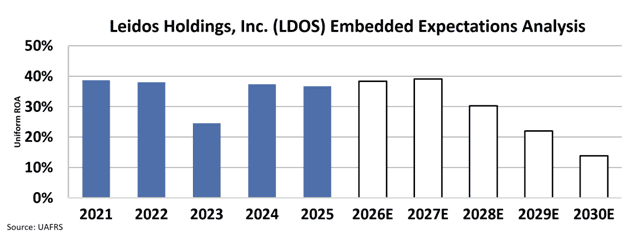
This negative forecast indicates the market appears cautious about the predictability of federal spending trends.
However, Leidos’ growing demand, deep customer relationships, mission-critical offerings, and the government’s prioritization of modernization efforts should position the company for further growth in the next several years.
Best regards,
Joel Litman & Rob Spivey
Chief Investment Officer &
Director of Research
at Valens Research
Today’s article only scratches the surface of what we share with our FA Alpha Members. If you want to get an in-depth analysis of market trends, uncover undervalued stocks, and more, become an FA Alpha Member today.