
The American financial markets process billions of transactions on a daily basis.
Each time equities or bonds change hands, the trades must be meticulously recorded, matched, and settled. While buying and selling these assets seems relatively simple on the surface, complex processes and specialized software are constantly at work to ensure these trades proceed smoothly.
And that’s where Broadridge Financial Solutions (BR) comes into play.
Broadridge specializes in operating the infrastructure needed to ensure the American financial markets work smoothly. It designs the software that processes trades, facilitates corporate communications, and builds custom-built solutions for asset managers and wealth managers.
The company’s solutions include proxy services, end-to-end tokenization, asset servicing, global trading, and others. The firm serves asset managers, issuers, capital markets, wealth managers, and consumer industries.
Broadridge operates two major segments: Investor Communications Solutions (“ICS”) and Global Technology and Operations (“GTO”).
GTO facilitates the back-, middle-, and front-office operations for capital markets. The processes involved in these functions include clearing, settlement, matching and allocation, and trading and execution.
This segment also provides specialized software that help wealth managers process front- and back-office processes.
Meanwhile, ICS specializes in communications, regulatory compliance, and software solutions. This unit serves public companies, funds, brokers, wealth managers, and institutional and retail investors.
Broadridge’s mission-critical solutions create high switching costs, resulting in customer retention rates exceeding 90%. Revenue is driven by a combination of transaction and software subscription fees.
For fiscal year 2026, the company delivered $7.4 billion in total revenue, with annual recurring revenue accounting for $4.8 billion.
Broadridge has delivered above-average returns in recent years. Since its 2023 fiscal year, its Uniform return on assets (“ROA”) have remained above 60%. During fiscal year 2026, it delivered a ROA of 66% alongside an asset growth of 15%.
Despite generating returns well above the corporate average of 12%, the company currently trades at below-average Uniform P/E of 16x. Investors expect returns to fall in the next few years as well.
We can see this through Valens’ Embedded Expectations Analysis (“EEA”) framework.
The EEA starts by looking at a company’s current stock price. From there, we can calculate what the market expects from the company’s future cash flows. We then compare that with our own cash-flow projections.
In other words, the EEA shows how well a company has to perform in the future to be worth what the market is paying for it today.
At current valuations, investors expect Broadridge’s returns to fall to 43% by 2031, below the returns it has delivered over the past few years.
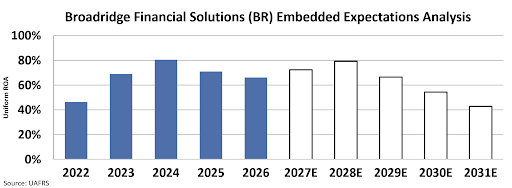
This signals that the market is adopting a balanced, if not slightly pessimistic, stance towards the company amid capital markets activity.
However, Broadridge’s mission–critical solutions and strong client retention rates support durable earnings and high returns for years to come.
Best regards,
Joel Litman & Rob Spivey
Chief Investment Officer &
Director of Research
at Valens Research
Today’s analysis only scratches the surface of what we share with our FA Alpha Members. If you want to gain an in-depth analysis of market trends and uncover undervalued stocks, become an FA Alpha Member today.