
How Can I Simplify Asset Allocation Timing Decisions?
September 3, 2026
Quick answer
You can simplify asset allocation timing decisions by replacing continuous judgment with three commitments. Set a fixed monthly review date, keep a short weighted signal list with defined normal ranges, and write change triggers down in advance. The default at every scheduled review is no change.
Act only when a heavily weighted signal breaks its normal range and stays out through the next scheduled review. Between review dates, news is commentary.
Timing decisions get hard when every headline reopens the question. In a choppy month, the inflation print, the Fed presser, and a client asking if it’s time to go to cash can each restart the same debate. The fix is structural. Decide once a month, against the same short list, with the triggers agreed before the cycle turns.
| Commitment | What it replaces | In practice |
|---|---|---|
| Fixed monthly review date | Continuous reaction to headlines | Review on one set day. Between dates, news is commentary and the default is no change. |
| Short, weighted signal list | A dozen unweighted inputs | Score the same few signals each month, each with a defined normal range. |
| Triggers written in advance | After-the-fact rationalizing | Change only on a sustained break, and record what you saw and what you did. |
Decide on a Schedule
Choose one review date each month and hold it. The first business day after month-end works well. By then the data is in, and the date is easy to keep. Between dates, nothing gets decided. The SEC’s plain-language guidance on asset allocation and rebalancing describes rebalancing on a schedule, and the same logic applies here.
This pays off in client reviews. Every question about a scary headline gets the same answer. Point to the monthly review and its notes, including the months where the answer was no change.
Watch a Short, Weighted Signal List
A short list with weights beats a long list without them. Our page on which macro signals matter for asset allocation covers the four signal families and their weights. Credit carries the most weight, earnings growth confirms, sentiment counts at extremes, and valuation is context.
A normal range is what makes each signal usable. Define the band where the signal spends most months, and read anything inside it as no change. You’re waiting for a condition, and one print is never a condition.
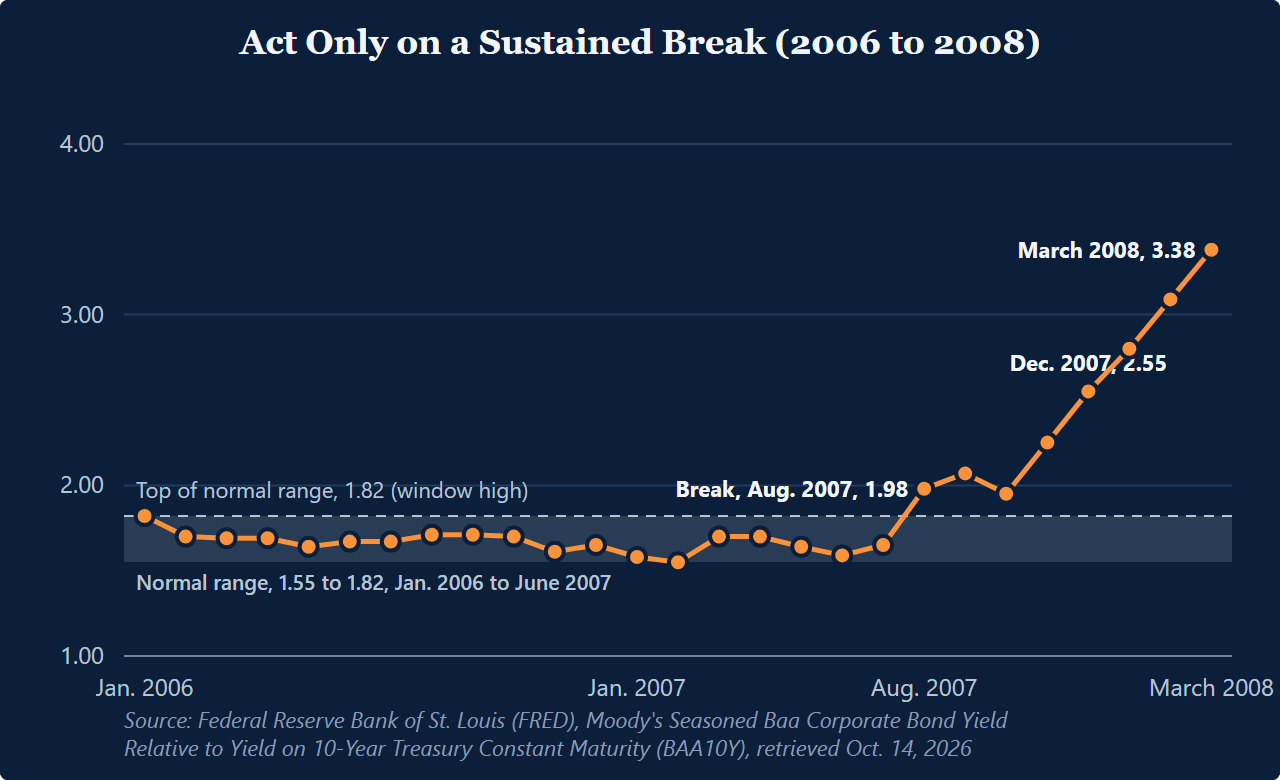
Moody’s Baa spread over the 10-year Treasury shows both halves of that rule. By monthly average it stayed between 1.55 and 1.82 percentage points from January 2006 through June 2007. In August 2007 it widened to 1.98, was still out at the next month-end at 2.07, and kept widening to 2.55 in December 2007 and 3.38 in March 2008. That is a sustained break. In April 2025 the same spread jumped to a 1.90 monthly average from 1.65 in March, and the ICE BofA high-yield spread peaked at 4.61 percentage points on April 7. By June 2025 the Baa spread averaged 1.76 and the high-yield spread 3.13. A scheduled reviewer saw one print, then a retreat, and no condition. Figures from the Federal Reserve Bank of St. Louis (FRED), series BAA10Y and BAMLH0A0HYM2, retrieved Oct. 14, 2026.
Write the Triggers Down in Advance
Write down what would change the allocation before the cycle turns. The document can be one page. It needs a threshold for each heavily weighted signal, and how long a break must last before it counts, for example still outside the range at the next month-end review.
It should also state the size of the move, as a staged shift decided in advance and documented the day it’s made. Deciding the size early is what keeps a scary month from becoming an oversized trade.
Documented after the fact, the same change reads as a reaction. Documented in advance, it reads as policy, and that’s the version a client and a compliance officer can live with.
Where a Monthly Schedule Can Lag
A scheduled review can lag a fast break. Ranges are judgment calls, and they need revisiting as cycles change. Across a full cycle, most reviews correctly end in no change, which takes discipline to accept when headlines feel urgent. The monthly Market Phase Cycle reading published in FA Alpha Pulse runs on this monthly schedule with the same weighted signals. Our page on adding macro insight to client conversations covers what to say in the months when nothing changed.
Key points
- Decide on a fixed monthly review date. Between dates, news is commentary.
- Score a short, weighted signal list with normal ranges, and expect “mixed, no change” most months.
- Act only on a sustained break, at a size you wrote down in advance.
One decision a month, one insight a morning
FA Alpha Daily applies this to one company, metric, or market signal every morning, free for financial advisors.