
In January, financial-infrastructure giant Global Payments (GPN) closed one of the biggest fintech deals in years. The company bought payment processor Worldpay for more than $24 billion.
Worldpay’s network handles trillions of dollars in merchant transactions every year. At the same time, Global Payments sold its issuer-solutions business to competitor Fidelity National Information Services (FIS) for nearly $14 billion.
That $38 billion worth of deals would normally dominate the headlines. But with all the nonstop news this year, they were barely a whisper. And the quiet tells more about the state of the market than any headline ever could.
A $24 billion acquisition only looks “normal” when the deal market is booming. It shows banks are willing to finance large transactions and that executives are confident enough to reshape their businesses.
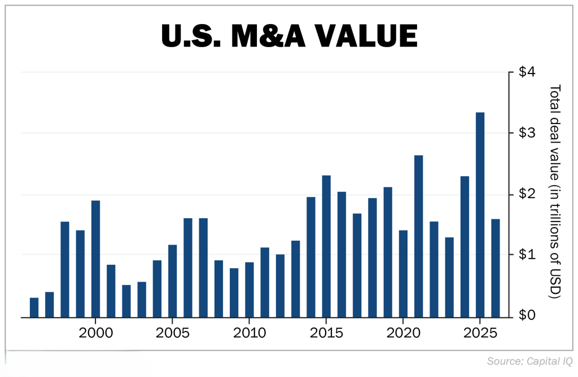
Global Payments isn’t alone. By early July, U.S. mergers and acquisitions (“M&A”) value had already reached roughly $1.6 trillion.
That’s slightly ahead of where it stood at the same point last year, and already more than halfway to 2025’s full-year total.
And 2025 wasn’t a quiet year. U.S. M&A value reached an all-time high last year, surpassing even the post-pandemic surge in 2021.
This means deal flow is on track for a new record.
This isn’t a sign of executives bracing for uncertainty.
Deals require confidence. Buyers need to believe an acquisition can add value to offset the financial burden. And banks need to be willing to fund the transaction at workable costs.
In other words, M&A is one of the best real-time indicators of business confidence.
If credit is tight, deals slow down. If lenders get nervous, financing becomes harder. If executives lose confidence, boards stop approving major transactions.
That’s exactly why there was a slowdown from 2022 to 2024. Higher interest rates kept a lid on activity. Plenty of companies wanted to buy, but prices weren’t right.
That has clearly changed.
So far this year, seven acquisitions have closed for more than $25 billion, including SpaceX’s (SPCX) $250 billion merger with xAI.
There’s also a $100 billion-plus merger between Paramount Skydance (PSKY) and Warner Bros. Discovery (WBD) still in the works, though a federal judge temporarily paused the deal a few weeks ago.
And it’s only halfway through the year.
M&A is more than a source of Wall Street fees. It’s one of the best windows investors have into market sentiment. When it’s strong like this, companies and financiers alike believe the market is healthy.
But the opposite is a warning sign. If M&A activity suddenly fell behind last year’s pace, it would suggest financing was tightening or confidence was fading.
Right now, there aren’t any signs of slowdown. Credit conditions remain strong. Corporate profits are still growing. And executives are betting with their wallets (or their companies’ wallets) that this cycle will continue.
As long as that keeps happening, volatility looks more like an opportunity than a warning.
Best regards,
Joel Litman & Rob Spivey
Chief Investment Officer &
Director of Research
at Valens Research
Today’s article only scratches the surface of what we share with our FA Alpha Members. If you want to get an in-depth analysis of market trends, uncover undervalued stocks, and more, become an FA Alpha Member today.