
Headlines out of the Middle East have driven volatility higher, leading sentiment to stay defensive.
However, something unusual has played out. Stocks got cheaper without breaking the economy. A few weeks ago, we made the case that oil would dictate the market’s next move—an argument that remains true.
Still, it remains to be seen how the conflict in Iran will play out. However, the most important market signal is that oil has fallen from recent highs.
After peaking around $120 per barrel following the fighting, Brent crude oil prices (the international standard) are hovering around $110 per barrel. That’s well below the levels that would drive a recession.
So instead of worrying about oil—which seems to have largely stabilized—investors should look at what’s actually changing.
Official fiscal 2025 data from across the market is finally available. Nearly every company has reported its 2025 earnings. And those results have been run through Valens’ Uniform Accounting framework.
That provides a clearer starting point for 2026 expectations. And the picture is stronger than many investors realize.
Valuations were already decent. The forward Uniform price-to-earnings (“P/E”) ratio was roughly 24x times last year—in line with expectations, given today’s level of corporate taxes, inflation, and earnings growth.
Based on 2025 results, expectations sit at roughly 19% earnings growth in 2026, well above the corporate average growth of 10%. Profits are still accelerating. Companies continue to spend and invest. And the earnings engine behind this bull market is chugging along.
Thanks to those stronger earnings expectations, the forward Uniform P/E ratio has fallen below 20. That’s low for a market with solid profit growth, a supportive tax backdrop, and inflation that—outside of energy—remains manageable.
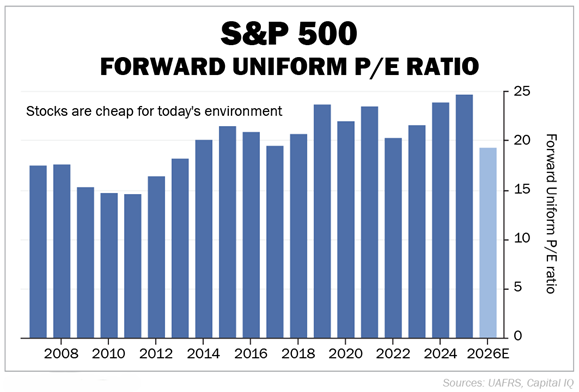
This shows the part investors often miss: Valuations don’t always fall because something breaks.
Sometimes, valuations fall because prices stall while earnings improve.
That’s the setup that’s playing out right now, and it’s perfect for today’s market.
Despite improving fundamentals, sentiment hasn’t caught up. The market is still reacting to March’s Iran-driven volatility.
Nonetheless, there’s still strong and accelerating earnings growth. That can keep powering the market forward. And with lower valuations, investors are presented with a good buying opportunity.
Sure, there may still be some near-term headline risk coming out of the Middle East. But there’s reason to remain bullish.
To sum up, this isn’t what the start of a bear market looks like.
Best regards,
Joel Litman & Rob Spivey
Chief Investment Officer &
Director of Research
at Valens Research
Today’s analysis highlights the same insights we share with our FA Alpha Members. If you want to an get in-depth analysis of market trends and uncover undervalued stocks, become an FA Alpha Member today.