
Artificial intelligence is reshaping how businesses operate, raising questions about the future of work and the broader economy. While fears of widespread job losses continue to grow, the relationship between technological progress, employment, and business growth may be more complicated than it first appears. In today’s FA Alpha Daily, we examine what AI’s evolving role in the workplace could mean for businesses and investors.
FA Alpha Daily:
The Monday Macro Report
Powered by Valens Research
Last year, some of the biggest names in AI warned that unemployment could spike as high as 20%.
Among them was Dario Amodei, CEO of AI developer Anthropic. He said the technology could wipe out half of all entry-level white-collar jobs within five years.
Forecasts like that spread fast. A record 27% of U.S. workers now fear technology could soon eliminate their jobs, according to Gallup.
Then the data showed up: The U.S. unemployment rate sits at 4.2%. That’s about a fifth of the worst-case warning.
In August this year, employers added 162,000 jobs, roughly triple Wall Street’s forecast of 53,000. The September numbers come out tomorrow.
Across the Atlantic, a new survey suggests AI is starting to add jobs. U.K. banking giant Lloyds Banking Group (LYG) polls about 1,200 British businesses every month.
In its latest survey, 54% said AI had led to new jobs.
The fear surrounding the technology makes sense. Workers have watched AI write code, answer customer calls, and draft legal briefs. It’s easy to imagine a wave of layoffs tipping the economy into recession.
The feared layoff wave hasn’t shown up in the numbers.
The workers most exposed to AI tend to be college-educated office workers. If AI were gutting white-collar work, they’d feel it first. They aren’t.
The unemployment rate for workers with a college degree is 2.7%, where it has held since May.
U.S. employers blamed roughly 55,000 layoffs on AI in all of 2025. That’s less than 1% of the year’s job cuts.
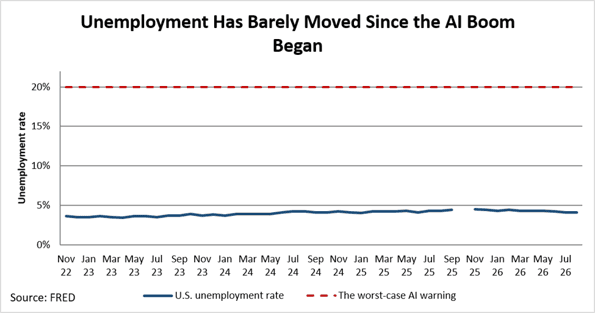
Nearly four years into the AI boom, unemployment has barely budged.
Since ChatGPT kicked off the boom in late 2022, the rate has stayed between 3.4% and 4.5%. Even the high point of the rate is less than a quarter of the worst-case warning.
That doesn’t mean AI is completely harmless.
Financial powerhouse Goldman Sachs (GS) estimates it has trimmed U.S. payroll growth by about 16,000 jobs a month, adding roughly 0.1 percentage points to the unemployment rate.
That’s a real cost for the people affected. But in an economy with nearly 160 million jobs, it’s a small drag, far from a recession trigger.
Today’s businesses are building their hiring around AI. The Lloyds survey shows how.
A quarter of firms are hiring more candidates with AI skills. A fifth are creating brand-new AI roles. And more than 70% of large businesses plan to invest more in the technology.
Amanda Murphy, CEO of Lloyds’ business and commercial banking division, told Bloomberg that firms now need to focus on “building the skills, culture and confidence to use it effectively.”
Some companies learned that the hard way.
Buy-now-pay-later company Klarna (KLAR) froze hiring because its AI assistant could do the work of 700 customer-service agents.
Months later, CEO Sebastian Siemiatkowski started hiring people again. He told Bloomberg that chasing cost savings had hurt the quality of Klarna’s support.
This type of disruption has been seen before.
When U.S. banks rolled out automated teller machines (“ATMs”) in a big way in the 1990s, tellers looked doomed. ATMs handed out cash and took deposits, the core of a teller’s job. But the tellers stuck around.
Boston University’s James Bessen found that between 1988 and 2004, ATMs cut the tellers an average city branch needed from 20 to 13.
That made each branch cheaper to run so banks opened more of them. Total teller jobs held steady and even rose, while the work shifted toward selling services and solving harder customer problems.
Goldman sees the same split with AI. Where AI can fully replace a worker, jobs are falling.
But where it helps workers do more, employment is rising, adding about 9,000 jobs a month. That’s the teller story again, and it’s what Lloyds is picking up in the U.K.
AI will cost some people their jobs. It already has. But the data shows no sign of the mass-unemployment event that would drag the U.S. into a recession.
Businesses are hiring for new skills and creating new roles, just as banks did when ATMs arrived.
As long as unemployment holds at around 4% levels, the AI-recession story stays a story.
The businesses worth looking out for today are those that use AI to serve more customers and use it to fuel long-term growth.
Best regards,
Joel Litman & Rob Spivey
Chief Investment Officer &
Director of Research
at Valens Research
Today’s analysis only scratches the surface of what we share with our FA Alpha Members. If you want to gain an in-depth analysis of market trends and uncover undervalued stocks, become an FA Alpha Member today.