The past few years have seen a dramatic shift in food and beverage consumption as consumers turn toward healthier alternatives. This change has been driven partly by the advent of GLP-1 drugs and renewed focus on physical health.
To achieve their fitness goals, health-conscious consumers are turning to nutritional beverages and food items such as protein bars, powders, and drinks to aid weight loss, boost energy levels, and assist muscle build-up.
As consumers continue to shift towards healthier beverages and food items, manufacturers of these staples have benefitted.
In all, the protein supplement market is valued at $26 billion today, and expected to reach $47 billion in the next five years.
BellRing Brands (BRBR) is a pure-play nutrition company that manufactures and sells healthy beverages and snacks in this market.
The company’s portfolio currently includes Premier Protein, the leading weight control nutritional drinks and snacks brand in the U.S., Dymatize, a protein powder manufacturer, and PowerBar, a nutritional snack brand that caters towards athletes.
The company is a leader in this market, commanding a 30% share in the protein shake market and is also a leading player in protein powder and bars markets.
Due to its reach and the popularity of its products, BellRing Brands has steadily grown its revenues from $988 million in 2020 to $2 billion last year.
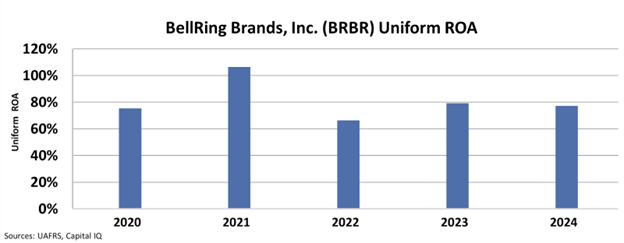
BellRing’s returns have likewise reflected the steady growth. Since 2020, the company’s Uniform return on assets (“ROA”) has averaged more than 75%. And last year, the company generated a Uniform ROA of 77% to go along with a 32% Uniform asset growth.
However, despite being a solid performer, the company currently trades at a Uniform P/E of 15.6x, which falls below corporate averages.
This valuation reflects market caution due to category saturation, consumer demand volatility, and price inflation Consequently, the market expects that the company’s Uniform ROA will decline below historical levels in the coming years.
We can see what the market thinks through our Embedded Expectations Analysis (“EEA”) framework.
The EEA starts by looking at a company’s current stock price. From there, we can calculate what the market expects from the company’s future cash flows. We then compare that with our own cash-flow projections.
In short, it tells us how well a company has to perform in the future to be worth what the market is paying for it today.
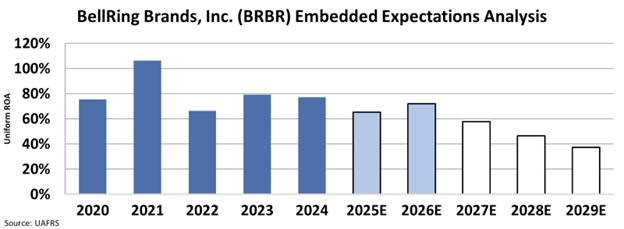
At its current stock price, Wall Street analysts forecast that BellRing’s returns will hover around 70% in the next two years. However, the rest of the market expects Uniform ROA to nosedive to 37% by 2029.
While BellRing’s segments face volatile demand and category saturation, the company has sufficient brand equity to weather these headwinds. And while price inflation will impact consumer choice, the shift toward healthier alternatives positions BellRing’s products as consumer staples.
With these factors in mind, if BellRing can sustain and grow its current performance levels, upside could be warranted for investors.
Best regards,
Joel Litman & Rob Spivey
Chief Investment Officer &
Director of Research
at Valens Research
Today’s analysis highlights the same insights we share with our FA Alpha Members. If you want to an get in-depth analysis of market trends and uncover undervalued stocks, become an FA Alpha Member today.