
The U.S. has continued—and continues—to navigate a complex geopolitical and military landscape in recent years.
The war in Ukraine and the instability in Europe, geopolitical tensions in Asia, and the conflict in Iran and other flashpoints across the Middle East have heightened the military’s defense posture, leading to the fast-tracking of arms procurements, increased military mobilizations, and munitions manufacturing.
Meanwhile, the advancement of AI has added another dimension to modern defense preparedness. Its advent has made it easier and faster for malicious and adversarial actors to conduct cyber attacks at scale.
Simply said, America is beset by challenges from multiple directions. As a result, defense spending has risen steadily in recent years.
The country’s defense budget has risen from roughly $705 billion in FY 2021 to $961 billion for FY 2026. For FY 2027, that figure could rise even further to $1.5 trillion if the White House’s defense budget proposal is granted.
While most headlines and investors focus on military hardware, vehicles, and other defense assets, there’s a crucial layer along the supply chain that’s often overlooked: specialized electronic components.
Advanced military equipment like a missile’s guidance computer, a fighter jet’s radar array, or a secure communication radio requires absolute synchronization to function efficiently.
Components such as quartz crystal oscillators deliver precise internal timing, ensuring different subsystems can communicate down to the millisecond.
Also needed are radio frequency filters, which function like ultra-precise noise-canceling headphones for machines, blocking out atmospheric static, electronic clutter, and intentional enemy jamming so critical defense hardware can send and receive clear data without disruption.
Those components aren’t easy to manufacture at scale, and that’s where M-tron Industries (MPTI) comes in.
M-tron is a materials science, design, and manufacturing company that specializes in filters, resonators, oscillators, and radio frequency (“RF”) solutions, used in aerospace, defense, space and avionics, and commercial applications.
The specialized electronic components M-tron manufacturers end up in precision-guided munitions, radar, electronic warfare, commercial aircraft, drones, satellite communications, and others.
M-tron’s business is deeply embedded in the defense supply chain. Its customer base include major firms such as Boeing, Lockheed Martin, Northrop Grumman, and other major global players.
Moreover, the company’s offerings are highly sticky. Once one of its components is listed into an official blueprint of a multi-year defense program, replacing it with a competitor’s part requires a lengthy, expensive, and complex re-certification process by the Department of Defense.
This creates powerful switching costs that secure predictable and highly profitable manufacturing demand for M-tron.
Aside from military hardware, the company is seeing expansion for its Space & SATCOM segment. The proliferation of low-Earth-orbit military satellites is leading to increased demand for the company’s filters, resonators, and other components—specifically designed to handle extreme radiation and severe temperature swings. Since these are highly-specialized and regulated components, the firm is able to command premium pricing.
M-tron is benefitting from a wave of higher spending and demand. The Defense Department is updating procurement rules to fast-track stockpile replenishment and expansion. Rule changes include long-term agreements, industrial base expansion, and further support to suppliers.
The firm recently secured defense production contracts. Among the notable ones include crystal oscillators for a Defense Department radar program and RF components for an air defense program.
Increased defense spending over the past few years has enabled the company to grow its Uniform return on assets (“ROA”) from 4% in 2022 to 11% by 2025.
That said, the market is underestimating the company’s opportunity for further ROA expansion.
We can see this through Valens’ Embedded Expectations Analysis (“EEA”) framework.
The EEA starts by looking at a company’s current stock price. From there, we can calculate what the market expects from the company’s future cash flows. We then compare that with our own cash-flow projections.
Investors expect M-tron’s Uniform ROA to rise slightly to 12% by 2030.
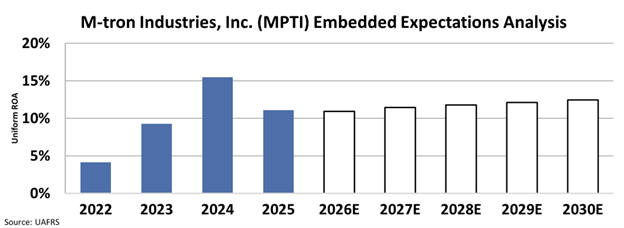
Market expectations indicate that surging defense spending isn’t being factored into M-tron’s future return forecasts.
While there’s no telling how much defense spending could rise in the next few years, recent geopolitical tensions and surging military spending could position M-tron to grow its returns further.
M-tron’s expertise and status as a supplier of highly specialized and heavily regulated components could propel its profitability for years to come, and investors who catch on early could position themselves for potential upside.
Best regards,
Joel Litman & Rob Spivey
Chief Investment Officer &
Director of Research
at Valens Research
Today’s analysis highlights the same insights we share with our FA Alpha Members. If you want to an get in-depth analysis of market trends and uncover undervalued stocks, become an FA Alpha Member today.