Inflation accelerated earlier this year after the U.S. began a war with Iran, and that revived concerns that the Fed may have to hike rates.
President Donald Trump has continued pushing for lower rates. Investors have been left trying to decide which force will win.
That uncertainty has made every economic datapoint feel more important. A segment of the market expects the Fed to raise rates again while another still sees room for cuts before the end of the year.
Warsh has kept both camps from getting too comfortable. He held rates steady at his first meeting and avoided committing the Fed to a fixed path.
He wants to give the committee room to respond to the data instead of defending an earlier forecast.
The Federal Open Market Committee (“FOMC”) begins its next meeting today, July 27, and will announce its rate decision Wednesday.
While there’s no way of knowing which policy direction the FOMC will take, the latest economic data supports another meeting with interest rates unchanged.
The Fed has two primary “mandates.”
The first is inflation. Policymakers aim to keep inflation near 2% over the long term. That’s enough inflation to let the economy grow without straining folks too much.
Inflation tends to rise when the economy is running “hot,” in which case, the FOMC wants to slow down the economy. Higher interest rates cool the economy by making purchases like mortgages, auto loans, credit cards, and business investments more expensive.
The Fed’s second mandate is “full employment.” Policymakers want the economy strong enough to support job creation and rising wages.
Economists often place full employment somewhere between an unemployment range of 4% to 6%, although the Fed uses no fixed target. Lower interest rates can support hiring by reducing borrowing costs and encouraging companies to invest.
Those goals regularly pull the Fed in opposite directions. A rate increase can slow inflation while placing pressure on hiring. A rate cut can strengthen employment while risking higher inflation.
That is why one weak employment report or a few strong inflation readings shouldn’t cause the Fed to jump the gun.
The Fed has to judge the long-term direction of the economy, rather than react to every monthly swing.
That said, the pressure for a rate hike seems to be fading. As mentioned previously, earlier this year, the balance appeared to tilt toward higher rates.
Inflation was heating up while the labor market remained firm. The unemployment rate peaked around 4.5% in November and improved to 4.2% by June. That gave the Fed little reason to worry about an immediate collapse in employment.
Some investors expected Warsh to raise rates at his first meeting in June, since inflation surged to 4.2% in May. He held the policy rate at 3.5% to 3.75% instead.
And now, the latest data suggests Warsh was right to wait. In June, consumer prices fell for the first time in six years. Energy prices finally started cooling down.
The Fed prefers to watch personal consumption expenditures (“PCE”) price index. The official June release arrives later this week, although most of the underlying components are already available.
PCE inflation is expected to be down to 3.7%, down from 4.1% in May. Excluding energy and food, it’s expected to be just 3.3%.
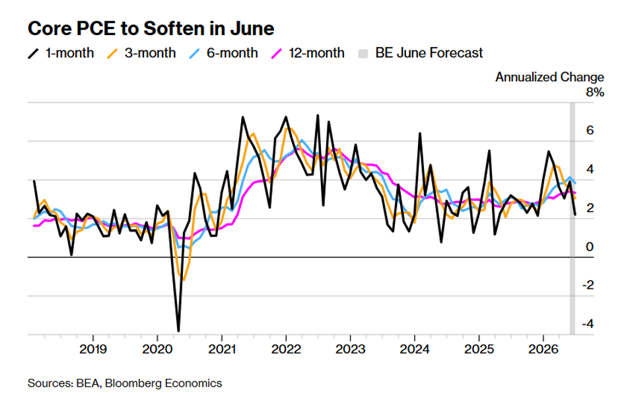
The main metric the Fed cares about is down to its lowest level of the year, and that shows the “wait and see” strategy seems to be working.
Demand is cooling gradually, and inflation is moving lower without a sharp deterioration in employment.
To sum up, Warsh has enough evidence to avoid another rate hike this week.
Employment remains stable. Inflation is still above the target, but its recent trend suggests patience might be the right strategy.
Warsh has already signaled that he wants the Fed to reveal less about its future decisions. That approach can frustrate investors searching for guidance, but it keeps markets from treating projections as promises.
Right now, the strongest rate decision is no change at all.
The Fed can wait for several more months of inflation and employment data before committing to its next move. That should help ground investors and prevent market panic.
Best regards,
Joel Litman & Rob Spivey
Chief Investment Officer &
Director of Research
at Valens Research
Today’s article only scratches the surface of what we share with our FA Alpha Members. If you want to get an in-depth analysis of market trends, uncover undervalued stocks, and more, become an FA Alpha Member today.