
Major market indices can mask significant differences in how individual stocks and sectors are performing. While some areas of the market struggle, others are gaining momentum, making it increasingly important to distinguish lasting opportunities from temporary rallies. In today’s FA Alpha Daily, we examine what separates sustainable market breakouts from trends that may quickly fade.
FA Alpha Daily:
The Monday Macro Report
Powered by Valens Research
The S&P 500 sat within about 3% of its record high earlier this month.
Yet 60% of the stocks inside it were in a bear market. In other words, these had fallen 20% or more from their highs.
Bobby Molavi, who runs execution services for Europe, the Middle East, and Africa at financial powerhouse Goldman Sachs (GS), called it a “stealth bear market” in a note to clients.
Much of the damage has hit the AI trade. Since mid-October, the “Magnificent Seven” tech giants have shed $4 trillion in market value. Investors are worried about how much these companies are spending on AI and how long it will take to pay off.
Investors buy an index fund because it appears to be a safe play. That said, cracks show up in that assumption if most of the stocks in it are shedding value.
While the headlines are all fear, some corners of the market are breaking out. This year, healthcare stocks are up 21%.
Consumer staples are up 20%. Meanwhile, the S&P 500 is up just 7%.
The challenging part in this trend is knowing which of these breakouts are real. And that’s because some breakouts fade within weeks.
Take utilities, the companies that deliver electricity, gas, and water to homes and businesses.
Early this year, investors bet that AI data centers would need far more electricity. Regulated utilities earn a set return on the power plants and lines they build, so more demand means more spending and bigger profits.
When tech stocks sold off in February, the sector also looked like a safe place to hide.
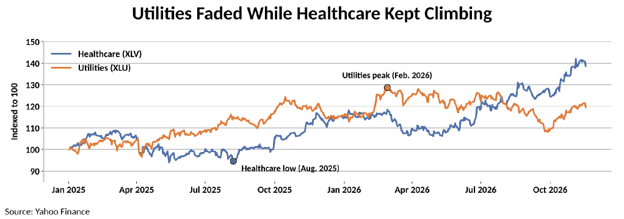
From early January to late February, the sector jumped 14%. Then the run reversed course.
By late September, utilities had fallen 16% from that peak, leaving them 4% below where the rally started. Investors who attempted to take advantage of that breakout in February lost money instead of achieving gains.
Meanwhile, other breakouts keep going for more than a year.
Healthcare hit its low in August 2025 after a rough stretch for drugmakers and insurers. Since then, the sector has climbed 47%, against 16% for the S&P 500.
At the start of their respective breakouts, healthcare and utility looked like they shared the same upward momentum. However, as both breakouts went on, one sector paid off for investors for more than a year. Meanwhile, the other one only paid off for seven weeks.
To sum up, an index hides a market where most stocks are struggling and a few trends are taking off.
As we discussed last month, the rest of the market is positioned to catch up to the Magnificent Seven as its earnings growth speeds up. The breakouts in healthcare and staples are early signs of that shift.
That said, not every breakout is built to last.
To separate a real trend from a short-lived one, there are two things to watch out for:
First, look at where the run started.
Healthcare broke out of a long slump. Drugmakers and insurers had been out of favor for months, so the bad news was already priced in. This meant there was room for investors to change their minds.
Meanwhile, utilities took off on a story the whole market was already chasing. Once almost every investor bought in, there was no one left to push prices higher.
Second, determine whether profits are backing up the move.
The utilities rally rested on spending that hadn’t happened yet. A trend that lasts needs earnings and returns that are on track to improve, not just a story or narrative that looks good in theory.
In short, when profits keep pace with the price, a breakout has room to run.
A sector worth paying attention fits both of the criteria laid out above. If a sector meets neither of those criteria, then there’s a good chance it’s short-lived.
Best regards,
Joel Litman & Rob Spivey
Chief Investment Officer &
Director of Research
at Valens Research
Today’s analysis only scratches the surface of what we share with our FA Alpha Members. If you want to gain an in-depth analysis of market trends and uncover undervalued stocks, become an FA Alpha Member today.