
The U.S. started this trade war and the U.S. will suffer the most from it.
At least, that’s what the market thinks.
The S&P 500 plunged 7.1% in the weeks following the Trump administration’s “Liberation Day” announcements. Meanwhile, stocks across the globe went down a mere 6.5%, as measured by the iShares MSCI ACWI ex U.S. Fund.
Investors have concluded that the Trump administration will lose its own trade war. But there’s a lot more to this story than meets the eye.
“Reciprocal tariffs” don’t actually have much to do with tariffs, per se.
That is, it’s not about tariffs other countries have levied on the U.S. Trump’s numbers are a rudimentary calculation of the U.S.’ trade deficit with each country.
We don’t think this is the right way to look at global trade. Slapping double-digit tariffs on these countries won’t close the trade gap overnight.
But the numbers are, admittedly, staggering.
Take Vietnam, which runs a 90% trade surplus with the U.S. That means America buys far more goods from Vietnam than it buys from the U.S.
And it’s nearly as bad in other parts of the world. China runs a 70% surplus with the U.S. India’s is more than 50%. Even the EU is looking at a 40% surplus.
Those numbers make it look like the U.S. is “losing” because other countries don’t want American goods.
They look at how much a country’s industry ships to the U.S. They don’t consider how much money those countries make from selling to the U.S.
America has spent decades moving out of lower-return businesses. U.S. corporations haven’t been outsourcing for three decades to do other countries a favor.
They took the least profitable parts of their business models and found overseas partners to handle them.
That’s why Big Tech giant Apple (AAPL) turned to Chinese electronics maker Foxconn to assemble iPhones.
It’s why athletic apparel retailer Nike (NKE) lets its Vietnamese and Chinese partners stitch together shoes and sportswear.
The list goes on and on. And all the while, those U.S. businesses have held on to the profitable pieces.
Apple still designs the iPhone and many of its components. It creates the software that allows its products to run. And Nike still controls its brand, innovation, and partnerships with famous athletes.
So, while other countries might sell lots of goods to the U.S., it’s still coming out on top.
If an industry is focused on innovation, knowledge leadership, and most other competitive advantages, it’s probably centered in the U.S.
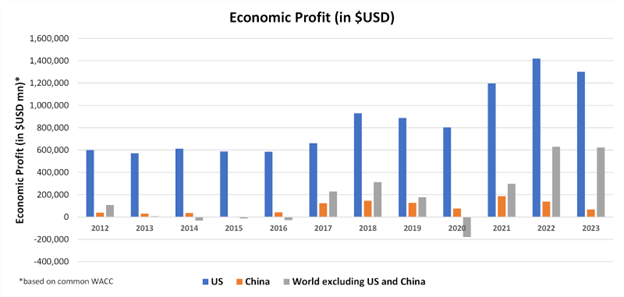
And that’s why the country’s economic profit—corporate earnings minus costs and investments—has dominated the rest of the world for decades, trade imbalance or not.
As seen in the chart below, U.S. economic profit was almost double the rest of the world in 2023. It was almost 20 times higher than China’s.
What’s more?
The gap between the U.S. and China is rising.
Other countries have plenty of trade barriers, both tariffs and otherwise. They’re decided to keep U.S. companies from maximizing how much they can sell to the rest of the world.
And it hasn’t mattered. America still came out on top.
The gap is so large, and U.S. corporations are so far ahead, the reality is that nothing else matters.
The U.S. is not reliant on selling its goods abroad. It has so many other ways to make profits that won’t get hurt by a trade war.
Best regards,
Joel Litman & Rob Spivey
Chief Investment Officer &
Director of Research
at Valens Research
Today’s analysis highlights the same insights we share with our FA Alpha Members. If you want to an get in-depth analysis of market trends and uncover undervalued stocks, become an FA Alpha Member today.