
Consumer-driven spending has powered the American economy over the past few years, especially as it dealt with the onslaught and aftermath of the COVID-19 pandemic.
With the economy temporarily stalled during the health crisis, the government issued stimulus checks and the Fed dropped rates to stimulate economic activity. As stimulus checks flowed and low interest rates prevailed, consumers across all income brackets possessed the confidence to spend freely.
This environment encouraged spending on luxuries, vacations, premium subscriptions and others. However, heightened spending eventually slowed, as inflation crept up and interest rates soared.
Inflation, which sat at 1.4% at the end of December 2020 surged to 9% by June 2022. And to bring this down to manageable levels, the Fed hiked rates 11 times between May 2022 and July 2023, raising rates from near-zero to as high as 5.5%.
Persistent inflation and high interest rates increased the cost of debt financing for many households. U.S. household debt currently sits at nearly $19 trillion, with delinquency rates on the rise since last year.
These pressures—combined with a cooling job market and stagnant wage growth—have put consumers under pressure, forcing many to become more selective about their spending.
That said, not everyone is feeling this pressure in the same way.
Over the past year many economists have claimed that the U.S. is currently in the midst of a “K-shaped economy,” a term used to describe the uneven economic situation where different groups fare better than others.
While prices skyrocket, unemployment ticks up, and wages stagnate for younger Americans, older and more affluent Americans are seeing rising 401(k) balances and home valuations.
As affluent Americans continue to grow their wealth, spending has increased for the group. High-income earners grew their expenditures by 2.2% last August. In contrast, lower-income households increased their spending by only 0.3% in the same period.
According to a Moody’s Analytics report, 10% of the highest-earning households now account for nearly half of all U.S. consumer spending today.
These trends point to a widening gap between upper- and lower-income households—and more importantly, a shrinking middle class. In 1971, 61% of the U.S. population belonged to the middle class. However, by 2023, the number of middle-income earners has shrunk to 51%.
With consumers moving in different directions, companies catering to the diverging groups have seen diverging results. Retailers TJX Companies (TJX) and Dollar General (DG) are examples of this divergence.
Dollar General currently operates over 20,000 stores across the U.S. and has built its business on selling goods to lower-income consumers at an affordable price.
On the other hand, TJX is an off-price retailer of apparel and other fashion items. While the company is often seen as a discount retailer, its target demographic is composed of middle to upper-income shoppers who want to buy luxury goods at more attainable prices.
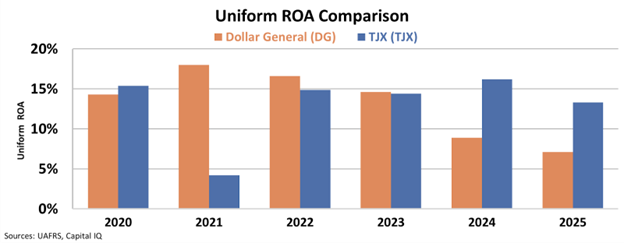
From 2020 to 2023, Dollar General and TJX both delivered an average Uniform return on assets (“ROA”) of 16% and 12%, respectively. However, pressure among Dollar General’s client base in recent years has resulted in declining returns while TJX has proved more resilient.
After peaking at 18% in 2021, Dollar General’s Uniform ROA has declined in each of the past four years, falling to just 7% in 2025.
Meanwhile, TJX has been able to maintain returns above 10%.
While broad economic pressures are weighing on consumers, the impact remains uneven. Even within the same industry, it is important for investors to understand the risks and opportunities that are arising from a diverging consumer base.
Best regards,
Joel Litman & Rob Spivey
Chief Investment Officer &
Director of Research
at Valens Research
Today’s analysis highlights the same insights we share with our FA Alpha Members. If you want to an get in-depth analysis of market trends and uncover undervalued stocks, become an FA Alpha Member today.