
September 10 marked a turning point in Oracle’s (ORCL) nearly five-decade history. Shares rocketed 36% in a single day, the company’s biggest surge since 1992, as management revealed a $455 billion cloud services backlog.
That’s up from $100 billion just a year ago, marking a staggering $355 billion jump. And now, Oracle has secured multibillion-dollar deals with AI giants like OpenAI, Nvidia (NVDA), and ByteDance’s TikTok.
This tech juggernaut is no longer playing catch-up in cloud computing as it’s sprinting ahead of legacy rivals in one of the most capital-intensive races in today’s market.
The company expects its cloud infrastructure business to grow 77% this year to $18 billion. By 2030, it’s targeting $144 billion in annual revenue from that segment alone. Before the guidance update, expectation by 2030 was only $84 billion.
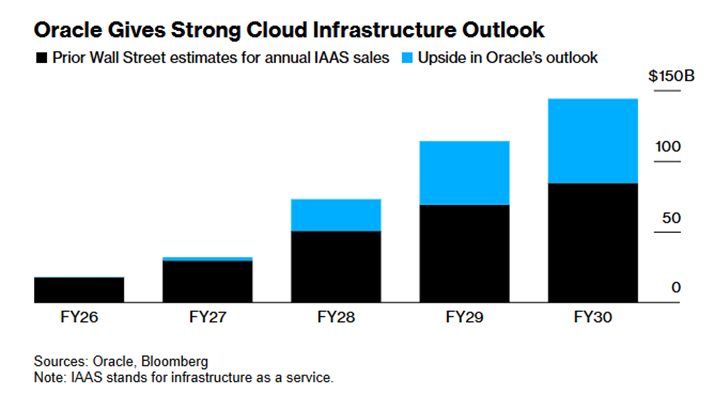
For context, that would put it ahead of where Amazon Web Services is today.
The company is already pulling ahead of key rivals. Oracle’s backlog is now four times larger than Google (GOOGL) Cloud’s—a complete reversal from where it stood just two years ago.
Four massive contracts in a single quarter helped fuel that shift. However, it’s the customers behind those contracts that matter most.
OpenAI is reportedly planning to spend trillions of dollars on compute infrastructure over the next decade. And it’s turning to Oracle for help.
The company’s custom-built AI clusters are uniquely optimized for Nvidia’s latest GPUs, which is considered as the gold standard in large language model training.
In other words, Oracle isn’t just riding the AI boom, it’s helping build the foundation.
Oracle’s stellar September performance wasn’t a one-day phenomenon. Before earnings, Oracle had quietly outpaced the S&P 500 for most of 2025.
Its stock was already up 45% this year before the news broke, and more than 250% since the AI revolution kicked off.
This is a pattern that’s surfaced time and again in major tech rallies.
Back in 2013, Tesla jumped 120% before it turned its first profit. Nvidia rallied 30% in late 2022, months ahead of its generative AI breakout in 2023.
In bull markets driven by structural tech shifts, price action often front-runs the headlines. And Oracle followed the same path.
The biggest winners usually move first and fast. Momentum like this doesn’t come out of nowhere.
Oracle’s stock doubled before earnings not because investors got lucky but because capital was already flowing toward the parts of the market positioned to win the AI infrastructure war.
When that happens, headlines tend to follow. Oracle just happened to be next in line.
Its vertical integration, purpose-built AI clusters, and surging contract backlog gave investors plenty of signals to act early. Earnings were the validation, not the surprise.
That’s the playbook behind previous tech-led booms. The next Oracle is out there, waiting to be found. And to find it, investors should follow price leadership.
Best regards,
Joel Litman & Rob Spivey
Chief Investment Officer &
Director of Research
at Valens Research
Today’s analysis highlights the same insights we share with our FA Alpha Members. If you want to an get in-depth analysis of market trends and uncover undervalued stocks, become an FA Alpha Member today.