
America’s decades-old copper phone infrastructure is being dismantled faster than many businesses can adapt. As regulations evolve, modern alternatives are quickly becoming essential for compliance and safety. In today’s FA Alpha Daily, we explore how Ooma (OOMA) is positioned to benefit from this unexpected shift and why the market may be underestimating the durability of its long-termopportunity.
FA Alpha Daily
Powered by Valens Research
For decades, most businesses have been required to maintain old-school phone lines for emergency services even if they don’t pay for landline phones themselves.
These lines, known as plain old telephone service (“POTS”), are dedicated mission-critical networks built on traditional copper wires. They’re primarily used for elevator communications, fire alarms, and security systems.
Recently, though, the Federal Communications Commission (“FCC”) started to loosen regulations on POTS to make room for more modern systems. Telecom companies, for example, are no longer required to maintain legacy copper POTS lines at regulated rates. And carriers can now refuse service entirely.
That’s great news for telecom giants like AT&T (T), Verizon Communications (VZ), and Lumen Technologies (LUMN). Copper lines are expensive, and they take a huge amount of labor to maintain. AT&T alone spends more than $6 billion per year on its aging copper network.
Now, AT&T has announced that it will stop all “adds, moves, or changes” for copper lines across nearly 20 states. Lumen and Verizon have issued similar grandfathering notices.
For businesses that still rely on POTS for emergencies, this “copper sunset” has become a nightmare.
With telecom companies abandoning their copper networks as fast as they can, it’s more expensive for businesses to keep their existing POTS lines. Some have reported price hikes as high as 648% in a single month.
Ooma (OOMA), a telecommunications firm, sits at the center of this transition.
Ooma is a cloud-based communications provider. Founded in 2004, the company got its start by offering simple home phone line subscriptions. Rather than running over old copper wires, its phone lines run over the Internet.
This business was great for customers who wanted to keep their home phone lines active at a much cheaper price. Lines cost between $6 and $10 per month.
Moreover, in 2021, Ooma launched a product called AirDial that directly replaces POTS with a cellular-based line.
AirDial offers the same reliability as POTS, but because it runs on cell towers instead of copper wires, it doesn’t suffer from the copper sunset.
So while individual POTS lines now cost as much as $1,000 per month, AirDial can offer the same service at a much lower price.
It’s no wonder that in the quarter after the FCC allowed telecom companies to raise POTS prices, AirDial’s bookings grew 50% year over year.
Despite this, the market seems to think demand for the company’s flagship product will slow.
We can see this through Valens’ Embedded Expectations Analysis (“EEA”) framework.
The EEA starts by looking at a company’s current stock price. From there, we can calculate what the market expects from the company’s future cash flows. We then compare that with our own cash-flow projections.
In short, it tells us how well a company has to perform in the future to be worth what the market is paying for it today.
Ooma turned profitable in 2021, the year it launched AirDial. Since then, its Uniform return on assets (“ROA”) has risen from 6% to as high as 13%. And Wall Street analysts expect it to climb to 21% by next year.
However, investors think Ooma’s Uniform ROA will slip back to just 7% by 2030.
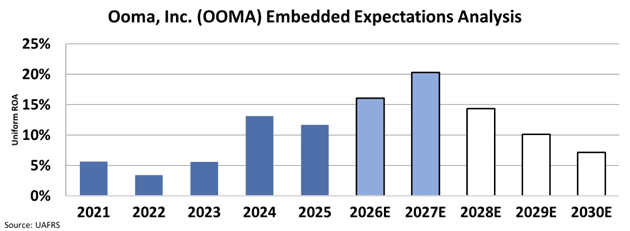
Investors don’t seem to understand that AirDial’s growth story is just getting started.
The recent FCC rulings created millions of new potential customers who are now desperate to replace their costly POTS lines. And that demand won’t go away anytime soon.
Telecom companies have been trying to do away with their copper-based networks for years. Now, thanks to the FCC’s deregulation of POTS, they can.
This copper sunset isn’t a gradual transition anymore. It’s happening seemingly overnight. And businesses that don’t want to pay steep prices for old POTS lines need to act fast.
Ooma already has the infrastructure to capture displaced customers—and it’s been driving the company’s margins higher for years.
Investors who can identify the disconnect between the market’s expectations and Ooma’s tailwinds are presented with an attractive opportunity that could generate upside.
Best regards,
Joel Litman & Rob Spivey
Chief Investment Officer &
Director of Research
at Valens Research
Today’s analysis highlights the same insights we share with our FA Alpha Members. If you want to an get in-depth analysis of market trends and uncover undervalued stocks, become an FA Alpha Member today.