
Software as a Service (“SaaS”) firms used to be the go-to stocks for tech investors due to their asset-light status and ability to generate high margins and recurring revenues. However, that bullish sentiment has changed in recent months due to advancements in AI.
AI tools like the ones developed by AI startup Anthropic threaten to disrupt the viability of SaaS solutions. And as a result, investor fears have led to massive selloffs in the software industry. The S&P Software & Services ETF (XSW) is down roughly 16% year-to-date.
One of the companies that has been negatively impacted is Intuit (INTU), The company’s stock is down 37% year-to-date.
Intuit is a software firm that specializes in accounting and business software solutions.
Its main offerings are TurboTax, a tax preparation software, QuickBooks, an accounting software solution, Credit Karma, a credit monitoring service, and Mailchimp, an email marketing platform.
Intuit serves roughly 100 million customers through each of its software offerings. More importantly, these offerings are mission-critical, making it difficult for customers to shift to other solutions.
The company has also integrated AI into its offerings through Intuit AI, further bolstering customer retention.
And with its multiple offerings and sheer number of customers, Intuit is sitting on a massive pool of proprietary data—arguably serving as the company’s “moat.”
Intuit’s “sticky” products have enabled it to generate strong returns over the past few years. Since 2021, the company has generated Uniform return on assets (“ROA”) well above 40%. And in 2025, it delivered a Uniform ROA of 58% alongside an asset growth of 10%.
Yet despite being a high-return business, Intuit is only trading at a Uniform P/E of 15x, indicating the market is wary of competitive pressures and AI disruption. Additionally, investors expect the company’s returns to dip in the next few years.
We can see this through Valens’ Embedded Expectations Analysis (“EEA”) framework.
The EEA starts by looking at a company’s current stock price. From there, we can calculate what the market expects from the company’s future cash flows. We then compare that with our own cash-flow projections.
In short, it tells us how well a company has to perform in the future to be worth what the market is paying for it today.
With AI wreaking havoc across the software space, investors expect that Intuit’s Uniform ROA will fall to 38% by 2030, far below the levels of returns it has enjoyed in the past few years.
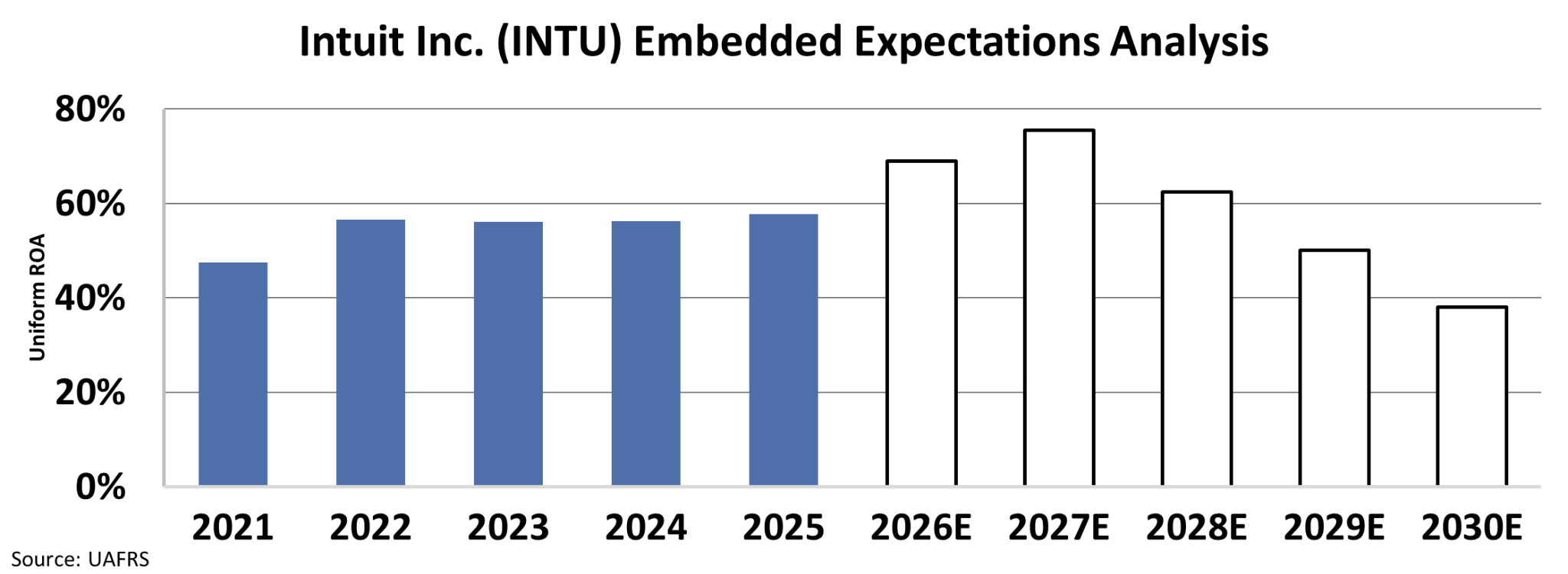
Investors assume Intuit will lose its edge due to the development and proliferation of advanced AI tools. However, this assumption ignores the company’s real edge—the trove of proprietary data it’s built over years.
Large language models (“LLMs”) have improved considerably in recent years. That said, these models are becoming increasingly commoditized, as Alphabet’s (GOOGL) Gemini and Anthropic’s Claude have narrowed ChatGPT’s early lead in terms of performance.
With these tools performing similarly, the true differentiator between them will come from the quality of the datafed to them. While LLMs are trained on millions of publicly available data points, they won’t be able to easily recreate the proprietary system Intuit has built over the years.
In all, Intuit’s sticky offerings and mountains of data will enable it to support durable earnings growth and sustain high returns for years to come.
Best regards,
Joel Litman & Rob Spivey
Chief Investment Officer &
Director of Research
at Valens Research
Today’s analysis highlights the same insights we share with our FA Alpha Members. If you want to an get in-depth analysis of market trends and uncover undervalued stocks, become an FA Alpha Member today.