
Powered by Valens Research
Cancer treatment is one of the most lucrative markets for the pharmaceutical industry.
Since this class of drugs is highly sought after, cancer treatment medication commands six-figure annual prices. Last year, over $240 billion was generated in global sales.
It’s clear these drugs can generate billions of revenue for pharmaceutical companies once they overcome regulatory hurdles and clinical trials successfully.
However, the resulting windfall in revenue from these drugs is temporary because patents last for only 20 years.
Two decades may seem like a long time, but research and development and clinical trials can take over a decade to materialize. As a result, companies realistically have only a few years to enjoy revenues from their patented drugs and treatments before the patent cliff hits.
And right now, pharmaceutical giant Merck & Co. (MRK), is in a race against time before keytruda, its flagship offering for cancer immunotherapy, loses its patent protection in 2028.
Keytruda is used to treat several types of cancers and holds several indications in the U.S. which include as metastatic melanoma, non-small cell lung cancer, advanced head and neck squamous cell carcinoma, cervical cancer, advanced esophageal or GEJ carcinoma, and others.
Keytruda was approved for medical use in the U.S. in 2014 and has since been a key revenue driver for Merck. In 2024, the drug generated $29 billion in sales, becoming the top-selling drug of that year. Moreover, the sales figure also represented nearly half of Merck’s revenues for that year, amounting to $64.1 billion.
The approaching patent cliff for keytruda represents a major challenge for Merck, given that the drug generates a huge portion of its revenue. Once patent protections expire, the company’s revenues would fall precipitously.
This is a challenge Merck is fully aware of, that’s why it’s been speeding up the development of an injectable version of keytruda before the patent for its old version expires in 2028.
The company is also developing new products such as Winrevair, a prescription medicine approved for U.S. use in 2024 for treating pulmonary arterial hypertension, and Capvaxive, a pneumococcal vaccine approved for U.S. use in the same year.
However, that’s not the only strategic step Merck is taking, as it has turned to acquisitions as well.
Last year, Merck acquired Cidara Therapeutics, a firm that specializes in developing immunotherapies and Verona Pharma, a biopharmaceutical firm specializing in respiratory drug treatments for $9.2 billion and $10 billion, respectively.
And most recently, it was reported that the company is in talks to acquire biotech firm Revolution Medicines (RVMD) for a deal worth between $28 billion and $32 billion.
Revolution Medicines is currently developing experimental drugs designed to block RAS, a molecular driver of cancers. By blocking RAS, cancers such as lung, pancreatic, and colon would be prevented.
Should the pancreatic-cancer drug pass trials, it’s estimated that it could generate roughly $10 billion by 2035 in global sales.
Merck is in a race against time to offset the impending expiration of its keytruda patent. The market sees this and is likewise expecting returns for the company to fall by 2029.
We can see this through Valens’ Embedded Expectations Analysis (“EEA”) framework.
The EEA starts by looking at a company’s current stock price. From there, we can calculate what the market expects from the company’s future cash flows. We then compare that with our own cash-flow projections.
In short, it tells us how well a company has to perform in the future to be worth what the market is paying for it today.
Investors expect Merck’s Uniform return on assets (“ROA”) to crater from the 17% it generated in 2024 to just 8.5% by 2029.
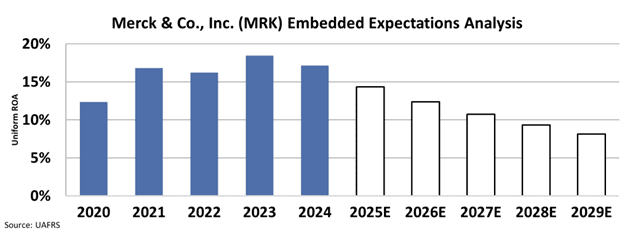
This is a massive drop in returns. And while Merck has made moves to address the impending expiration of its most valuable drug’s patent, it remains to be seen whether these new products and acquisitions will pay off.
In the meantime, investors should adopt a wait-and-see approach to this stock.
Best regards,
Joel Litman & Rob Spivey
Chief Investment Officer &
Director of Research
at Valens Research
Today’s analysis highlights the same insights we share with our FA Alpha Members. If you want to an get in-depth analysis of market trends and uncover undervalued stocks, become an FA Alpha Member today.