
When competition intensifies and performance becomes sluggish, companies will attempt to improve their businesses to meet investor expectations and revitalize returns.
This typically involves cost-cutting measures such as layoffs, changes to organizational structure, or outright leadership change.
Companies that opt for a leadership change frequently turn to outsiders, hoping that fresh eyes can diagnose and fix what’s wrong with the business.
However, retail giant Target (TGT), which has struggled in recent years, bucked this trend and turned towards a familiar face instead.
Target made a name for itself by being considered as a go-to retailer for stylish, but affordable products. However, it has lost some of its magic in recent years.
Since 2023, the company’s revenue has fallen from $109 billion to $106.5 million, after it had previously grown in each of the past six years.
With momentum stalling, the company decided a change at CEO is required.
Last week, long-time CEO Brian Cornell announced he will be leaving the role in February 2026, and Michael Fiddelke has been chosen as his successor. Fiddelke, Target’s current chief operating officer and a 20-year company veteran would take over once Cornell departs.
Fiddelke isn’t just Target’s current CEO, he’s also a lifer since he first started at the company as an intern 20 years ago. While Cornell’s exit was widely anticipated, analysts and industry observers were surprised when Target opted for an internal candidate instead of an outside executive from a blue-chip retailer. As a result, the company’s shares dropped slightly in the aftermath of the announcement.
Outsiders are often seen by shareholders as the logical choice in turnaround plans because it’s assumed that they can bring a fresh perspective on how a business’ sluggish performance could be improved.
Fiddelke will inherit a company that’s been in a downwards slump in the past couple of years.
Target has seen its quarterly sales for two and a half years decline steadily due to changing customer preferences shaped by economic headwinds and increased competition from rivals such as Walmart (WMT) and T.J Maxx owner TJX Companies (TJX).
Due to shrinking purchasing power brought about by inflation, consumers are becoming increasingly mindful of their purchases and are cutting back on non-essential spending.
To save on costs, many shoppers are spending more time researching prices before they make a purchase. Even though online shopping traffic increased 18% during the first half of 2025, spending only rose by 0.4%.
In addition to external pressure, Target’s recent shortcomings are also a result of failed internal operations and initiatives.
Target has faced backlash due to a declining shopper experience. Stores have struggled to reconcile with operating as both an in-person shopping center and an e-commerce hub, resulting in difficulties keeping stores properly stocked.
Moreover, the decision to discontinue its price-matching policy and stance on DEI initiatives have further alienated customer groups.
As a result of these struggles, Target’s profitability has declined in recent years.
Since 2010, Target has delivered an average Uniform return on assets (“ROA”) of 10%. Following the pandemic, the retailer saw its returns skyrocket as consumers were flush with cash and willing to spend. Target’s ROA peaked at 16% in 2022.
However, in 2023, Uniform ROA declined to just 6% amid declining sales and has remained at sub-10% levels since, well below both historical levels and its 2022 peak.
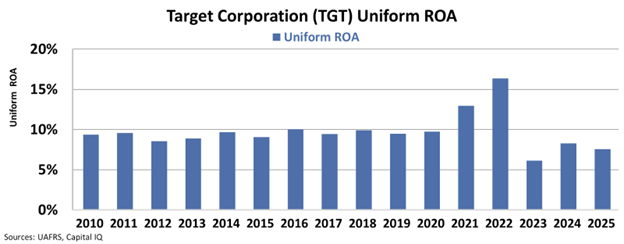
These returns show that Target has lost some of its shine. And this reality isn’t lost on its incoming CEO.
Fiddelke recently acknowledged as much and has said that the retailer has to revive its focus on stylish merchandise and great customer experiences to achieve growth and regain its former glory.
While the appointment drew the ire of some investors, Target will hope that Fiddelke’s experience in various roles with Target, and the fact that he has been a part of the company during its best moments, will help the company unlock this potential once again.
For now, investors will just have to wait for Fiddelke to take over as CEO to see whether he can help Target restore some of the magic it has lost in recent years.
Best regards,
Joel Litman & Rob Spivey
Chief Investment Officer &
Director of Research
at Valens Research
Today’s analysis highlights the same insights we share with our FA Alpha Members. If you want to an get in-depth analysis of market trends and uncover undervalued stocks, become an FA Alpha Member today.