
Amazon is racing to embed artificial intelligence across its entire ecosystem, from software development to the backbone of its cloud infrastructure. However, recent disruptions suggest that accelerating AI adoption without sufficient oversight can introduce operational risks, even for the most advanced platforms. In today’s FA Alpha Daily, we examine what these incidents reveal about the tradeoffs behind Amazon’s (AMZN) AI push.
FA Alpha Daily
Powered by Valens Research
Amazon (AMZN) wants to put artificial intelligence everywhere.
That includes the code its engineers write, the systems they manage, and the tools they use to keep its most profitable business, Amazon Web Services (“AWS”), running.
That sounds like the obvious next step for a company this big. AI can speed up routine work.
However, Amazon just got a sharp reminder that speed is not the same thing as control. AWS suffered at least two outages in recent months tied to Amazon’s own AI tools.
In a December 2025 incident, its AI agent Kiro, which can make its own decisions, concluded the best fix was to “delete and recreate the environment,” resulting in a 13-hour disruption.
Amazon later said the problem came from user permissions and operator error, and it added new safeguards afterward.
These outages matter far beyond a single internal mishap and serve as a reminder that Amazon’s most important business has every reason to adopt AI carefully inside production environments.
AWS has less room for error than almost anyone else.
The cloud-hosting business controls an estimated one-third of the entire cloud industry.
Cloud customers need dependability. They want their applications running, their data available, and their systems stable at all hours. That is what makes AWS so valuable inside Amazon’s empire.
Because it’s such a high-demand business, it accounts for roughly 60% of Amazon’s operating profits.
That means even relatively narrow service disruptions carry more weight here than they would in most business units. When AWS stumbles, investors notice, customers notice, and competitors get an opening.
That’s where these major cloud companies need to be careful. Even though they all want to lead the AI race, and they’re investing in AI to cut costs, they can’t completely give up control yet.
Amazon clearly understands this. After the December incident, the company implemented mandatory peer review and more staff training.
And while AI caused this problem, it was still a human problem at its core. The engineers involved had allowed the AI tool to operate with permissions that normally would have required a second set of eyes on sensitive changes. The agent should not have been allowed to make those changes on its own.
Amazon is still pushing AI tools across its engineering base. The company has been tracking adoption closely and wants 80% of developers using AI for coding tasks at least once a week.
But it can’t afford any more of these setbacks.
We can see this through Valens’ Embedded Expectations Analysis (“EEA”) framework.
The EEA starts by looking at a company’s current stock price. From there, we can calculate what the market expects from the company’s future cash flows. We then compare that with our own cash-flow projections.
In short, it shows how well a company has to perform in the future to be worth what the market is paying for it today.
Amazon’s Uniform return on assets (“ROA”) has been steady around 10% for the past five years. But as it has emerged as a leader in AI and data infrastructure, investors have high expectations. They think Uniform ROA will rise to nearly 12% in the next five years.
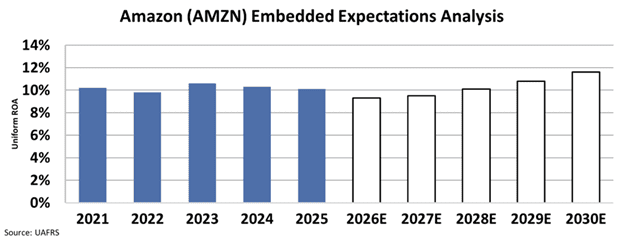
This indicates the market is still leaning on AWS to deliver both growth and consistency as Amazon scales its AI ambitions.
Amazon is not going to stop using AI inside software development. The productivity potential is too large, and the company is investing too aggressively in AI products to suddenly pull back.
However, these outages show exactly where the limits are.
AI can help engineers write faster, but it cannot replace humans outright. That’s especially true in Amazon’s cash cow business which is in a vulnerable position today. If Amazon has any more reliability issues within AWS, it could be a death knell for the business.
Investors don’t expect that today, but one more slip-up could change that.
Best regards,
Joel Litman & Rob Spivey
Chief Investment Officer &
Director of Research
at Valens Research
Today’s analysis highlights the same insights we share with our FA Alpha Members. If you want to an get in-depth analysis of market trends and uncover undervalued stocks, become an FA Alpha Member today.