
During its September meeting, the U.S. Federal Reserve cut interest rates by 25 basis points, and Fed Chair Jerome Powell hinted at the possibility of two more cuts before the end of the year.
The official rationale was clear enough: in the face of softening employment data and slowdown in consumer spending, policymakers want to protect the American household.
However, as far as historical precedent is concerned, the effects of these cuts will stretch well beyond consumers, and will likely impact corporate investment as well.
The Fed faced a similar situation back in 1998.
Post-Cold War Russia defaulted on its government debt that summer and the news subsequently sparked fears of a wider emerging market crisis that could bleed into losses for U.S. banks.
Soon after, Long-Term Capital Management—a highly leveraged U.S. hedge fund backed by Wall Street’s biggest banks—collapsed. Volatility from the Russian default crushed its debt-laden strategy..
These two shocks threatened U.S. financial stability. So Alan Greenspan, then-chair of the Fed delivered three cuts in quick succession, totaling 75 bps.
While the cuts calmed financial markets, they also threw gasoline on the dot-com boom.
Lower rates fueled even stronger investment for telecom and tech companies, along with U.S. corporations in general.
The tech-heavy Nasdaq Composite Index finished 1998 up 40%, then nearly doubled in 1999.
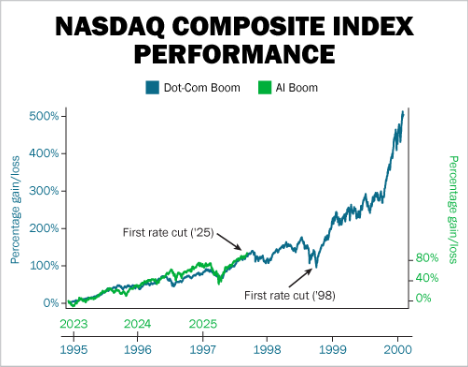
Today’s rate cuts are echoing this event.
While Powell’s rate cut is aimed at helping consumers, it will simultaneously accelerate investment in today’s tech-drive cycle.
AI infrastructure was already in overdrive before the rate cut. But with borrowing costs falling, companies have even more incentive to accelerate spending, sending earnings expectations upward.
Uniform profits grew 9% in 2024. Wall Street expects that number to grow another 9% this year, followed by 10% in each of the next two years.
And those expectations change how today’s valuations are viewed. The market’s Uniform price-to-earnings (P/E) ratio still sits at about 24x, well above the 20x long-term average
But as earnings keep moving higher, those multiples look reasonable. Higher earnings growth supports higher valuations which is why tech stocks so frequently look expensive on a P/E basis.
This story has played out before. Rate cuts intended as insurance for consumers end up supercharging tech investment.
Of course, risks remain. Sentiment is elevated. And valuations will always matter if earnings stumble. But for now, earnings are accelerating, credit conditions are steady, and it’s getting cheaper to finance growth.
This is the background that can continue supporting a bull market.
Best regards,
Joel Litman & Rob Spivey
Chief Investment Officer &
Director of Research
at Valens Research
Today’s analysis highlights the same insights we share with our FA Alpha Members. If you want to an get in-depth analysis of market trends and uncover undervalued stocks, become an FA Alpha Member today.
at Valens Research