
Prospective clients are often influenced by more than facts and figures when making important financial decisions. Trust, confidence, and effective communication can play just as significant a role in shaping how people respond to an advisor’s recommendations. In today’s FA Alpha Daily, we examine how Benjamin Franklin’s formula for fundraising can help financial advisors encourage meaningful action.
FA Alpha Daily:
Practice Management Insights
Powered by Valens Research
Benjamin Franklin.
One of the Founding Fathers of the United States of America.
A politician.
A diplomat.
An author and publisher.
Is there something else we haven’t mentioned about him?
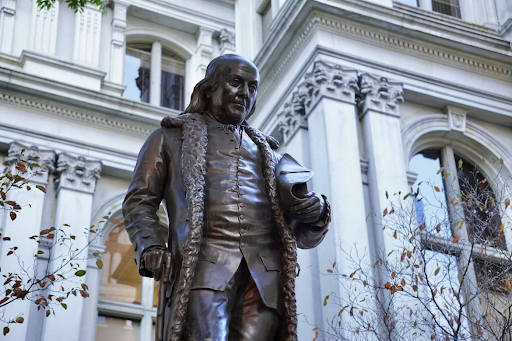
Photo from Unsplash
Oh wait, there is!
Franklin was also known as America’s “Great Persuader.”
A Master of Persuasion
In 1776, when America couldn’t reach an agreement on the vote for the Declaration of Independence, Franklin persuaded John Morton, a Pennsylvanian representative at the Continental Congress, to vote for the resolution although it would guarantee Morton’s defeat in his district.
This was what Franklin told Morton at that time:
“You will be remembered in history as a Signer.”
Pennsylvania got its vote for freedom through Morton’s signature and his name was permanently engraved in American history—just as Franklin said.
What was the secret behind Franklin’s words that convinced Morton to sign the resolution?
The POWER DOLLAR.
This is one of the concepts discussed in James C. Humes’ book titled, “Speak Like Churchill, Stand Like Lincoln. ”
Just like an actual dollar, your words can work wonders for you!
… and that’s why even though this is a concept identified with public speaking, it is very much applicable to financial advisors like you.
It might not even be an exaggeration to say that the top advisors already apply this concept in their respective financial advisory practices.
The Power Dollar works by utilizing your words (instead of actual money) to “buy” your prospect’s stance so they can share your stance on a certain topic.
With the right words and the right posture, you can persuade people and convince them to listen to your pitch intently, follow your call-to-action, or even turn a prospect into a client!
The Superb Fundraiser
Aside from being known as America’s “Great Persuader,” Benjamin Franklin was also known as the “First Superb Fundraiser” of his time.
Franklin knew how to secure financial support from the wealthy. By conversing with these people and persuading them to donate money, he raised funds for America’s first public library, first hospital, and first college in Philadelphia (now known as the University of Pennsylvania).
Here are the components of the Franklin formula for fundraising, as stated in Humes’ book
-
Defiance
This word suggests an audacious attitude.
Franklin believed that psychology played a role in fundraising.
In order to convince your prospects, believe that you are doing them a favor by providing them with a win-win situation.
Franklin demonstrated this when he approached Pennsylvanian Governor William Keith to talk about Philadelphia’s printing press while the governor was taking his supper.
Here’s what Franklin said at the time:
“Give me money for sea passage to London, and I will find the best printing press in the world and buy it, my lord.”
Franklin got the trip ticket and for four years in London, he mastered the techniques in printing. He then became the city’s top printer when he returned to Philadelphia!
This wouldn’t have happened if Franklin didn’t approach Governor Keith, the most powerful person in Philadelphia at that time, and ask him for money.
When you’re trying to persuade prospects, don’t act as if you’re down on bended knees. Approach them as if you’re an equal.
-
Design
Next to being defiant, Franklin believed that you must be able to paint a picture of the product or service you’re offering.
A skilled inventor, Franklin invented the lightning rod. After creating the product, he told people it is capable of protecting their houses as it deflects a lightning strike.
After also inventing the bifocals, he showed interested people how it would enable them to identify trees outside their window while they are reading a book with the same set of spectacles.
People are always after the benefits they can get from listening to what you have to say. Give it to them by answering the question, What’s in it for them?
-
Donation
As a fundraiser, Franklin knew how to tackle finances well. When it comes to requesting for donations, here’s what he had to say:
“What is the most you think you can ask for? Then double it! Don’t base your request on how much he will give you but on how much you will need!”
While this was said in the context of fundraising, this offers a valuable lesson for financial advisors as well.
If you don’t want your prospect to ignore your pitch completely, then be specific about the types of services you offer and the cost tied to them.
This way, carve a pathway for clear communication and open a space for negotiation.
-
Duel
Franklin observed that rejection often happens because the one asking for a favor speaks immediately after making the request.
Think of it as if you’re in a duel with the people you’re talking to.
After making your pitch, wait.
Let your prospect speak first. Make sure he or she answers before you speak once again.
Remember the first D in this formula: Defiance.
You’re approaching them as an equal. If you speak too soon after making your request, it’s as if you’re giving up your status as an equal.
Using this tactic disarms or blunts any objections your prospect may have.
… and if a potential client rejects your pitch, then at least you’ve at least put yourself in his or her radar.
A rejection now doesn’t always mean it’ll last forever. A prospect who has rejected you before can always be re-engaged with.
Simply said, it’s still a win-win situation for you!
Getting Your Prospects to Say “Yes”
It’s not just Franklin’s words that got the “yes” of the people he conversed with—it’s HOW he said those words as well.
The Franklin formula is not just applicable in fundraising. You can also use it in discovery calls or client meetings where you try to convince a prospect to become your client.
You don’t have to do it exactly as Franklin did!
As long as you present yourself as confidently as you can, paint a good picture of the service you’re offering, and be specific with details, you have a sure-fire key to convince potential clients.
Best regards,
Joel Litman & Rob Spivey
Chief Investment Officer &
Director of Research
at Valens Research
Today’s article only scratches the surface of what we share with our FA Alpha Members. If you want to get an in-depth analysis of market trends, uncover undervalued stocks, and more, become an FA Alpha Member today.