
Ubisoft’s struggles are deepening as weak game releases, rising restructuring costs, and delayed profitability targets continue to weigh on the business. The underwhelming results have fueled concerns that the publisher behind franchises like Assassin’s Creed and Far Cry may face a longer and more difficult turnaround than investors expected. In today’s FA Alpha Daily, we examine why Ubisoft’s stock looks cheap on the surface and what the market may already be signaling about the company’s future.
FA Alpha Daily
Powered by Valens Research
Shares of Ubisoft (EPA:UBI) are down 18% following disappointing results that included pushing profitability targets back by a year.
Ubisoft is the video game publisher known for popular video game franchises such as “Assassin’s Creed,” “Far Cry, and “Rainbow Six.”
The video game publisher saw massive success across the 2010s up to the early 2020s. It saw its revenue rise from just €871 million in 2009 to €2.2 billion in 2021 thanks to successful launches across the company’s flagship franchises.
However this success has unraveled in recent years.
Between 2018 and 2021, the publisher nearly doubled its global workforce from over 11,000 to 20,000. This bloated organizational structure once the pandemic-era demand and consumption for video games cooled.
As a result, Ubisoft was forced to undertake expensive cost-cutting measures and restructuring. Since late 2022, the company has laid off roughly 4,000 employees.
The company also saw its momentum decline due to mixed reception for its video game releases over the past few years. Unfinished game launches, project delays, and unpopular microtransactions embedded in games have all played a part in the company’s declining reputation and standing in the video game industry.
Ubisoft’s changing release cadence for its blockbuster franchises also played a part. While “Assassin’s Creed” has followed a consistent release pattern (2020, 2023, and 2025), there hasn’t been any main-line entries for “Ghost Recon” and “Far Cry” since 2019 and 2021, respectively.
In an effort to turn around the company’s fortunes, Ubisoft announced a major overhaul to its operations. Earlier this year, the company announced that it would set up five business units (or creative houses) with each focusing on specific game categories.
Vantage Studios, one of these creative houses, was set up earlier last year. It is the studio in charge of the “Assassin’s Creed,” “Far Cry, and “Rainbow Six” franchises. Meanwhile, the second creative house would specialize in shooter games and will take charge of franchises like “The Division,” “Ghost Recon,” and “Splinter Cell.”
The rest of the houses will specialize in live service games, narrative-driven game franchises, and casual and family-friendly titles.
Ubisoft’s turnaround strategy has yet to yield immediate positive results. During its most recent quarter, it generated €415 million ($481.7 million) in net bookings, down 54% year-over-year. Meanwhile, net loss rose to €1.48 billion for fiscal 2026, a massive rise compared to the €243.5 million reported for fiscal 2025.
The company also said it expects to restore positive operating profit and free cash flow generation to fiscal year 2028, not 2027, as previously announced.
CEO Yves Guillemot told investors that “this two-year transformation comes with difficult decisions and a disappointing short-term financial performance, but I firmly believe that, together, these actions are better positioning Ubisoft to deliver sustainable free cash flow over time.”
Uniform Accounting affirms the view that Ubisoft is a business in decline. Its Uniform return on assets (“ROA”) has fallen from 19% in 2021 to just 0.6% in 2025.
Investors, as a result, are pricing Ubisoft cheaply. We can see this through its Uniform price-to-book (“P/B”) ratio.
The Uniform P/B ratio compares a company’s total value with the value of the assets on its balance sheet (or “book”). The higher the P/B ratio, the more investors are willing to pay for those assets.
In other words, it measures how valuable investors think a company’s assets are.
A company normally trades below a Uniform P/B ratio of 1x when the market is worried about bankruptcy risk. Ubisoft has traded at 3x from 2019 to 2020, before declining steadily from 2021 onwards.
By 2024, the company’s P/B had sunk to 0.9x, and it is currently trading at just 0.6x Uniform P/B. And over the past 3 years, the company’s shares have dropped 80%.
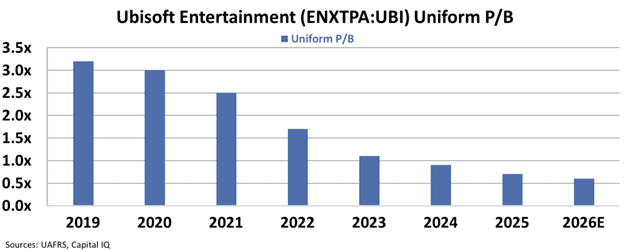
Ubisoft’s stock is very cheap right now, but not because it’s undervalued. Its valuation is low because the market has continued to punish it for years of underperformance.
Oftentimes, cheap companies are cheap for a reason. This is the case currently for Ubisoft; investors would be wise to keep their distance.
Best regards,
Joel Litman & Rob Spivey
Chief Investment Officer &
Director of Research
at Valens Research
Today’s analysis highlights the same insights we share with our FA Alpha Members. If you want to an get in-depth analysis of market trends and uncover undervalued stocks, become an FA Alpha Member today.